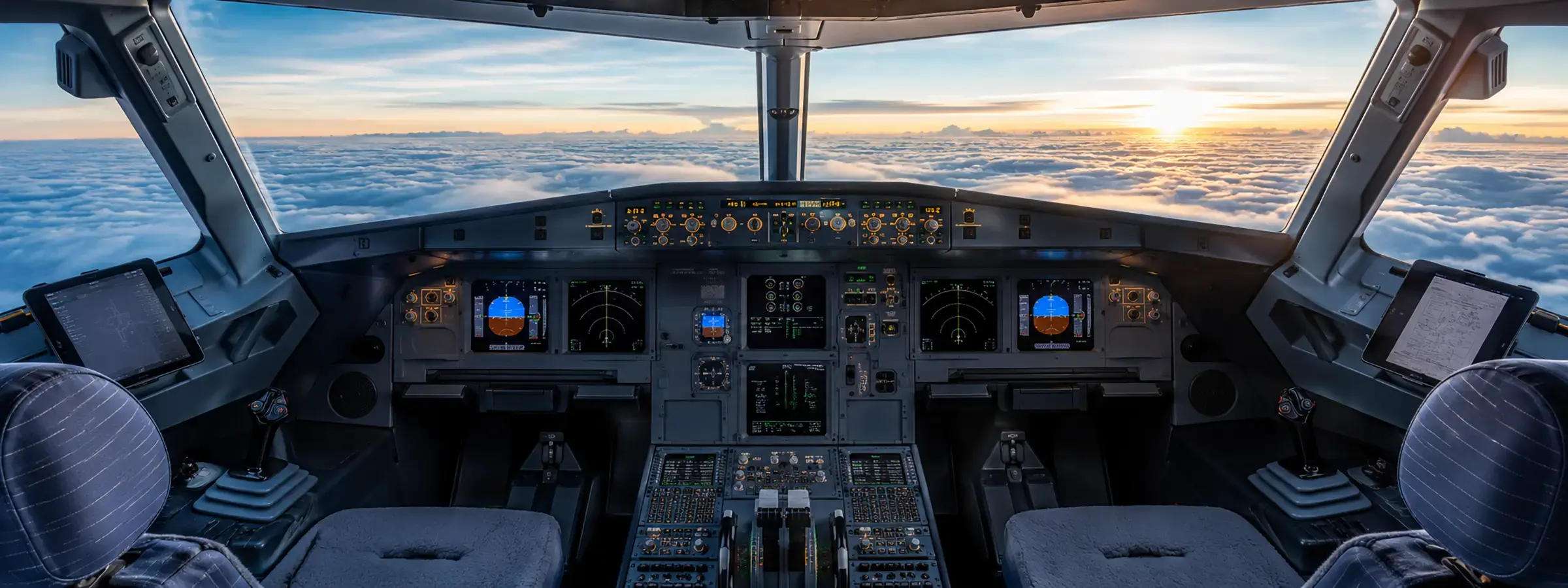
AI is revolutionising the aviation industry by improving operational efficiency, increasing safety, reducing costs, and offering enhanced experiences for both airlines and passengers.
Let’s go back to the summer of 1999. It was the summer of The Matrix, that film which depicted a dystopian future, where machines had taken over humanity through artificial intelligence.
The fact is that 23 years later, at the end of 2022, ChatGPT was unveiled, that interface that allows you to interact with a “robot” that answers anything you ask or request. In fact, it was the first real and direct experience that many users have had with artificial intelligence. It is true that its answers are still improvable and that humans can offer a more reasoned and contextualised reply today. However, Artificial intelligence has the advantage of very similar analysis capabilities, being, without a doubt, much faster.. And this would only be a preview of what awaits us in the coming years.
From the information and news that sporadically appear, we can deduce that its progress is being made by leaps and bounds. Furthermore, the most uncertain thing for humanity is that we are talking about a silent giant, as we have few certainties about the real state of technology or what fields it already covers that affect us daily.
The reality is that Artificial intelligence is expanding into all industries., including aeronautics, still posing certain questions and concerns generally linked to a lack of knowledge about its scope and control. Let's try to analyse whether it is a risk or if, as is desirable, it is here to help us and be our collaborator.
First, to understand how it would revolutionise the industrial world, let's keep in mind that Artificial intelligence analyses data precisely to offer us a concrete answer.. From here, there is an endless amount of possibilities on how this technology would facilitate carrying out each specific task. From assisting pilots during flight, offering a faster response on industrial processes, preventing failures in certain processes, or reducing the factor of human error.
On a strictly employment level, artificial intelligence will undoubtedly cause job losses. But just as happened during the Industrial Revolution that began in the mid-18th century, there is certainty that The employment it will generate will be greater. However, a large part of those new jobs will require Improve employee qualifications, which is always desirable from a socio-labour point of view.
In the specific realm of the aviation sector, artificial intelligence is playing an increasingly important role, transforming the way aircraft are designed, manufactured, maintained, and operated. Let's look at some key areas where AI is impacting this industry
- Design and simulationAI can assist in the creation of more efficient and aerodynamic design models. Powered by machine learning algorithms, AI can analyse data and simulate different conditions to find optimal design solutions.
- Innovation in diverse fieldsAI is used in the research and development of new materials, technologies, and systems that drive innovation in the aerospace industry.
- Predictive maintenanceAI is used to analyse real-time sensor data from aircraft and predict when technical issues are likely to occur. This enables proactive maintenance and reduces unplanned downtime.
- Real-time anomaly detectionAI can identify anomalous behaviour in aircraft systems in real-time, helping to prevent accidents and improve safety.
- Aircraft inspection and maintenanceDrones equipped with computer vision systems and AI algorithms can autonomously inspect aircraft structures for damage or wear.
- Pilot trainingAI is used in advanced flight simulators to train pilots in a variety of situations and scenarios, including emergencies. This improves pilot safety and preparedness.
- Human-machine interactionAssistance and automation systems in the cockpit benefit from AI to provide and analyse real-time information, make decisions, and assist pilots in critical situations.
- Route and operations optimisationAirlines use AI to optimise flight routes, air traffic management and flight scheduling. This helps to reduce fuel consumption, minimise delays and improve overall efficiency.
- Air traffic controlAir traffic management is also being optimised with AI to efficiently coordinate and direct flights, especially in areas with congested traffic.
- Customer experience personalisationAirlines can use AI to analyse passenger preferences and behaviour and offer personalised services, from seat selection to in-flight entertainment options.
Together, AI is revolutionising the aviation industry by improve operational efficiency, increase safety, reduce costs and offer enhanced experiences for both airlines and passengers.
We also need to take into account that there are some AI applications in aeronautics that require social acceptance by users, whether they be industry workers, pilots or passengers, among others. That would be the turning point of this revolution. As knowledge of the technology grows, its benefits become more evident, and detractors and the fearful diminish, its acceptance will be a certainty.
We are accustomed to human decision-making often involving both the head and the heart. It's true that in the case of using artificial intelligence, it would be as if we were only using the head... albeit with infinitely greater capacity and incomparable speed. But let's not lose sight of the fact that humans must always be there, ultimately, to apply a bit of heart when decision-making requires it. Or, at least, that would be desirable.