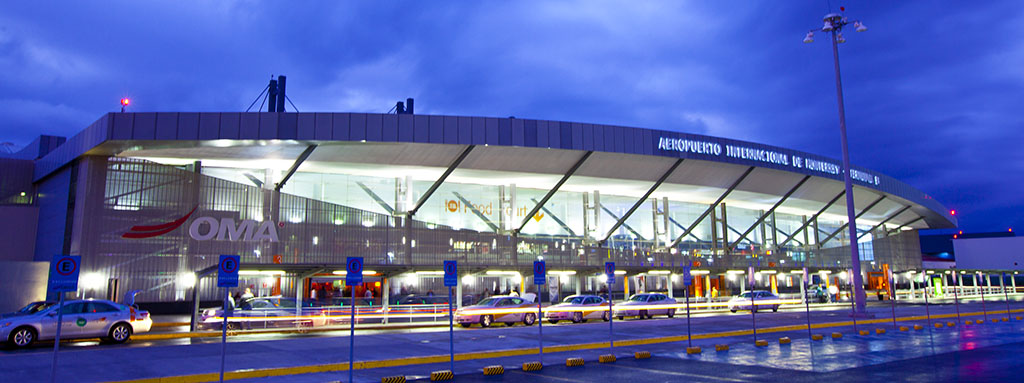
Porfirio González Álvarez is General Director of Grupo Aeroportuario del Centro Norte, OMA, in Mexico.
"The results achieved today demonstrate OMA's ability to transform ideas and needs into integrated solutions".

Airport engineering and design is evolving towards a model where the focus is on improving the passenger experience. What is your concept of the airport of the future?
The global trend in the airport industry is to project the creation of urban developments with airports, to promote the creation of airport-cities through multifunctional infrastructure that provides a set of services that add value to the passenger's journey, such as commercial areas, accommodation, corporate offices, warehouses, as well as entertainment areas.
This planning can also lead to the creation of multifunctional centres where they converge to support goods distribution channels. The growth and development of freight and freight logistics benefit from these infrastructures, by facilitating land, air or rail transport connections depending on the final destination, increasing the reach between different regions and reducing distribution times.
This involves road planning of the airport area with industrial zones, the city centre, highways or roads connecting to other nearby towns.
This is how this trend of unifying urban development plans can be visualised, evolving transport systems that make it possible to generate economically efficient, attractive and sustainable development poles in the same region.
How does OMA organise its airport infrastructure plan?
OMA develops comprehensive solutions for its operational infrastructure and building projects, planning their evolution in an orderly manner, through Master Development Plans. These master plans are reviewed and updated every 5 years with the aeronautical authority.
For the definition and development of the plan, OMA analyses in detail the occupancy and usage levels of its airports, as well as short, medium and long term growth projections in order to foresee and anticipate infrastructure needs before reaching saturation levels or non-compliance with quality standards.
New buildings are currently under construction, expanding and remodelling more than 50,000 square metres at the airports of Acapulco, Chihuahua, San Luis Potosí and Reynosa.
What refurbishments are currently underway?
Of all our investments, the start of work on the new terminal building at Acapulco airport stands out, which will have a surface area of 18,800 square metres on 3 levels and a mezzanine. The terminal will have the capacity to handle 1.3 million domestic and international passengers, with separation of arrival and departure flows, six boarding gates and three telescopic walkways. The project stands out for its avant-garde architecture and equipment with modern technology that will allow it to distinguish itself as a sustainable building, maintaining a balance with the environment.
The Reynosa Airport project includes the construction of a new terminal building, which will have a capacity to handle more than 1 million passengers in a surface area of more than 8,000 square metres distributed over two levels. In addition, it will have new passenger service areas to provide greater comfort with ample space in the ambulatory, documentation, inspection point, departure lounge and baggage reclaim areas.
The terminal building at San Luis Potosi Airport will increase its surface area to 13,000 square metres, a 200% increase, in order to meet the growing demand for traffic at the airport. The new capacity will allow more than 1.2 million passengers to be handled.
Chihuahua Airport, in addition to the remodelling of the terminal building, will be expanded by 78%, increasing its capacity from 900,000 passengers per year to 1.7 million passengers. The documentation area will also be enlarged, which will allow the introduction of a greater number of documentation modules. The expansion also includes larger areas in the departure lounges, baggage reclaim, ambulatory and inspection points.
What are the basic principles of OMA's sustainability policy?
OMA's sustainability policy is one of the corporate tools that allow the Group to ensure and have continuity in the actions it undertakes, which seeks to contribute to the well-being and satisfaction of our employees and their families, customers, shareholders and economic partners, by developing airports with quality infrastructure and services based on respect for human rights, mitigating the environmental impact of our operations, caring for the quality of life at work and balancing the use of economic, social and environmental resources, preserving them for future generations. Likewise, to collaborate in the socio-economic development of the communities surrounding our airports.
The current dynamic of environmental challenges drives OMA to ensure all its operations and activities with quality and operational efficiency, respecting the environment, stakeholders and airport neighbouring communities.
OMA's Board of Directors approved, through the Company's Strategic Plan, the creation of an internal Risk Committee, whose main objective is to identify all the Company's risks and assess their impact.
At each of the meetings of the Board of Directors and the Audit, Corporate Practices, Finance and Planning Committee, the Directors are informed of the risks foreseen for the Company, as well as the possible options to mitigate them. The decision on the actions to be taken is based on the level of risk that the Company and its Board of Directors are willing to take.
Last year OMA celebrated its tenth anniversary as a public company. How has it evolved over the last decade?
Grupo Aeroportuario Centro Norte celebrated its tenth anniversary as a Public Company after being listed for 10 years on the Mexican Stock Exchange and the Nasdaq Stock Market in New York. During this period, OMA has worked on different lines of action with the aim of growing in a comprehensive manner, boosting the connectivity of the destinations where it has a presence, developing quality infrastructure and improving the passenger experience, all within a sustainable framework that promotes economic, social and environmental balance.
The results achieved to date demonstrate the company's ability to transform ideas and needs into comprehensive solutions. The commitments to investors and the quality required by customers to trust our value proposition have borne fruit from the initial stages and commit us to the challenge of excellence that characterises the Group.
OMA will continue to execute actions that generate a positive impact on the destinations where it is present, activating trade, industry and tourism through airport services with quality infrastructure and facilities, providing the necessary conditions for the development of air connectivity and the provision of services for the transport of passengers and goods.