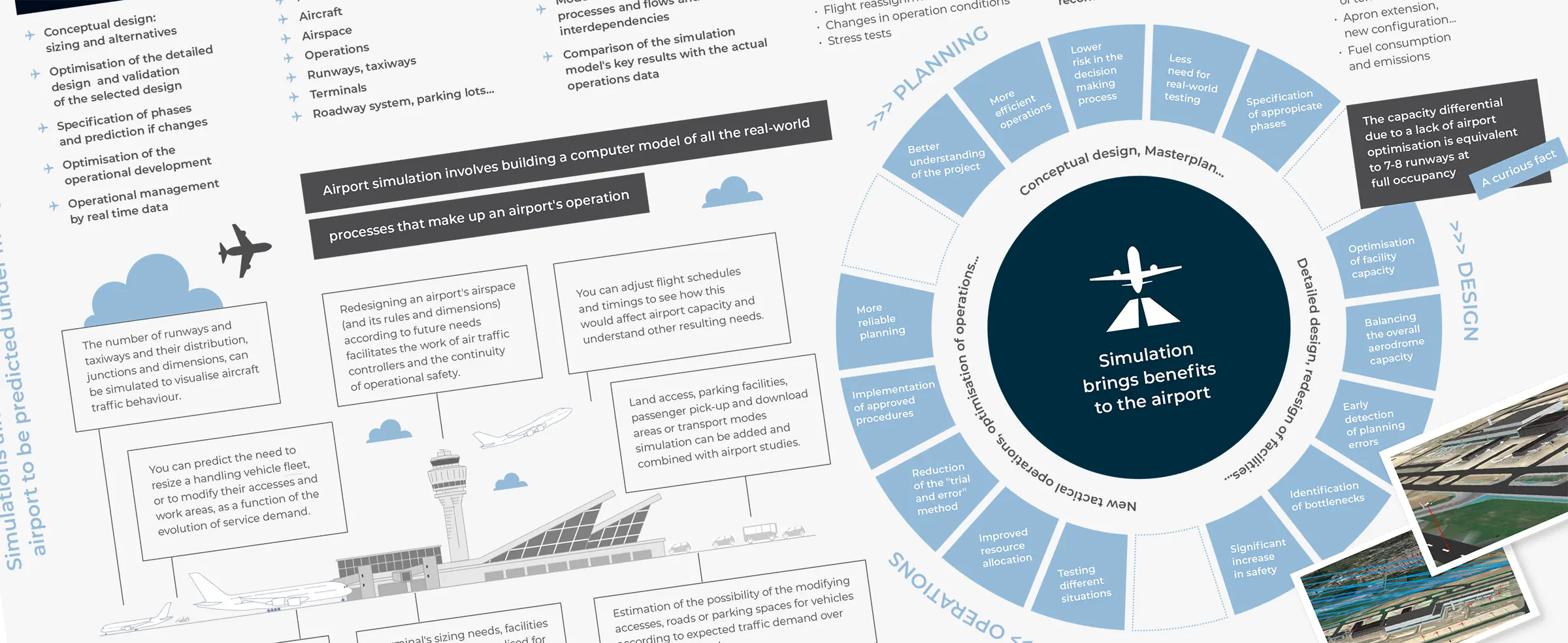
Airports are the air transport epicentre and, therefore, the place where most of the effort is concentrated on improving the passenger experience. Since the first air terminals were built, there has been constant progress in many areas, ranging from the architecture of the buildings themselves to the technology available to optimise the services provided to users. In this sense, practically any technological progress has had a direct or indirect application in some aspect related to air transport.
Sometimes, however, developments go unnoticed by airport users because they focus on aspects that are not directly visible to them. This is the case of improvements related to infrastructure, security or internal services. On other occasions, however, passengers do notice them and enjoy some of these experiences.
Undoubtedly, one of the elements that have contributed the most in this sense has been the universalisation of the smartphone as a vehicle for people's global communication and interaction. Possibly the most outstanding aspects of the new mobile devices, apart from their obvious usefulness for communications, are the unique identification with its bearer and its capacity for personalisation in each case. Moreover, you will hardly find a single person in an entire airport or aircraft that does not have one. This makes it a key element in the context of the smart airport or, going a step further, smart travel.
In this infographics we take a closer look at the possibilities offered by personal mobile phones for passengers and airport managers, as well as some applications which, although not yet operational, are already being developed and will be operational in a very short time.
Sources: Own elaboration.
The contents of this document are the intellectual property of AERTEC Solutions. Any copying or distribution is permitted, provided that the document is reproduced in its entirety and that the AERTEC Solutions logo is preserved at all times.