Building an aircraft is a very complex process. It is even more so nowadays, when large aircraft are aeronautical programmes are sponsored by international alliances, backed by public funds. This means that there are political and labour decisions, as well as technical ones, behind the establishment of an aircraft construction plant.
New tools to make processes increasingly safer, more reliable and less costly.
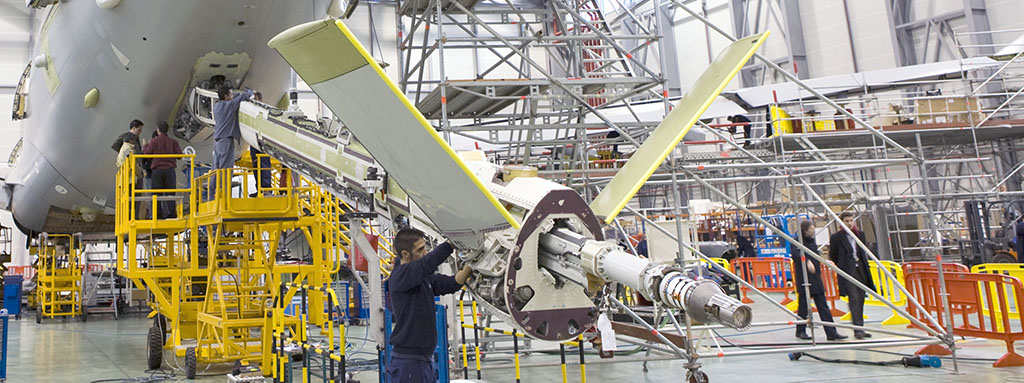
As a result, it is common to encounter geographically distributed facilities in different regions or countries, where at each plant a part of the aircraft is manufactured. All parts are then transferred to the final assembly line (FAL): Final Assembly Line) to be put together like a jigsaw puzzle.
During the construction process of each part, those responsible for the part must validate and verify every piece of equipment, cable, pipe, etc. that is assembled on it before the part is sent to the FAL. Once there, parts have to be assembled with each other, and systems have to be interconnected, and new equipment has to be installed.
Each assembly step requires validation of the affected systems. Not so long ago, checks were done by hand, verifying the continuity of cables, the operability of equipment or the tightness of pipes and tanks.
Many of these operations are still carried out by hand, although nowadays available technology makes it possible to automate The majority of these tests, improving the reliability, repeatability and traceability of these tests.
ReliabilityBy eliminating the human factor in some checks and using sensors to measure some parameters, we guarantee the accuracy of the measurement and the absence of errors in the recording of the result.
RepetitivenessAutomating a test ensures that it can be repeated as many times as you want under the same conditions.
TraceabilityAutomated data processing allows information to be recorded in databases. This makes it possible to subsequently consult the results, the incidents that occurred during the test, the operator who carried it out, the engineer who designed it, the aircraft on which it was carried out, etc.
However, the greatest value of all this recorded information will come from your processing using data mining techniques. A proper application of these techniques can provide, first of all, statistics to identify the most repetitive or costly incidents, to evaluate mitigation plans for such failures or to improve processes, among other things. But it can also be used to predict errors and optimise maintenance of test equipment and tools. This results in considerable quality cost savings.
The next step in the field of functional testing in aeronautical environments is the "Internet of Things", through the interconnection of elements that allow the self-management of tests and that send autonomous fault reportsto warn of problems in real time.
This may require several things:
- Firstly, to have a standard for the verification of aircraft systems: a common language in which the verification systems and the systems to be validated are understood, and to define the testing framework: initial conditions, stimulation and response.
- Secondly, develop the tests taking into account that the specific equipment of each aircraft varies from one unit to another (as in cars, there are "versions" that incorporate more or less equipment).
- Thirdly, to have the processes and infrastructure in place to manage and maintain all this information.
Obviously, these innovations are not applicable to all elements of an aircraft, and many of the tests to be carried out will require human intervention. In fact, the aim should not be to replace the human being, whose professional judgement will always be one step ahead, but to assist him and provide new tools so that he can processes are becoming safer, more reliable and less costly..
Although the evolution of technology in the aeronautical sector has a much slower cadence than in other industries, we can be sure that there are technological revolutions to come, and that fortunately we live in a constant challenge to improve and make what we build more reliable. And there is no doubt that when it comes to flying, this is always a priority.