During airport Certification/Verification processes such as in the framework of the Operational Safety Management System (OSMS/SMS) may require the implementation of Aeronautical Safety Studies (EAS).
The need to carry out an EAS in airport Certification or Verification processes arises when the certification specifications (CS) in the scope of Regulation (EU) 139/2014 or the Technical Standards (NNTT) according to RD 862/2009 in the cases of verification are not fulfilled. If we focus on Certification processes under the European Regulation, EAS can be used for the application of Special Conditions (SC), Documentation of Acceptance and Action for Deviation (DAAD) or Equivalent Level of Security (ELOS) documentation.
These are lengthy processes that require a thorough analysis of the airport environment, involving various experts and users. Nothing is left to chance to ensure the highest level of operational safety.
With regard to the SMSO, they are included in the module on risk management, where all actions carried out by the airport with an impact on operational safety are covered. and with the objective of correcting deviations detected during the previous certification process and contemplated in the DAADs and in the airport's Corrective Action Plan (CAP).
So what does an EAS consist of?
As with any other study, a clear definition of the objective of the studywhether for analysis of a deviation, for the effect of works to remedy a non-compliance, for the change of a procedure, etc.
It should also include the airport scene where the study is carried out, so that it is easy for the reader to identify the boundary conditions, main features, timetable, type of operations or any peculiarities of the environment.
It sets out the legislation concerned and the study itself from the point of view of operational safety, for example, in the case of an engine jet EAS, all the manoeuvres entering/exiting each stand would be presented, as well as all the turns affected, so that it could be visually observed how much the jet of an aircraft affects other stands, roads or nearby equipment waiting areas. Another example could be the risk management of a construction site that would remedy a DAAD on the distance of the signs to taxiways, where the phases of the construction site, the taxiways that could be closed during the works and the new operation would be defined.
From this point onwards, the Risk Managementwhere the following terms appear:
Starting assumptionsThese are assumptions made at the beginning of the study that may have an impact on the final outcome of the study.
FactorsThese are real characteristics, contemplated in the airport scenario, which can act both positively and negatively in the risk analysis and usually refer to the configuration of the airfield, the type and intensity of traffic, the weather conditions or the CNS/ATM scenario.
DefencesRisk reduction measures: These are measures implemented at the airport at the beginning of the safety study that reduce risks, e.g. in the case of engine jet analysis, the airport is equipped with deflector barriers.
DangersDerived from the non-compliance of a regulatory item.
Risks: Derived from the hazards identified, there are partial and final hazards.
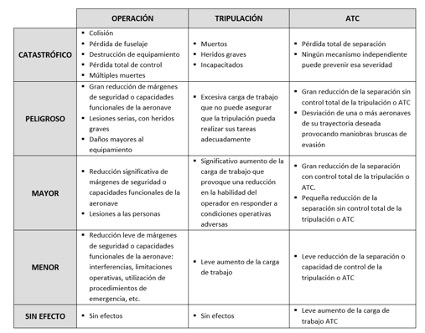
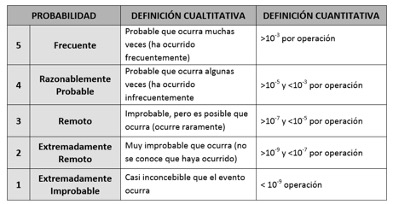
The risks detected will depend on two variables, severity and probability of occurrence, so that with both we can classify it.
For severity, the following estimation matrix is used:
For the probability Incidents related to the hazards detected in recent years are consulted. If there are no related incidents at the airport under study, the data of a complete network or of a state will be used, or even the data of the supranational network (Europe, North America, Asia-Pacific, etc.) may be used. It is then entered into the following matrix:
Once the severity and probability we would enter the risk assessment matrix:
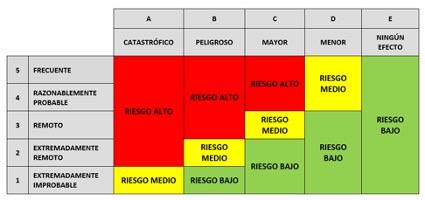
Whether the risk is high, medium or low, the following will be defined mitigation measures to be implemented in such a way that the risk is as low as possible.
Where the risk is high, it will not be possible to operate under certain conditions, or work will not commence in this case, until the necessary mitigating measures to lower the risk to medium or low risk are in place, in which case those measures will become defences.
Mitigating measures can be of various kinds and with the priority objective of minimising the risk as much as is reasonable. They can range from NOTAM publications, to painting, training, ...
Prior to the completion of the EAS, the EAS must be taken to a expert session where it will be attended by the risk assessors, pilots operating at the airport, air navigation staff and others involved, so that they can validate or modify the entire risk assessment.
Subsequently, the EAS will be amended on the basis of the minutes taken during the expert session, and these will be included in the EAS together with the agreement of all attendees.
As can be seen, it is a lengthy process that requires a thorough analysis of the situation and the involvement of various experts and users. so that nothing is left to chance and the highest level of operational safety can be ensured.