"UAS/RPAS allow continuous, detailed, real-time monitoring of the fire, even in areas with poor radio or telephone coverage".
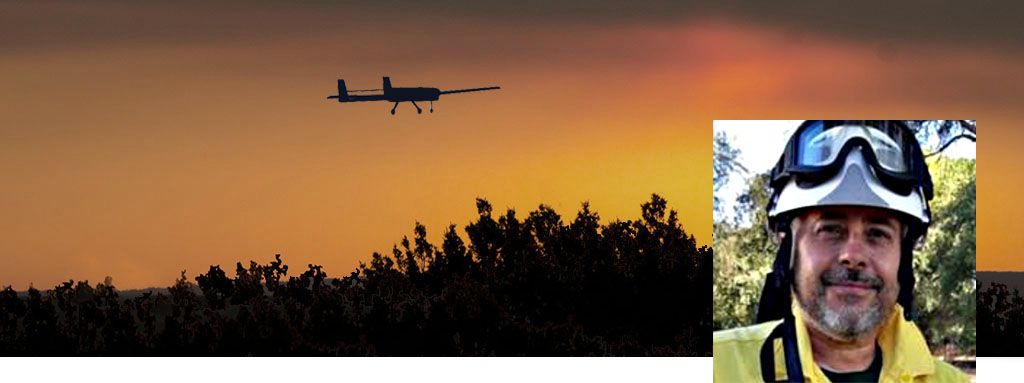
Juan Sánchez Ruiz is Director of the Regional Operational Centre in the Forest Fire Fighting Service of Andalusia (Spain).

For some years now, the INFOCA system maintains its commitment to the use of RPAS technology and its implementation in firefighting operations. In this regard, although tests with fixed-wing aircraft began to be carried out in 2011 with fairly good results, it was not until 2017 that the first real test operations were carried out.
As a result of these operations, since the high-risk period of 2018, this service has been operating continuously and is now one of the services provided in support of the extinguishing of large forest fires in Andalusia. Even so, for the moment this service is focused on operations carried out for the device with logical limitations. These limitations are based mainly on the the need to maintain full safety conditions for the sharing of airspace between manned and unmanned aircraft.
This situation in its application is not only exclusive to the INFOCA Plan, but is also repeated in other extinguishing devices. However, in the face of this limited use, the future and the potential catalogue of missions that RPAS can carry out can be as broad as our imagination desires.
An example of this is that they can be used from the moments prior to the declaration of a fire, in pre-emergency, risk or prevention situations, for example. In addition, RPAS can support prescribed burns, in the assessment of potential risks, or in preventive surveillance tasks, among others.
Already, with the fire itself active and during the extinguishing of the fire, we can to highlight its important contribution in different missions, especially during the night.It is extremely useful for determining the perimeter, monitoring the evolution of the fire, identifying affected or threatened areas, as well as for the safety of the intervening personnel in a sector, determining hot spots or secondary sources, etc.
RPAS allow for continuous and detailed monitoringThe aircraft can be used during the real time of the fire, even in areas with poor radio or telephone coverage, where they can also act as a communications relay and support aerial communication. In short, a tremendously useful tool, without even considering its possible use as an extinguishing aircraft, or as a support tool for the subsequent restoration of the areas affected by the fire.
Of this important catalogue of missions, not all are implemented today. Some of them are already considered a commercial service available in the offer of many operators; others, although advanced in their current development, are considered only as possibilities for the not too distant future.
To be sure, a good number of the latter we do not know if they will become a commercially widespread service. However, we are faced with a tool with a future fully open to technological advances that are being incorporated into its development.
Progress, which sometimes crystallises almost against the clock, and which has already given it a leading role within the range of work they carry out to extinguish forest fires in the INFOCA Plan.