Meeting with Libyan Airport Authority experts
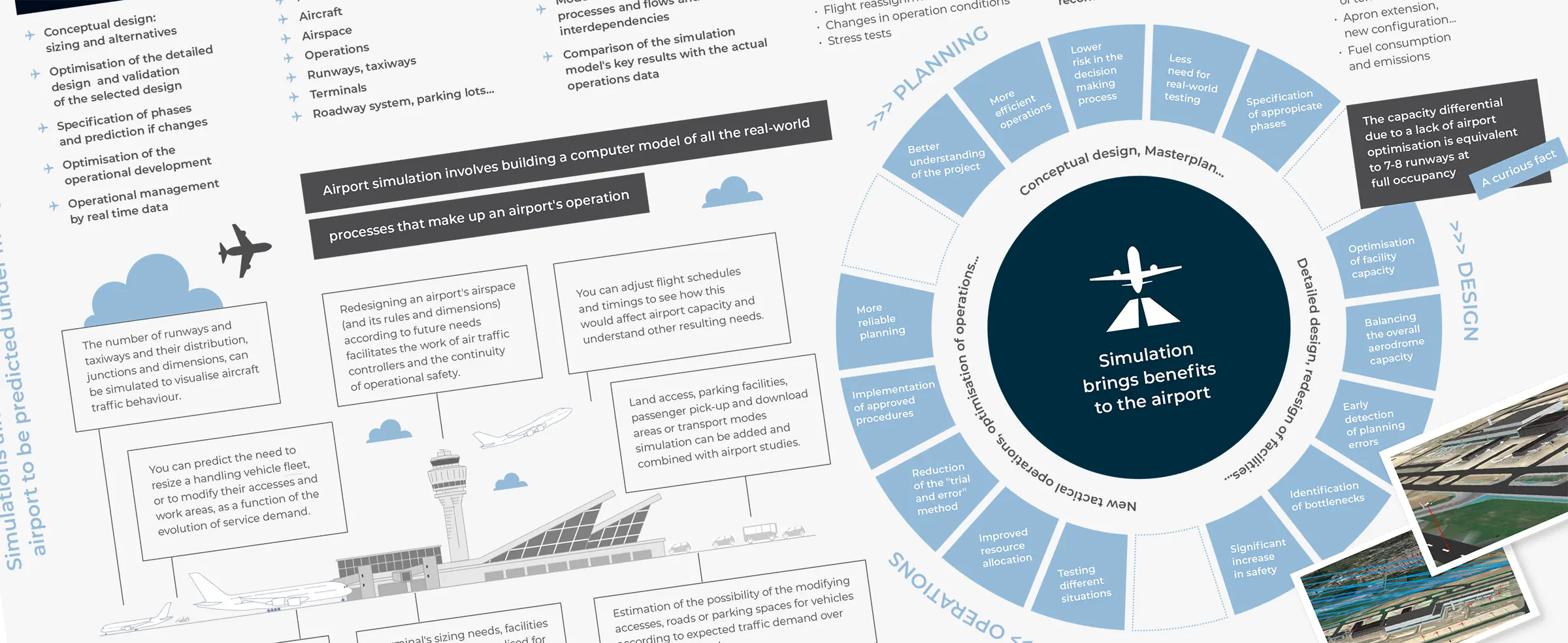
We have recently been visited by a delegation from the European Commission. Libyan Airport Authority. This action is part of the project to update the Masterplan for Libya's Misrata International Airport, and included a course on Masterplan development given by AERTEC.
"We need Spanish expertise in the field of aviation".
To find out more about the situation of airports in the Maghreb country, we spoke to Waleed S. Haddaqah, Director of Construction Department, and Wael Saeid Aishawish, Head of Design and Specifications Department.
What is the current situation of the airport sector in Libya?
In Libya we have 12 airports, 7 of which are international. But given the current context we only have 4 serving airlines and passengers. The situation of each of these airports is different.
In some we have ongoing developments and improvements, and in others we are doing studies and master plans, but we are working with the less well served airports. We want to develop and improve our infrastructures so that they result in a better service for both passengers and airlines.
How is air traffic developing in the country? Which airports are growing the most?
Developments are going well, especially the growth at Tripoli and Mitiga international airports. Many projects are underway at the latter, such as the extension of the terminal building. We are carrying out maintenance work on the apron, connections and taxiway. We have already carried out preventive maintenance on the runway and other areas.
We are also developing and adding new facilities for infrastructure improvement.
Planning for the future: What are your plans for the addition of new destinations and airlines?
We are in contact with a number of airlines, and they are telling us their demands. We are working to satisfy them. That is why it is very important to make progress in the certification of Libyan airports, and for this we have the support and advice of AERTEC. If we achieve certification for these 4 airports in our country, it will be easier for airlines to operate and for airlines to open new destinations.
What are the short- and medium-term priorities of the Libyan Airport Authority with regard to infrastructure development?
We are now focusing on the development of the master plan for Misrata Airport, which we are working on together with AERTEC. We also have a master plan for Tripoli airport, and we are studying a tender for international companies to start the reconstruction of this airport soon.
One of our objectives is to encourage investment in airports in western Libya. Some companies are asking us to invest there, given its favourable conditions for, for example, aircraft maintenance and parking.
We also want to be part of the transit of aircraft from Europe to parts of southern Africa, to be a refuelling stop for aircraft and to take advantage of lower fuel prices in Libya. It is important for this to open up our airspace, which is restricted due to the political situation, but it is a necessary measure that will result in increased taxes and revenues.
The incorporation of new technologies is essential for airport management. What are your priorities in the field of technology?
Incorporating the latest technology in our airports is undoubtedly one of the priorities of the Libyan Airports Authority, where we have a department working precisely on this objective. For example, smart airports, smart baggage storage, smart boarding pass. We are working and contracting international technology providers to adapt airport infrastructures to current demands.
Libya and Spain collaborate in aviation matters, especially in training. What actions are being developed in this regard and how is the exchange of experiences going?
These training days at AERTEC have allowed us to exchange many experiences and, above all, to work with the necessary information to jointly draw up master plans. Knowing first-hand the work that AERTEC has already carried out at Benina International Airport in Benghazi will greatly facilitate future planning.
We hope to continue promoting this cooperation between Libya and Spain, especially in the field of aviation, because we need your experience in this sector. Thanks to this training activity we have been able to share knowledge with AERTEC experts, so we hope to be able to carry out more training courses like this one both in Spain and in Libya.
The Chairman of the Libyan Airports Authority, Mr. Mohammed Bait Al-Mal, is doing a great job to improve our expertise in the airport sector with the support of Spanish companies. And this will be reflected in the development and performance of our airports and in the field of aviation in the future.