Simulating airport processes allows us to anticipate, on a technical basis and before actual implementation, the operational impact of any decision in a highly complex environment.
Simulating airport processes allows for comprehensive modelling and analysis of airport operations in order to anticipate the most efficient solutions in any past, present or future scenario. In highly complex systems such as airports, traditional analytical calculations may be insufficient or unfeasible. Simulation integrates multiple interdependencies, parameters and operational dynamics into detailed and realistic models, capable of reproducing internal processes, the distribution of ground elements and air traffic behaviour. This allows the impact of each decision to be accurately analysed before it is actually implemented.
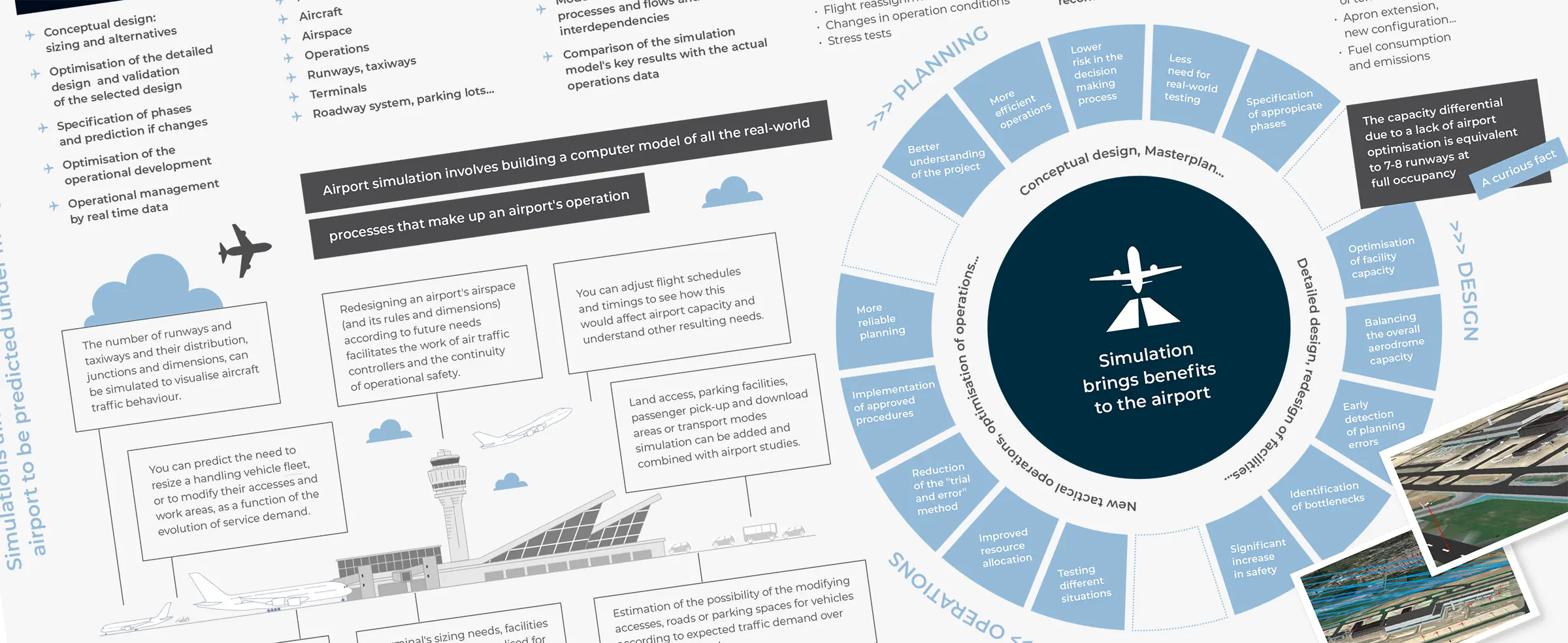
Its benefits span planning, design and operations. It improves understanding of processes, provides greater reliability in planning and reduces risk in decision-making. In design, it helps to optimise infrastructure capacity and detect potential errors or impediments. In operations, it increases efficiency, allows procedures to be tested before implementation and optimises resource allocation. In addition, simulation provides key results for evaluating flight procedures and airspace capacity, analysing new aerodrome infrastructure, optimising apron configurations and sequences, and modelling fuel consumption and emissions on the ground.
In this infographic, we review some of the most relevant concepts in airport simulation and its extraordinary usefulness in improving efficiency and safety at every stage of its evolution.
Key topics related to this infographic: «Consultancy«, «Airport planning and design«, «Airport operations"