Aeronautical efficiency is much more than a technical achievement: it is the driving force behind aviation's move towards a sustainable, clean and environmentally responsible future.
The transition to a sustainable economic and social model has become a global priority. In this context, civil aviation—one of the most technologically advanced and strategic sectors in the world—is not only accompanying this transformation, but also leading a genuine revolution towards sustainability. The aviation industry is fully committed to reducing its environmental footprint, taking on the challenge of achieving climate-neutral aviation in the coming decades.
This commitment translates into constant efforts in research, development and innovation (R&D&I). From aircraft and engine manufacturers to airlines and air traffic managers, all players in the sector are working in a coordinated manner to reduce energy consumption, pollutant emissions and noise, without compromising safety or competitiveness. The common goal is clear: to minimise the environmental impact of each flight and accelerate progress towards a sustainable, efficient and responsible aviation model.
A sustained improvement in efficiency
Improving aircraft efficiency is not a recent phenomenon. Since 2009, global air transport efficiency has grown at a rate of more than 2% per annum, the result of a continuous process of technological and operational optimisation. This progress, although steady, is becoming increasingly challenging. Incremental improvements in aerodynamic design, weight reduction and engine refinement have led to significant achievements, but marginal gains tend to diminish as the physical and technological limits of current configurations are reached.
Even so, the industry is not standing still. Innovative solutions are being explored that combine advances in propulsion, aerodynamics and lightweight materials, three fundamental areas that determine an aircraft's energy efficiency. New generations of aircraft are being designed not only to consume less fuel, but also to fly more quietly and emit fewer greenhouse gases.
Continuous innovation: improving what already exists
Aeronautical sustainability does not depend solely on the design of new models. In fact, much of the current commercial aircraft fleet benefits from progressive improvements that are incorporated throughout its life cycle. Each aircraft that leaves the final assembly line is, on average, between 2 and 3 per cent more efficient than its original version a decade earlier.
In addition, manufacturers offer performance improvement packages that enable airlines to upgrade systems, surfaces or flight software to reduce fuel consumption during operation. This philosophy of continuous evolution maximises the efficiency of the existing fleet and contributes immediately to global sustainability goals.
Aeronautical efficiency is much more than a technical indicator: it is the key to ensuring the viability of air transport in a sustainable world.
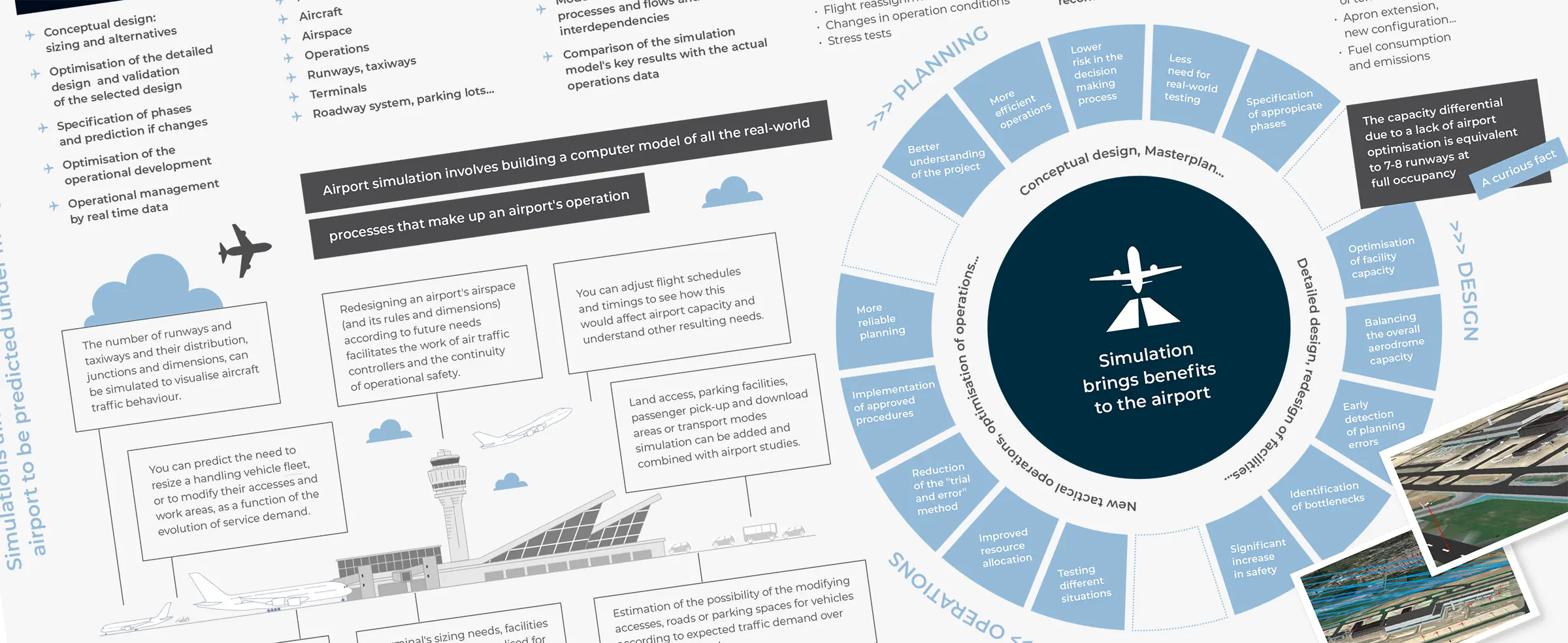
This infographic, developed jointly by the Official Association of Aeronautical Engineers of Spain (COIAE) and AERTEC, offers a clear and concise overview of this technological evolution, showing how aeronautical engineering continues to push the boundaries of what is possible to make flying increasingly safer, cleaner, more efficient and more environmentally friendly.