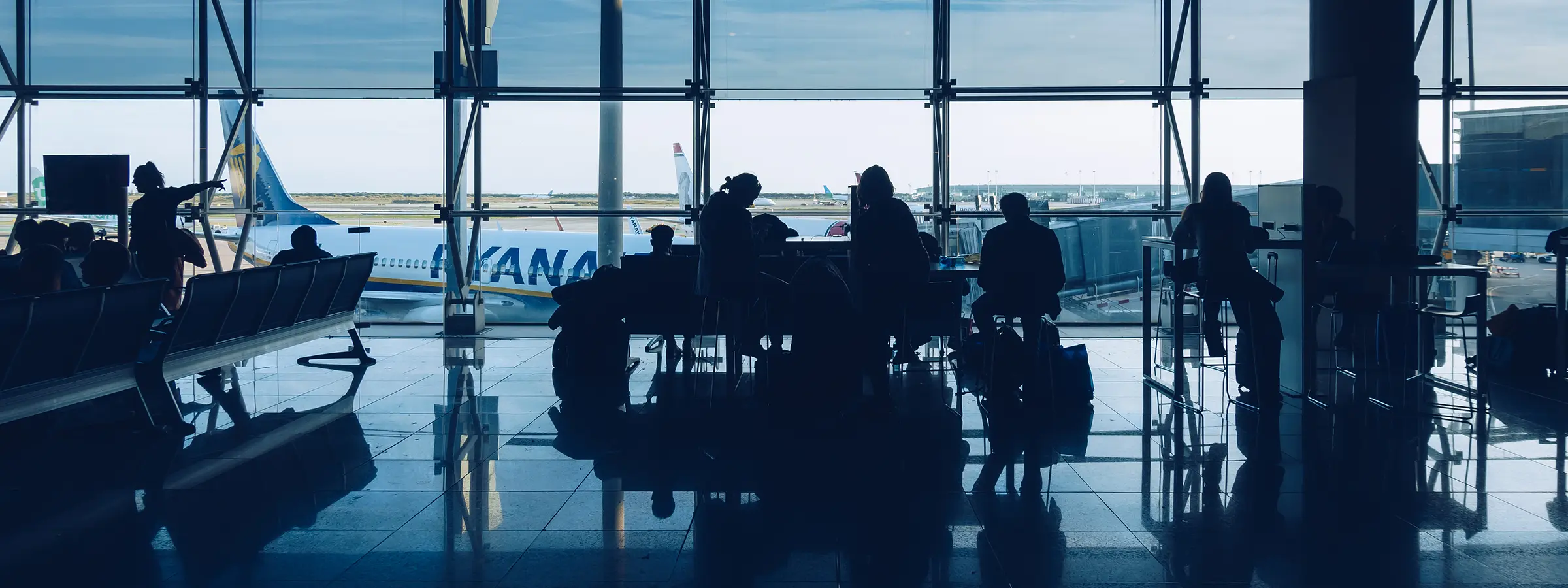
In the times in which we live, almost everyone is familiar with the words data, roaming, wi-fi... In this post we are going to talk about a term that is indispensable in a traveller's vocabulary... the word wi-fi. Anyone who is used to travelling and spends days and days at airports will know that, while waiting for a plane, thousands of things go through our heads and that almost 80 % of them are related to our mobile phones and, of course, the Internet. Things like answering emails, talking to the family on WhatsApp, reading today's newspaper... All of these things have a common denominator: Internet. However, when we think of the Internet, we automatically think of wi-fi, as we know that in almost every corner of a shopping mall, in restaurants or airports there will be a wi-fi receiver waiting for us to connect.
The quality of service provided by wi-fi receivers at airports in Europe is relatively good.
But when did it really get the first wi-fi adaptor in an airport? It is known that wi-fi as such was created in 1991 by the hand of Vic Hayes (1)but not when it was implemented at an airport. What can be said is that one of the pioneers was Prague Airport, back in 2005, about 12 years ago... and that access was granted for about 150 Czech crowns (about 15 € today). (Prague airport website).
Has the term wi-fi evolved since 2005? Yes, and a lot. Standards and types of connections have changed much since then. In 2005, the maximum connection speed was estimated at 11MbpsThe wi-fi connection was not yet available, as long as you had the receiver nearby and your PDA was of the latest generation (smartphones were not so deeply rooted in society at that time). In 2011 and 2012 the famous smartphones and tablets already existed, so the wi-fi term continued to improve its functionalities, reaching speeds of up to 1.3-3.46 Gbpsas at present.
Focusing a little more on the subject of wi-fi and its use in airports, I must say that we must be cautious with the networks to which we connect in airports, and not use any bank password or private key that can "hack" us, making us the now famous term "hackers". Man in the Middle (2) and causing a stir in our lives.
The quality of service provided by the wi-fi receivers in the Europe's airports is relatively good. This means that we still need to improve in many aspects, although in terms of quality and safety it is good, despite the fact that passengers are still being charged fees for the "premium" service. In the Americas, more specifically in Argentina, Resolution 109/2016 of the Regulatory Body of the National Airport System (ORSNA), published in the Official Gazette, approved the "standard for wireless internet service provision (wi-fi) in Group A airports" of the system, so that there are currently around 33 terminals in Argentina with a totally free and high quality wi-fi network.
Finally, let's talk about an initiative promoted by a blogger who travelled a lot around the world called AnilPolat, who decided to collect all the passwords and wi-fi networks of all the airports in the world and put them on a map. On this map (See), it comments on the name of the wi-fi network, the password and whether or not it has a time limit. This idea has been so well received that there is already an application for iOS or Android and there are already many users participating in this project, which has been dubbed the Open-Source. A luxury for those who travel from country to country and need to stay connected.
(1) Vic Hayes
Victor "Vic" Hayes was a Senior Research Fellow at Delft University of Technology. His role in establishing and coordinating the IEEE 802.11 Standards Working Group for Wireless Local Area Networks has led many to refer to him as the "father of wifi".
(2) Man in the Middle
The Man In The Middle attack consists of hacking into the communication between two computers so that all the traffic passes through us and we can decrypt their data, passwords, etc. In the case of airports, one possible way would be to create a wi-fi hotspot and name it after a shop or café, for example.