How many of us have dreamt of going into space? How many of us have looked out of our bedroom window as we gazed into the sky in search of a celestial body or flying object? It is an innate human interest in the unknown, and what could be more unknown than what lies in space?
Nowadays, so that ordinary citizens can be a little closer to what is going on out there, there are different technologies and applications that allow us to monitor aircraft flying over our planet in real time. One of the most pursued and interesting objects is undoubtedly the International Space Station (ISS), which is usually visible at twilight.
There are a number of applications that already allow anyone to follow in real time what is going on above our heads, especially the International Space Station.
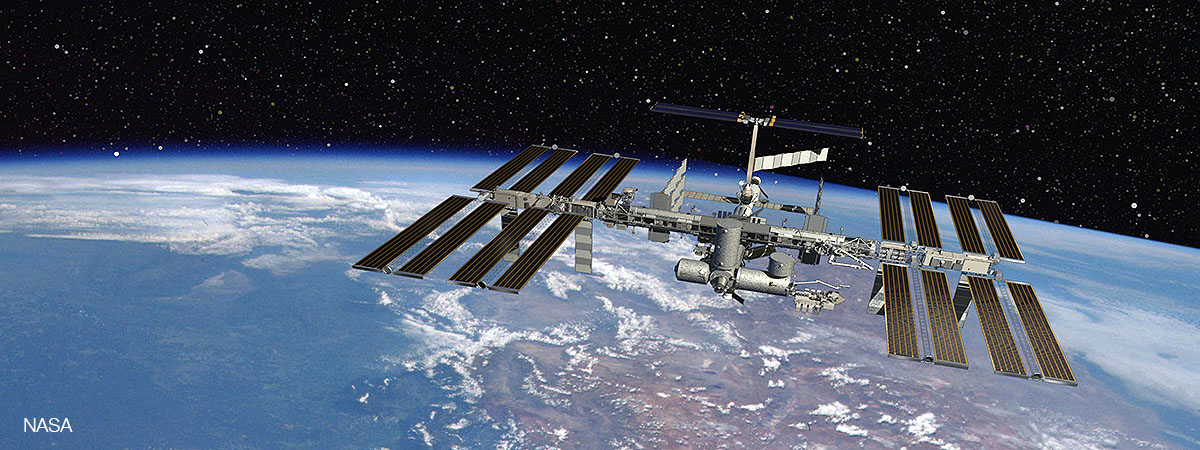
What is the International Space Station?
The International Space Station is a research centre located in Earth orbit and which is dedicated to the administration, management and development of hundreds of experiments and trials carried out by universities, laboratories and research centres around the world. To monitor all tasks, it maintains a permanent crew of astronauts and researchers from the National Aeronautics and Space Administration (NASA), the Russian Federal Space Agency (Roscosmos), the Japan Space Exploration Agency (JAXA), the Canadian Space Agency (CSA) and the European Space Agency (ESA).
The International Space Station began construction in 1998, making it 20 years into its history, which includes a long list of successes in terms of research and development of space technology (see infographic).
A new milestone associated with the ISS has recently been reached, as 31 October 2000 at 8:51 a.m. was the last time that all human beings were on Earth. Since that day there have always been at least two people in orbit as space station crew members. The number of occupants has ranged from 2 to 13, although the most common has been 6 people at any one time. A total of 241 astronauts from 19 countries have visited the space station so far.
Can we know where the International Space Station is at any given moment?
The International Space Station flies over our planet at an altitude of about 400 kilometres every day. Can we see it? Strangely enough, the answer is yes, mainly at twilight, as it reflects the sunlight. In fact, the ISS is considered to be the second brightest object in the night skyAfter the moon and ahead of the planet Venus.
The International Space Station is considered one of the great milestones achieved by mankind. Beyond the technical complexity of a project of this magnitude, it is worth highlighting the enormous and close-knit international cooperation that has made it possible. Hundreds of scientists and companies from countries, some openly antagonistic, have worked side by side to make it all work.
But, going back to the beginning, we often wonder how it would be possible to see the ISS from Earth, from our window. The advance of technology associated with the Internet and mobile applications has put this possibility in the hands of any user.
In order to know your location in real time, there is a fabulous website at our disposal, called Spot The Station. This platform has been configured by the NASA and through it we will be able to know where the International Space Station is located in real time and estimate when we will be able to see it based on our location.
Once we have accessed the web page of the NASA: Spot The StationIn the map below, a map of the position of the International Space Station is shown according to the different regions of the planet. In this way, we will be able to see where the International Space Station is located from the place where we are, that is to say, from our position. To make this possible, all we have to do is type in the name of the town, city or region where we are.
In addition to showing us where the International Space Station is located, NASA also informs us of the best times to enjoy the experience of seeing the ISS. It does this by telling us the time when it will be visible in the sky, as well as the optimal coordinates for viewing and the time it will remain in view. Finally, we can also subscribe to the alert service available at Spot The Station to notify us every time we have the ship near our location.
There are other applications on the web or downloadable for mobile phones that are also a reference for locating and viewing the ISS. These include Heavens Above, ISS Tracker, ISS on Live, ISS Detector and others.
Being in space without leaving home has never been as easy as it is today. Now, thanks to these kinds of applications and the dissemination work of the different space agencies, we can make our dreams of watching and controlling what happens up there come true. What are you waiting for to observe the International Special Station?