The criteria for defining the first flight in history can be varied and, depending on this, there are also several candidates for the award.
17 December 2023 marked the 120th anniversary of what is widely accepted as the the first flight of an aircraftBut was it really the first flight in history?
Indeed, on 17 December 1903, after several unsuccessful attempts, the youngest of the Wright brothers, Orville, climbed up to a heavier-than-air deviceThe Flyer, and made a 12-second, 36-metre flight. From today's perspective it doesn't look like much, but it was a significant precedent for the nascent aeronautical industry.
However, this statement generates some controversy, as many consider that in reality the first flight that deserves such a name was not that of the Wright brothers. The list of pioneers who aspire to this high distinction includes Alberto Santos Dumont, Samuel Langley, Clément Ader, Glen Curtiss and Gustave Whitehead. The key to this issue lies in "what is considered an aircraft", in "what is considered flight", in "registered patents" or even in the "certification (or not) of the flight", either by an official body or by an audience other than a handful of family or friends. The options are varied and, therefore, there may be several answers.
If we define flying as lifting one's feet off the ground and landing alive and well to tell the tale, we would have to go back to the year 875, when the Andalusi Abbas Ibn Firnas did the same from the Arruzafa hill in Cordoba (Spain), staying in the air for about ten seconds (almost as long as the Wrights). It was a gliding flight without much control, but a flight nonetheless. Some time later, in 1010, Eilmer of Malmesbury took off in another glider from a tower at his abbey, flying some 200 metres in Wiltshire (UK). They both broke bones on landing, but they both flew and lived a few more years to boast about it.
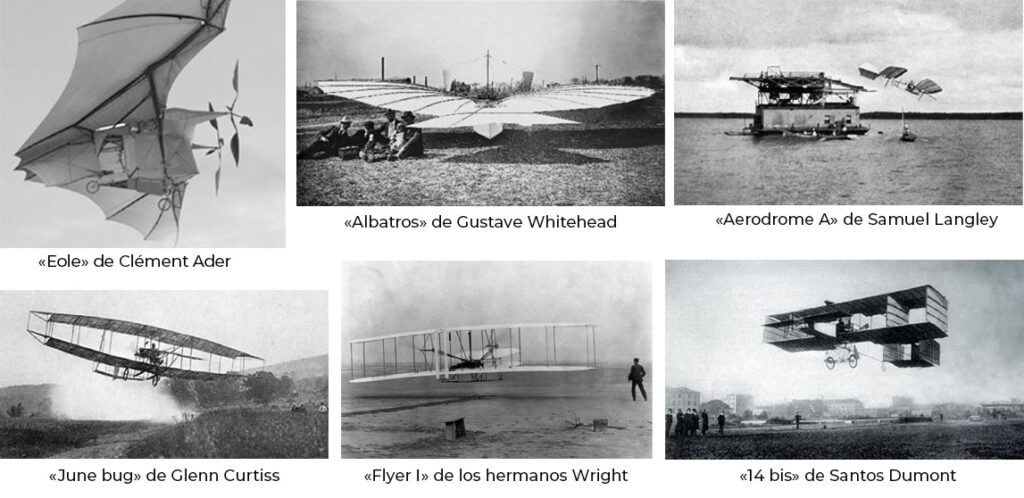
If what we are considering is the first heavier-than-air, self-propelled, manned and manned craft that would soar for a few metres, then we should bear in mind what the French engineer achieved. Clément Ader. It is generally accepted in the aeronautical community that on October 9, 1890, he took off and flew his model Eole. The "jump" was totally uncontrolled and barely covered a distance of 100 metres, flying a few centimetres above the ground. In the end it crashed hopelessly. This is considered to be the first "flying machine" that shares most of its concepts with today's aircraftalthough flight control was his unfinished business.
A few years before him, the French inventor Alphonse Pénaud got his model aeroplanes to fly, but on a small scale. In fact, he is considered to be the father of aeromodelling. On 18 August 1871, he publicly flew one of his models, which was propelled by rubber strips that turned the propellers. It flew almost 60 metres in 11 seconds. It should be remembered that, in this case, the aircraft was unmanned and uncontrolled, although his conclusions influenced later aeronautical pioneers, such as George Cayley, Samuel Langley and the Wright brothers themselves, who were inspired by some of his designs.
The first piloted engine flight recorded in writing took place on 14 August 1901 in Connecticut (United States) by the German-born engineer Gustave Whitehead. He was inspired by the designs of his compatriot Otto Lilienthal, to which he made some adaptations and added a small engine. The longest flight was over 2 kilometres and he reached a height of 60 metres after taking off under his own power. For the first of his flights, he used a light 2-cylinder, 20hp (15kW) engine that he built himself, although he increased its power on subsequent occasions. For the take-off phase, the engine was responsible for accelerating the wheels until, at a given moment, the pilot switched the power to the propellers by means of a mechanism, generating the necessary thrust to stay in the air.
Although it made headlines in various local and national media, Whitehead never recorded his progressHe would therefore have lost in advance any patent litigation he might have wanted to pursue. In fact, once the nascent aviation business seemed to have a future, there was nothing he could do when he tried to fight to have some of his breakthroughs recognised. Many, especially the defenders of the Wright brothers, question their flights of 1901 and 1902, arguing that there are no graphic testimonies, but the truth is that there were many media outlets of the time that reported on them as well as sworn testimonies from people who saw some of their aircraft fly.
During these same years, the American physicist and inventor Samuel Langley designed and built his first aircraft, powered by a steam engine, but unmanned. He received financial support for the development of a manned version from the government and the Smithsonian Institution, of which he was the secretary. Equipped with a 53-horsepower petrol engine, he attempted to take off with his "Aerodrome A" model from a barge on which a catapult was installed. The craft had grade and yaw control, but no tilt controlHe relied on the pilot's own weight distribution to maintain the proper angle. His models flew years later and in other hands, but in his last attempts on 7 and 8 December 1903, the aircraft fell into the Potomac River without ever getting airborne.
Ten days later, on 17 December 1903, the Orville and Wilbur Wright brothers They managed to fly their plane in the dunes of Kitty Hawk in North Carolina (USA). Since 1900, they had invested many hours of work and just over 2,000 dollars to reach this culminating moment. Their Flyer I model, a 35 kg aeroplane built from basic materials (spruce and ash wood for the frame and muslin cloth for the wings) and powered by an engine of only 12 horsepower, flew about 40 metres in twelve seconds. They continued to advance their models and by October 1905 they were able to control their aircraft to the point where they could follow a pre-set trajectory and stay in flight for more than half an hour.
It is worth noting that the Wright Brothers were the first to understand that a propeller is actually a rotating wing and that it must have an aerodynamic profile. The propellers they made for their 1903 flight were almost as efficient (about a 70%) as the wooden propellers we can make today, which is an outstanding achievement.
The truth is that their first flight went virtually unnoticed by the media and public opinion, being witnessed by only a handful of close collaborators. In fact, the Wright brothers themselves contributed to the lack of publicity for their work because they wanted to continue working, without witnesses who could copy their ideas. They wanted to have enough time to perfect their apparatus without giving other pioneers an easy ride. Ongoing commercial work and potential government contracts seem to have been the key to this zeal.
The first major debate about "who came first" (which is still going on today) arose over the work of Alberto Santos Dumont. Actually, if we consider "aeroplane" as a heavier-than-air machine that can take off on its own (unaided), return to its starting point and land softly, then Santos Dumont's model 14bis did that on 23 October 1906.
The 14bis took off on its own and without the aid of launching devices, covering 60 metres in 7 seconds, doing so in front of more than a thousand spectators. In addition, the flight of the 14bis was the first in history to be approved by an aeronautical institutionthe Aeroclub de France.
The Wright brothers, however, registered their patent before Santos Dumont.
4 July 1908, Glenn Curtissa Hammondsport engine manufacturer made what is believed to be the first public flight in the United States, previously announced, with his June Bug aircraft. This flight earned him the Scientific American award. He did so as a member of the AEA (Aerial Experiment Association), created by Alexandre Graham Bell. A month later, the Wright brothers made their first public flights, already with an important degree of perfection in the handling of the different phases of flight.
Hasta aquí, algunos de los pioneros que fueron protagonistas en aquellos años en los que se dilucidaba la capacidad de levantar el vuelo en una aeronave más pesada que el aire. Desde aquel momento, el abanico de aportaciones y logros en el ámbito del vuelo ha ido creciendo exponencialmente.
It goes without saying that the struggle for patents relating to aircraft and flight systems that originated in the early years of the 20th century was immense. Beyond this important procedure, it is honest to admit that although the credit for having made the first flight must go to one of the pioneers mentioned in this article, it is no less true that before them there were other pioneers who were not so well known. dozens of pioneers who made important contributions to reach the point where a heavier-than-air craft could take off, fly and finally land in a controlled manner.
And having said all this... Who was the first to fly?
Para saber más, puedes leer: