Although it may seem a truism, this article must begin by pointing out the importance of airports in terms of connecting different national and international markets. Therefore, investment in airport infrastructure (either for new installations or as refurbishment and/or extension of existing ones) is presented as a key factor in global economic development..
The adoption of a PPP model for airport management has many advantages that ultimately benefit the economic development of the region served by the airport.
Traditionally, airport infrastructures were owned, managed and operated by governments (public sector). However, In recent years, this trend has shifted towards greater private sector involvement.modulated with different degrees of ownership, responsibilities and management models. Within these management models is the APPof Public-Private Partnership.
But what are public-private partnerships in concrete terms?
Actually, there is no commonly accepted definition of the meaning of a Public-Private Partnership (PPP model). In general terms, a Public-Private Partnership refers to an agreement between the public sector and the private sector in which part of the services or functions that are the responsibility of the public sector is provided by the private sectorThe public service or public infrastructure is provided under a clear agreement on shared objectives for the provision of the public service or public infrastructure.
An increasing number of countries are including a definition of Public-Private Partnerships in their laws, adapting their definition to the institutions and particularities of their legislation. Some of the countries that have their own PPP laws are listed below:
| AFRICA | AMERICA | EUROPA | ||
| Angola | Argentina | Bulgaria | ||
| Benin | Brazil | Croatia | ||
| Cameroon | Canada | Spain | ||
| Egypt | Chile | France | ||
| Ghana | Colombia | Greece | ||
| Kenya | Mexico | Ireland | ||
| Madagascar | Peru | Kosovo | ||
| Malawi | USA | Latvia | ||
| Morocco | Lithuania | |||
| Mauritania | ASIA | Macedonia | ||
| Mauritius | Cambodia | Poland | ||
| Mozambique | South Korea | Czech Republic | ||
| Senegal | Philippines | Romania | ||
| South Africa | India | |||
| Tunisia | Indonesia | OCEANIA | ||
| Tanzania | Jordan | Australia | ||
| Zambia | Sri Lanka | Fiji | ||
| Vietnam |
The following chart shows in more detail the range of agreements which are normally classified as PPP projects:
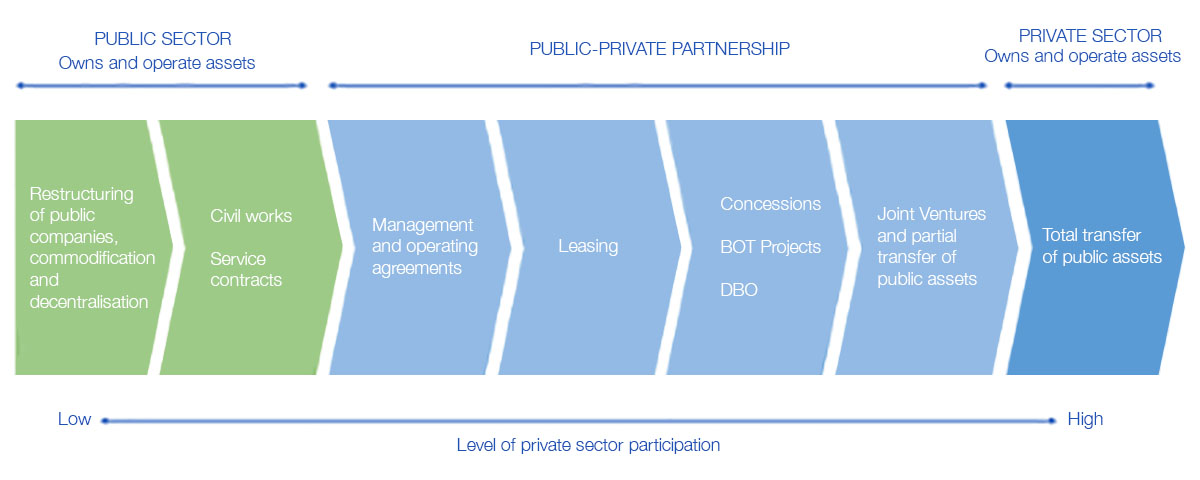
In other words, the agreements defined in the framework of PPP projects are as follows:
- Management and operating agreements.
- Leases
- Concessions, BOT and DOB projects.
- Joint Ventures and partial detachment of public assets.
- Agreed mixtures of the above.
Therefore, PPPs do not include service contracts or turnkey contracts.as these contracts are considered to be public procurement projects or privatisation of public services.
Main aspects to consider in the PPP model for airports
Some of the main advantages of adopting PPP models at airports are the following:
- Contribution of additional funding by the private sector.
- They usually provide better infrastructure solutions than fully public or fully private initiatives, as each party focuses on its speciality and field of expertise.
- It achieves a faster project completion and delays in infrastructure projects are reduced, due to the inclusion of early completion bonuses that increase efficiency.
- Increased management flexibility airport, due to the reduction of administrative and bureaucratic procedures that can slow down decision making.
- Risks are assessed in full and from additional perspectives to determine the feasibility of the project. In this sense, the private part can serve as a an additional control against unrealistic expectations on the public side.
- The operational and implementation risks of the project are transferred from the public side to the private side, which usually has more experience in control and cost reduction in infrastructure projects.
All players in this sector are aware that the PPP model has been consolidating in recent years as a successful operating model for many airports. An example of this are the congresses and seminars that are promoted internationally to raise awareness of this approach. This is the case of the MAF (Malaga Airport Forum), where the PPP model was expressly addressed and where the conclusions of the round table were of particular interest [see]. The following relevant aspects of the PPP model, among others, were discussed:
- Key challenges facing major PPP initiatives.
- Key drivers and triggers that should be considered to maximise the chances of success of a PPP initiative.
- Regions and markets leading the way in terms of successful implementation of PPP projects.
- Regions and markets where more opportunities for PPP projects are identified in the future.
- Non-financial risks of a PPP transaction, both for the public and private parties.
- Importance of airport environmental and sustainability issues in PPP projects.
The Public-Private Partnership model, the future of airport management
As explained, there are many advantages to adopting a PPP model for airport managementand which ultimately benefit the economic development of the region served by the airport.
Moreover, in recent years, this model is being consolidated as a successful operating model for many airports, putting these theoretical advantages of the model into practice.
Therefore, in the short term future, we will see more and more PPP models in the airport sector, thus increasing the collaboration between the public and private sectors.