The emerging concept known as Urban Air Mobility (UAM) represents one of the most unique markets to have been seen or experienced within the aviation industry. In a recent article on “Air Taxis as Part of Urban Air Mobility” (see), I introduced this idea by focusing on one of its applications, air taxis. In recent years, numerous demonstrations and events have been held with the aim of showcasing these latest-generation models, and on several occasions, they have revealed surprising levels of technological maturity.
There are currently over two hundred air taxi projects active worldwide.
Within the European framework, the German company Volocopter, is internationally recognised for its successful advances in the journey to bring urban mobility into the third dimension. Its prototype VoloCity (eVTOL) with capacity for 2 passengers, it is powered by its 18 rotors driven by the energy of 9 electric batteries. Volocopter has carried out full-scale demonstrations of its VoloCity in regions such as Germany, Dubai, Helsinki and Singapore (TRL 7).
Its commercial flights are estimated to launch in the next 2 or 3 years, although it is still working to obtain the certification EASA SC-VTOL, one of the main barriers affecting the air taxi market today.
But this is not the end of the story; the German firm has not contented itself with developing aerial platforms, but has opted to embrace another of the areas that make up the UAM, which is Construction and infrastructure management by establishing strategic relationships. Volocopter and Skyports (United Kingdom) partnered to create the Voloport, the first vertiport landing centre that was unveiled in 2019 in the region of Singapore.
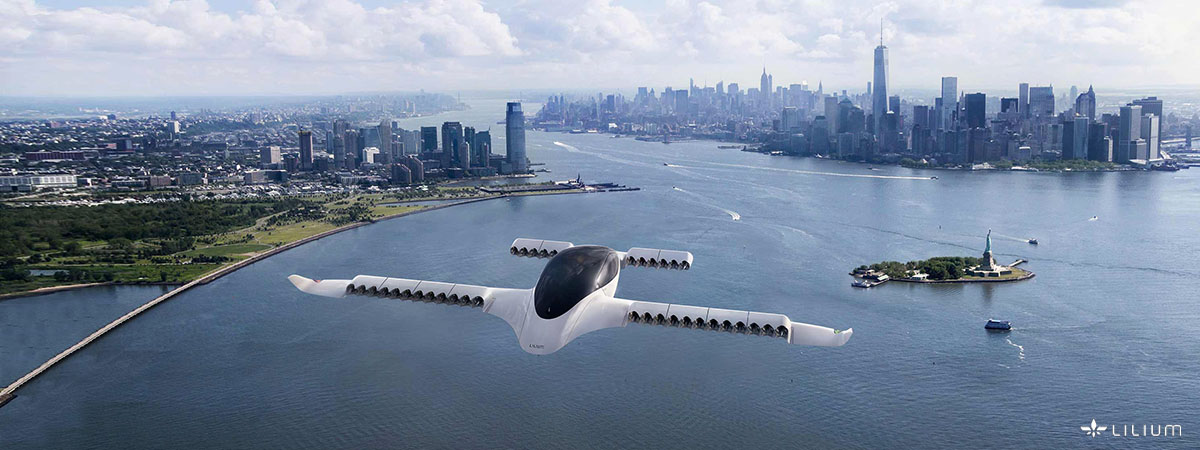
On the other hand, Lily is another one of the most revealing German companies in the sector. Its prototype Lilium JET The eVTOL has a capacity for 5 passengers and is designed with 36 electric motors, allowing it to reach 300 km/h and achieve a range of up to 60 minutes. The current test aircraft is a large-scale demonstrator whose data is being used to inform the design of the production aircraft, which is being carried out simultaneously, in accordance with the strict aerospace processes and guidelines established by the relevant regulatory authorities. (TRL 7). Its objective is to obtain EASA SC-VTOL certification within the next 3 years, although it also aims to be certified by the FAA in the United States.
Furthermore, it is another of the ambitious firms that has joined infrastructure development. Lilium and Ferrovial (Spain), recently (January 2021) announced their collaboration agreement to develop and exploit a network of vertiports along the peninsula Florida United States.
In terms of Airbus, the European aerospace giant, has also positioned itself as one of the benchmarks in the UAM market. It has joined the initiative and taken advantage of its technological “know-how” in vertical flight, as well as its track record in bringing aerospace systems to market, including certification, industrialisation and related services. Specifically, it is focusing its efforts on the development of its CityAirbus. This is a fully electric, four-seater, multicopter (eight fixed-pitch propellers and eight motors) full-scale demonstration vehicle that focuses on advancing piloted remote electric vertical take-off and landing (eVTOL). (TRL 6).
Now, although Spain it is not positioned among the leading countries in the development of urban air mobility, it welcomes potential market drivers such as Tecnalia, which has been awarded by several entities (including ENAIRE) and has gained recognition for its air taxi prototype Lauren. In 2019, it launched its single-seater (eVTOL) model based on a configuration of 4 motors attached to a main structure and carried out its last demonstration at the Donostia Arena in July 2019. (TRL 5).
Moving on now to a more global framework which exceeds European boundaries, the “start-ups” they have been the protagonists, especially in the area of passenger aircraft platform development. Most are of origin American due to the initiative launched by Uber in 2016 with the creation of the Red Uber Elevate, where it aimed to offer shared air taxi services in various US cities by 2023. To achieve this, it selected several partners who would help create its network. However, in December 2020, due to the pressure of the COVID-19 crisis and in order to divest from secondary activities or those with a more uncertain future, Uber Elevate was acquired by one of the initial partners, the start-up Joby Aviation, which is currently the beneficiary of one of the largest total investments in the UAM market. Furthermore, its model (still without an established name), powered by six electric motors, with a capacity for 5 passengers and a range exceeding 240 km, is undergoing a multi-year testing programme with the FAA to certify the vehicle for commercial operations. (TRL 7).
On the other side of the globe, the Chinese company EHang, it has become the world's leading company in technology platforms for Autonomous aerial vehicles (AAV). Your model EHang 216 It has a capacity for two passengers, is powered by 16 high-performance electric motors mounted on 8 foldable dual-rotor arms, has a range of 40 km and can reach speeds of 130 km/h.
Furthermore, its diverse applications, worldwide flight demonstrations, and reiterated participation in UAM-related research projects (AMU-LED, GOF 2.0, SAFIR-Med Project, Paris Region, etc.) make it one of the sector's favourites. (TRL 8).
In the same way, the car company Hyundai is working on developing a personal air vehicle (PAV) network called the S-A1 PAV. This model is fully electric, winged, and capable of carrying 5 occupants, though currently only a small-scale model exists. (TRL 5).
So EHang as the car manufacturing company Hyundai they work on the development of projects that span various branches of urban air mobility, the first plans to build the E-Port, an autonomous vertiport model that will accelerate the commercialisation of EHang AAVs in the tourism industry, specifically in the Chinese region. The second is working on HUB terminals and Personal Use Vehicles (PBVs) that will favour the UAM ecosystem, in addition to collaborating with other entities such as Urban-Air Port (UK) for the deployment of a full-scale vertiport prototype which will include live electric VTOL demonstrations in the UK in Coventry (2021) and Birmingham (2022).
All of the above indicates that, although the term “air taxis” might have seemed like madness years ago, the truth is that this idea is no longer so far removed from reality. All the advances reflected in the aircraft manufactured in various parts of the world show how the interest and trust placed in the system have made it possible to develop these concepts beyond the limits of science fiction.
Now is the time to reflect on this new sector that will shape a part of the aeronautical industry, on the key players who will be involved, and on the strategic relationships that will define the new market.
#uam