Drones, or RPAS, are remotely controlled aerial systems. The simplest and most recreational versions require a pilot to operate the drone using a radio-controlled controller while observing it from the ground. As contact with the naked eye would limit the range to just a few hundred metres, the more ambitious hobbyists incorporate a video camera on the front of the drone that transmits a first-person view of the flight (FPV). In this way they are able to control it within a radius of up to tens of kilometres, depending on the radio communications link.
The potential of RPAS is enormous to make them work in swarms with differentiated tasks and capabilities.
Although the range has increased, there is still a limitation, so the question is: is it necessary for a person to control the drone? The answer is no. Several companies have developed autopilot systems who control the flight controls to steer it along specific routes. The drone sends back telemetry information so that ground personnel can know its location, but the drone can also be used by the ground crew. does not need any additional control messages to complete its mission. autonomously.
Next will come the application of artificial intelligence so that the control software will not only include the route but also a behavioural plan. For example, in surveillance tasks, it could be able to identify situations such as ships with illegal behaviour, such as dumping, bunkering, sailing in restricted areas, etc., which would make it take decisions such as modifying its trajectory, communicating with ground personnel or simply capturing some images. If we were to look for an antecedent in science fiction, we would have the sentinels that pursued the ship Zion along the network of tunnels in the Matrix.
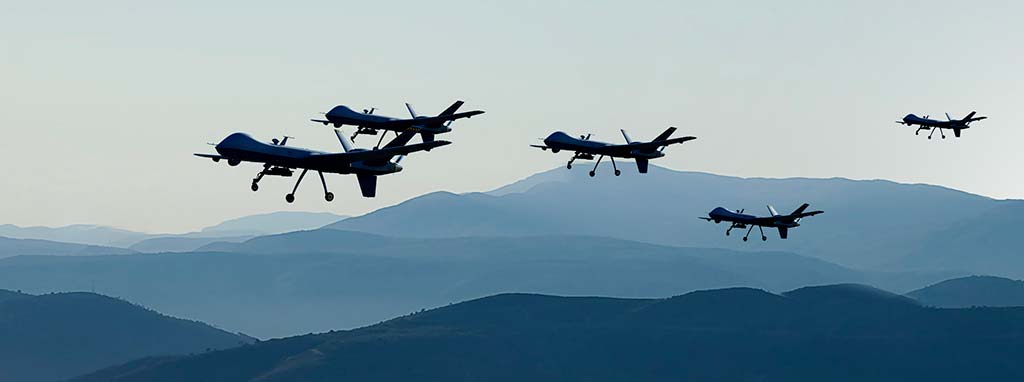
RPAS, thanks to their smaller size compared with manned aircraft, can operate in groupings of several tens known as "drone swarms". This requires each unit to have adequate sensors and intelligence that turns it into a collaborative robot. This technology is currently under development but there are already models, which, launched at intervals of a few seconds, end up forming a set that flies in harmony to perform certain tasks such as taking photographs, delivering seeds or fertilisers to fields, etc. Sometimes a pilot directs some units for others to follow, sometimes, however, no instruction is necessary for them to complete the task at hand.
At the moment, existing drone swarms tend to be homogeneous units, but complex behaviours could be programmed to allow the creation of heterogeneous and specialised fleets of units to help each other. We could incorporate radio-link repeater drones that move around helping to maintain communications for the rest of the fleet, have multiple units with articulated arms that build structures or carry loads between them, units with thermal sensors for fires while others recharge water or carry out clearing tasks. All this information would be handled more quickly and efficiently by the RPAS themselves than by human controllers.
Technology has given us many very useful autonomous drone models in isolation but, as we have seen, their potential is enormous as we become more able to programming sufficient artificial intelligence to make them work in swarms with differentiated tasks and capabilities. After all, that is what bees have been doing for millions of years.