Nowadays, the transport sector is aeronautics is becoming more and more accessible for those users who are attracted to this subject, or for those who would like to learn more about it. Gone are the days of watching a rocket taking off on television or an astronaut landing on the moon. Now we can see it live The camera can even be chosen from which camera you want to enjoy the best perspective. Surprising, isn't it?
This is a great opportunity for enthusiasts who have always dreamed of participating in an aerospace programme.
Not only can we do that, but we can also actively participate in the projects being developed by NASA (https://www.nasa.gov/). In the context of programming, any user can collaborate, either by commenting on the bugs we see in their applications or by modifying their code. Many will ask, "Your code?
The answer is "yes, its code". Recently, NASA has published the code of the applications of some 1000 projects that they have used in their experiments in space. Now, we can see for ourselves how they have done it and we can even modify parameters so that the product continues to improve. There are several projects I would like to name. It is amazing what can be learned using the applications.
There's a reason behind all this... And it's simple: aeronautics is increasingly going hand in hand with OpenSource, since thanks to this "open source" philosophy anyone can participate and improve the programme. This is a great opportunity for enthusiasts who have always dreamed of participating in an aerospace programme.
An example would be OpenVSP (http://www.openvsp.org/), which allows you to view the 3D design of aircraft and perform analysis on these models. This type of software is used to calculate parameters such as those involved in the design of wings, ailerons, etc. Here you have a videotutorial to get started. Cheer up! https://www.youtube.com/watch?v=xMRn_F0_yvU
Another example is a programme that NASA is working on directly that simulates the behaviour of the robots it sends into space, the so-called robots, rovers (1). The software is called OpenMCT and allows you to see live all the movements of the spacecraft, the temperature of the ground, the battery level, the air on Mars, the atmospheric pressure, the exact point on the planet and even make a template with all the parameters you want to see on the screen. And all this with just an Internet connection. The link is as follows: https://openmct-demo.herokuapp.com
Now is the time to let your imagination run wild with these programmes, learn about new ones, and who knows if one day one of your designs will be flying in space.
The most important thing about all this is that an aeronautical reference such as NASA is betting on people who are not inside its organisation and wants to attract talent outside its offices. A breath of fresh air.
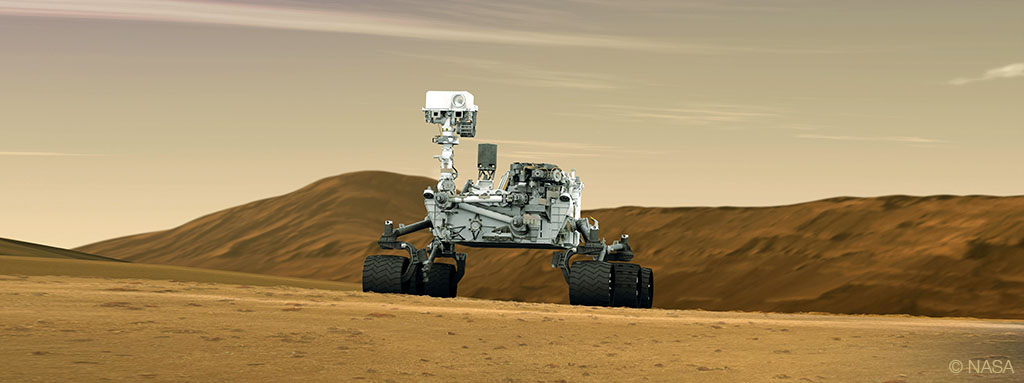
(1) A rover, also known as an astromobile, is a space exploration vehicle designed to move over the surface of a planet or other astronomical object. Some of them have been designed to carry passengers during manned spaceflight; others are partially or fully autonomous robotic vehicles.