Birds, through an evolutionary process spanning millions of years, have evolved internal and external anatomical and physiological adaptations that allow them to absolute flexibility and freedom in the air. Even after the incredible progress of aviation in the last century, bird flight still outperforms artificial flight in many respects. Despite having a slower speed, birds still enjoy the benefits of more versatile, quieter and more efficient flying. Below, we explore some of the lessons birds have taught us.
Since the origin of aeronautics, the flight of birds has always been a source of inspiration for aircraft design.
Many of the revolutions in commercial aviation were based on the study of birds. For example, the great contribution of the Wright brothers was the aircraft control system, which enabled controlling the turn in three axes: roll, pitch and yaw. They discovered that they could control the roll of their aircraft by twisting their wings, a technique used by birds.
Both aircraft and birds must generate lift to be able to flyIn both cases, wings are used, fixed in the case of aircraft and flapping in the case of birds. Interestingly, the similarities between the two types of wings are remarkable, the shape of their cross-section being very similar. However, the superiority of the bird's wing is remarkable.
One of the main advantages of birds is the feather, which combines the qualities of being strong, flexible and light to the highest degree. The feather allows the bird to change the shape of the wing instantly, and with greater flexibility than the moving surfaces of aircraft wings. A bird's feather is made up of a shaft called the rachis, which divides it into two asymmetrical halves called vane-shaped feathers, formed by branches or barbs, which in turn are made up of barbules that intertwine, trapping the air. There are different types of feathers, depending on their function and location on the wing.
- AlulasThis group of feathers is located on the leading edge of the wing, in the position corresponding to the human thumb, and increases the lift of the wing at low speed, reducing turbulence.
- T-shirtsIn charge of generating most of the lift during flapping.
- CobertresThe wing feathers are smaller feathers, which shape the wing, enhancing lift by creating the airfoil shape of the wing.
- ScapularsFeathers: Feathers arising from the humeral region of the bird.
The arrangement of the feathers on the wing is also very important, which determines their shape and function. The primary wing feathers are responsible for propulsion and the secondary for lift.
The control surfaces of the aircraft were inspired by bird wings.as well as in the movement of their feathers. For example, in modern aircraft, the front flaps have a similar function to the wing feathers.
With regard to thrust, however, the differences are even greater, as aircraft use engines, while birds flap their wings. In flapping we can consider two movements. When the wing descends, the feathers tend to rise upwards, thus joining with their partners, with which the air is trapped, achieving a great thrust force. At the same time, the wing moves backwards a little in a rowing motion, thus increasing the thrust. As the wing rises, the feathers bend downwards and spread apart, so that the air resistance is about ten times lower, resulting in high energy efficiency. This is greatly influenced by the asymmetry of the two vane feathers.
Just as there are different types of feathers, there are different categories of wings, both bird and aircraft. Each wing type is optimised for different types of flight.. There are three main groups of wing shapes in birds. Some have a small wingspan in relation to their chord, this characteristic being referred to as a low aspect ratio. They have an oval shape and are pointed at the tip. This type of wing is optimised for rapid take-off and abrupt changes of direction, but is not suitable for fast, sustained flight.
Another type of wing with a higher aspect ratio, characteristic of vultures and large eagles, specialises in gliding flight. They have a large separation between the primary remiges, so that each behaves like a small wing with a high aspect ratio, allowing slow flight. This separation is easily modified by the bird, which can vary the airflow at will, achieving great flight versatility and manoeuvring power.
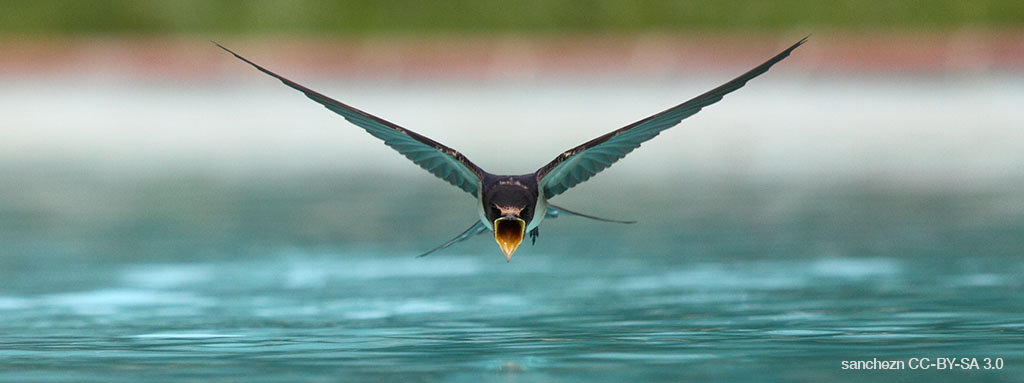
The third type is a wing with a very high aspect ratio, typical of swallows and hawks, becoming extreme in seabirds such as albatrosses. They are very long and narrow, ending in a point. With this type of wing, vortex formation is minimal, maximising its energy efficiency.
This is a very simplified classification, as there is a wide gradation according to the habitat and way of life of each species. For example, a bush bird has a totally different flight requirement from a steppe bird.
To continue improving flight mechanicsLet's study birds. We can learn a lot from them.