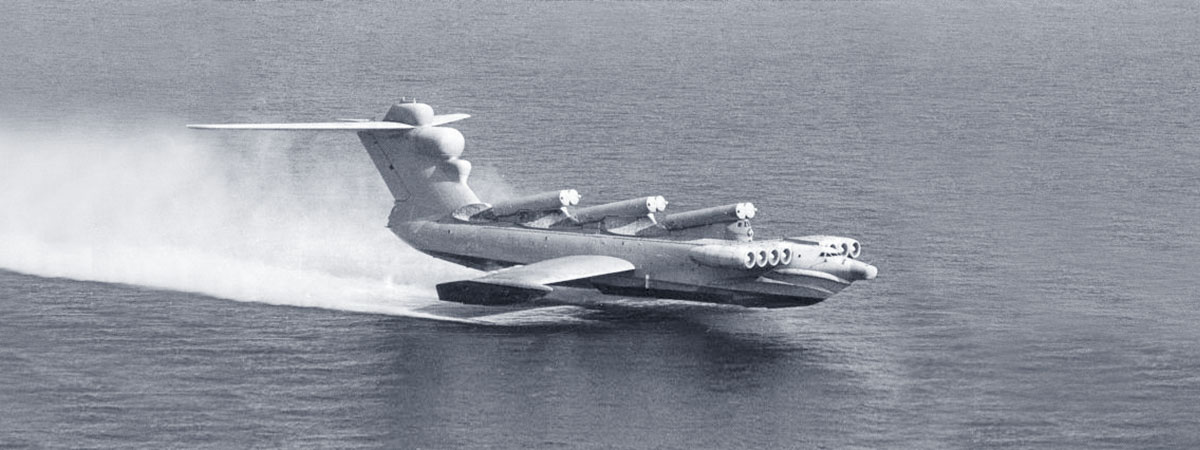
In 1967, an American spy satellite took pictures of a huge aircraft flying over the waters of the Caspian Sea. It had 106 metres long, 42 metres wingspanIt weighed 544 tonnes and travelled at over 400 kilometres per hour. Nothing like it had ever been seen before, so when it came to light, the Western press dubbed it the the Caspian Sea monster. The KM (Russian for test ship) was one of the most secret Soviet military projects.
The Ekranoplano was an aircraft concept that did not come to fruition, but which provided a novel aeronautical approach by exploiting ground effect.
The object that alarmed the Americans so much was developed in a protected area of Russia with the intention of improving speeds achieved in the shipping industrywhich were relatively low due to water resistance. Russian engineers led by Rostislav Alekseyev devised a kind of underwater wing that they placed on the ships in such a way that it would push the ship over the water when it was fast enough. It was a breakthrough, as with this new design the friction caused by water was radically reduced.. Once at cruising speed, the aircraft maintains no contact with the water and is able to fly over obstacle-free terrain regardless of its nature (snow, ice, land), although it again requires water to slow it down and stop. Before long, high-speed aircraft with underwater wings were flying over the seas and lakes of the Soviet Union.
Alekseyev was obsessed with speed, his aircraft were capable of speeds of 100 kilometres per hour (55 knots) but to achieve higher speeds he knew he had to get them out of the water. So he began researching the ground effectan aerodynamic phenomenon that generates a high-pressure zone under the wings when they are close to the ground that increases lift. He concluded that the ideal height was to fly in a range between 30 centimetres and 3 metres above the water.
By applying this phenomenon, they could design an amphibious vehicle to travel over water and land. Alekseyev managed to convince the Russian government to support his project, which sought a device that would give the Soviet Union superpower status at sea. To achieve this, the new ship would have to be large, powerful and capable of high speeds. The ekranoplano, the ground effect vehicleThe new report, which was published in the Official Journal of the European Union, met all the requirements.
For its design, as this type of aircraft did not previously exist, the engineers had to build a special wind tunnel to test the models. The next step was to find a suitable location to test it, but this was no easy task, as they needed a place far from cities and with a large expanse of water where they could carry out high-speed manoeuvres. In the end, the KM took four years to build.
During the Cold War, the development of new military equipment was kept in the strictest secrecy. In fact, for the first test conducted in the Caspian Sea in 1966, the fuselage of the KM ekranoplane was secretly transported to the Volga River, its wings carried separately and it only moved at night. It took a month to complete the transport to the test site.
Ironically, the ekranoplane remained a mystery only to the Soviets themselves. In 1967 US Defense Intelligence Agency analysts met to try to find out what was hidden in the images they were receiving from the satellite, and came to the conclusion that the machine could not fly..
The Caspian Sea Monster was the prototype for all ekranoplanes. The Soviet Navy saw interesting properties in them, such as carrying troops and equipment to the combat zone while evading minefields or carrying out surprise attacks, since at that altitude it was invisible to radar.
In 1974, one of the Ekranoplanes designed for assault missions, the Orlyonok, was testing in rough seas when a wave hit its fuselage, causing major damage. At the time, the designer Alekseyev was on board and took the controls himself, guiding the aircraft safely back to base. Engineers were forbidden to fly test aircraft because of the risk to their lives, but Alekseyev broke this rule several times in order to get a first-hand feel for how his aircraft operated. In fact, this accident was used as an excuse to fire him as head of the design engineering team.
In the mid-1980s a new administration took control of the Soviet weapons department and decided to divert resources from the ekranoplane programme to atomic submarines.
Russia is currently manufacturing a small civilian ekranoplane for transportthe Aquaglide. Other countries such as Germany, China and Korea have been encouraged to produce ground effect aircraft, but their ekranoplanes have not been able to reach the level of reliability of the models developed by the Russians.
The United States also designed its own ground effect aircraft: the Boeing Pelican ULTRA (Ultra Large Transport Aircraft). It was a huge transport aircraft that would become the largest and heaviest aircraft ever built: 1270 tons of cargo, 2 decks, carrying 190 standard 20-foot containers or 17 M1 Abrams tanks,122 metres in length, 152 metres wingspanThe wing area is 4000 m2, low altitude range 10000 nautical miles, high altitude range 6500 nautical miles, take-off distance 2200 metres, flight altitude in economy mode from 7 to 17 metres at 10000 miles range, maximum flight altitude 6000 metres at 6500 miles range, cruising speed 445 km/h and a maximum speed of 600 km/h.
However, the project was cancelled due to the tremendous investment required to be able to finalise the development of an operational product due to the scale of the aircraft and the use of high-risk technologies.
This time the Russians had won the game.