When we visit the airport and see the different aircraft arriving and departing, are we able to locate the aircraft that are arriving and departing? source of energy what moves them? In every aircraft, housed in its wings, are part of the 360 billion litres of fuel emissions that IATA estimates were consumed during 2019 on commercial flights alone.
For some years now, a major effort has been made to develop renewable alternatives for aviation fuels that are also viable.
At the end of World War II, most jet fuels were kerosene-based. In the following years, the details of the specifications were adjusted to ensure the availability of compatible fuels worldwide.
The paraffinobtained from the distillation of natural petroleum, is the main fuel component of commercial jet aircraft, under the designations of Jet A y Jet A-1.
The former is only supplied in the United States, following the indications of its own ASTM standard, Jet A-1 is the standard fuel used worldwide.. It has a flash point above 38°C and an ignition temperature of 210°C, so it is considered safe enough for use in large aircraft.
To further enhance its features, additional features include additives to fuel. With them, for example, the aviation fuel is prevented from being electrically charged or, if it burns, it burns uncontrollably.
Other additives achieve lowering its freezing point to -47°CThis eliminates the risk of fuel freezing, which is important to bear in mind as the air temperature at cruising altitude is usually below -30°C.
Finally, it is worth mentioning the use of additives that prevent the growth of organisms in aviation fuel and the formation of turbine deposits.
In particular, it is very important that jet fuel is free of water.. In most commercial aircraft, the engines are located under the wings, with fuel flowing under gravity to feed them. If the dissolved water precipitates and freezes due to low outside temperatures, it can become denser and block the fuel inlet valves.
To ensure the quality of the fuel, the following are carried out inspections to it, checking that the above-mentioned characteristics are complied with throughout the manufacturing, transport and storage process.
At civil aviationInstead of paraffin, it is operated with the aviation gasolinealso known by its acronym AVGAS. It is intended for use in reciprocating engines used in sport and private aircraft. This petrol can be distinguished from non-aeronautical engines by the stability, safety and performance it offers.
The options available in fuels for military use are much wider. Typically, military fuels offer better anti-corrosion and anti-oxidant properties than those in civilian use.
A common fuel in this area is Jet BIt is a blend of approximately 65% gasoline and 35% paraffin. It is intended for use in regions with particularly low temperatures, as it has a freezing point as low as -72°C and a flash point of 20°C, which makes it more flammable. However, the engines in which it is to be used must be adapted for this purpose.
The use of some types of fuels can become very specific, as is the case for fuels intended for aircraft housed on aircraft carrierswhere the risk of fire is particularly high. Therefore, are manufactured with a higher flash pointwhich also makes them more expensive.
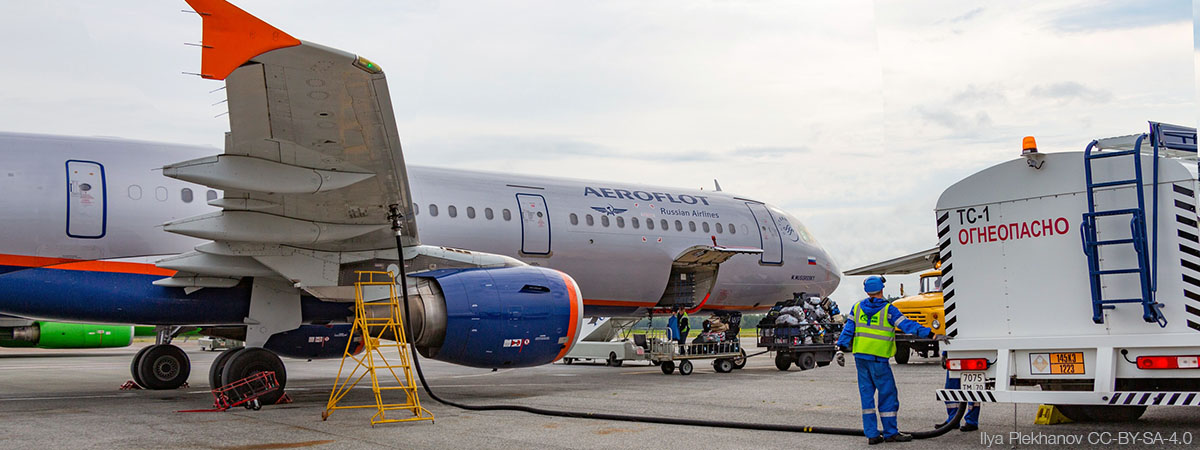
Extreme examples of this specialisation would be F-76, a fuel for ships powered by state-of-the-art turbines; TS-1, a Russian variant based on its own standards, which offers better performance in cold climates; or JPTS (Jet Propellant Thermally Stable), designed for high-altitude flight, such as that of the Lockheed U-2.
However, this trend towards the use of oil derivatives is set to change in the near future.
From the point of view of resource availability, between 2003 and 2008, the price per barrel increased by about five times. This set a horizon in which world oil production would be unable to meet the demand of the aeronautics industry.
Looking back, paraffin consumption has continued to increaseThe increase in air traffic is expected to increase by 30% over the last 10 years according to IATA data, in line with the increase in air traffic recorded worldwide.
Although the price of a barrel of paraffin has been falling for some years, as a fossil fuel product it will become more expensive in the long term. The fact that there are few alternatives to oil for aviation fuel increases the urgency of finding solutions.
This is why, for a number of years now, a race has been underway to in search of renewable alternatives. One of the options available is biokerosene, the name of which covers both those blends in which it is the sole component and those in which it is blended with traditional paraffin.
Ideal candidates as feedstock for biokerosene generation are different species of algae, but this option is still under development. In the short term, the use of vegetable oils is being considered.
However, developments in the use of new fuels pose a problem both in terms of implementation time and economics, as the introduction of some of them requires complex modification of aircraft engines.
On the other hand, with regard to environmental protection, the use of substances that improve this aspect is planned, such as the paraffinic paraffin synthetic fuels. This mixture is produced from sugar, corn, or forestry harvest residues, and according to the FAA could reduce greenhouse gas emissions by up to 85%. Measures such as this will improve air quality around airports, which is of particular interest for airports located in the centre of large cities.
It is only a matter of time, decades at most, before the industry undergoes these changes. The positive point is the global readiness for changeThe EU's commitment to the environment, as institutions, airlines, fuel producers and research centres, such as universities, work together to ensure that the alternatives arrive on time and as efficiently as possible.