Since the dawn of mankind, we have experienced a constant quest to overcoming which has been reflected in increasingly improbable feats. Aeronautics is possibly one of the fields where this is most evident. It is the essence of progress: faster, taller, bigger, more electric, more efficient...
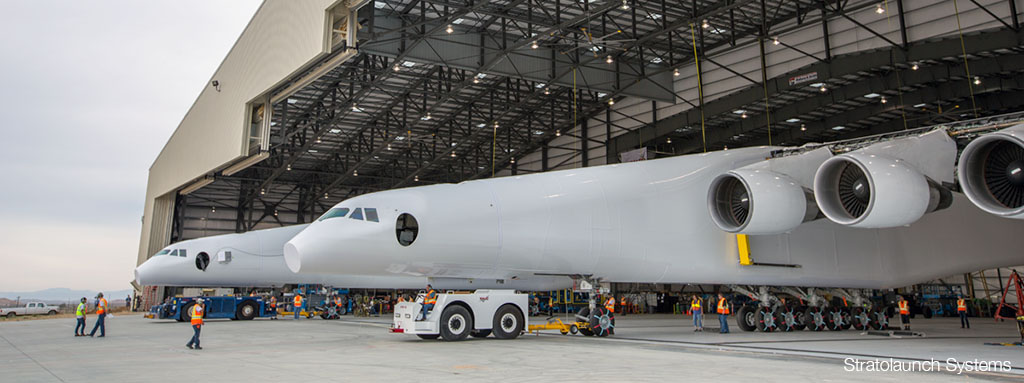
Even today we are impressed when an Antonov An-225, the world's largest aircraft currently in service and with an extensive collection of records in the Guinness Book of Records, appears before our eyes. However, a larger and more powerful aircraft has now entered the scene: the Stratolaunch.
Its purpose is not, at least in principle, to carry passengers or heavy loads, but is intended to putting payloads into Earth orbit at low cost which can be up to 70% less than what is charged today for a conventional launch using traditional rockets.
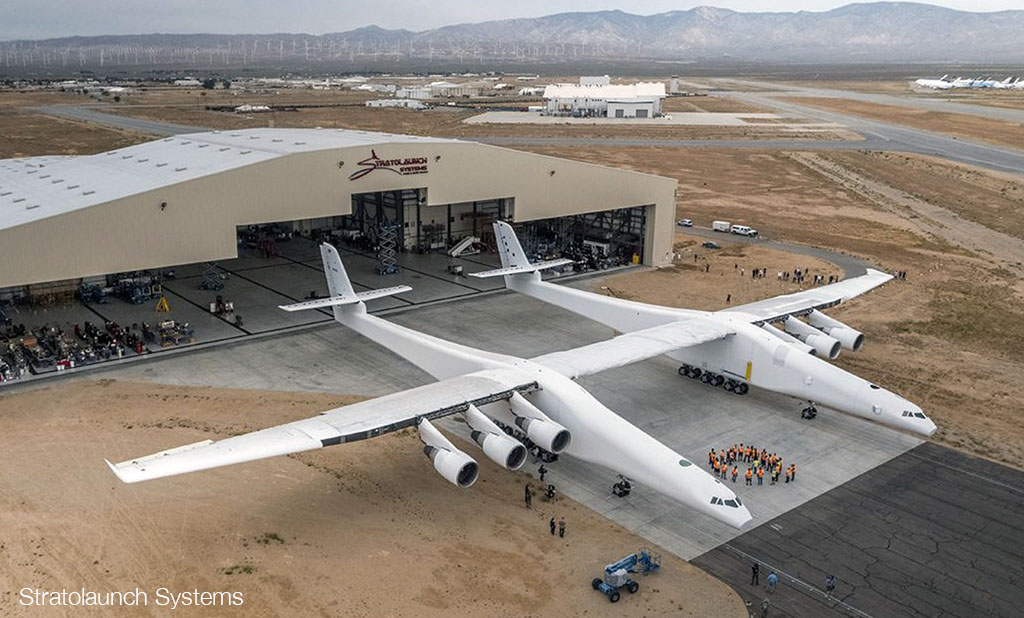 The company that builds this huge aircraft, Stratolaunch Systems Corporation (Vulcan Aerospace), is owned by Microsoft co-founder Paul Allen, who joins the ranks of other technology entrepreneurs who have also set their sights on space.
The whole story started in 2010 with the first approaches for a future cargo aircraft that would standardise access to the low Earth orbit and which is expected to support NASA missions. In 2011 Paul Allen teamed up with engineer Burt Rutan (Scaled Composites), who had previously been involved in the development of Virgin's SpaceShipOne. This was followed by the purchase of two used Boeing 747s from United Airlines with the aim of cannibalising them, especially engines and electronics.
The result has been a huge aircraft with two cabins joined by a wingOne of which (right) will carry the crew, while the other (left) will house the flight systems. It has a wingspan of 117 metres (more than the length of a football pitch), length of 72 metres, height of 15 metres and an unladen weight of 227 tonnes. It will be powered by six engines taken from the aforementioned Boeing 747s. Composites have been used in a significant percentage of its construction. According to the company, it will be able to take off with a payload of 590 tonnes (MTOW), although it will require a runway of at least 3.6 kilometres long, which it will cover with a set of 28 wheels.
Indeed, Paul Allen's goal of making the currently costly access to low Earth orbit routine is closer to becoming a reality.