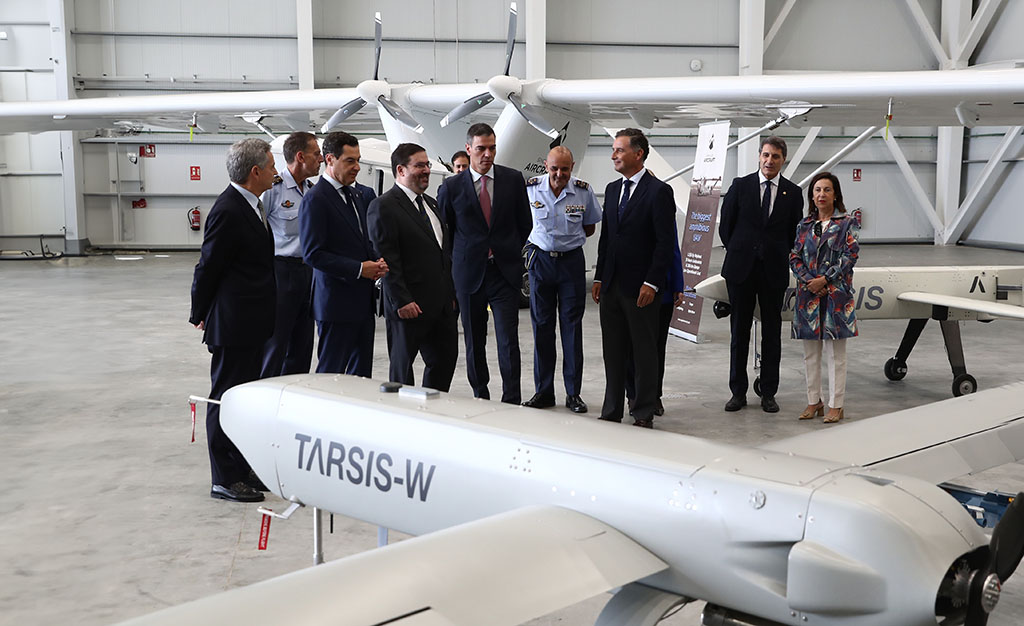
TARSIS ha estado presente en el acto de inauguración, en Moguer (Huelva), del Unmanned Aircraft Research and Test Centre -known as CEUS-, donde estuvieron expuestas para la ocasión las plataformas aéreas de ala fija de mayor tamaño, TARSIS ISTAR y TARSIS-W. AERTEC ha estado involucrada en el diseño del campo de vuelo del CEUS desde los orígenes del proyecto y se ha sumado al interés mostrado por otras grandes empresas para el uso futuro de sus instalaciones.
The inauguration was attended by the President of the Spanish GovernmentPedro Sánchez, the President of the Junta de AndalucíaJuan Manuel Moreno, the Minister of DefenceMargarita Robles, the Secretary of State for DefenceAmparo Valcarce, and the director of the National Institute for Aerospace Technology (INTA)General Julio Ayuso, as well as other civilian and military authorities and officials of INTA and of the CEDEA. AERTEC was represented at this event by its CEO and founder, Antonio Gómez-Guillamón, who was accompanied by Pedro Becerra, General Manager of the Aerospace and Defence Systems Division, Ignacio Barandiarán, Defence Advisor, and Rafael Márquez, Operations Director.
The CEUS project is part of the CEDEA -Centro de Experimentación de El Arenosillo-.located only a few kilometres away, and both are now becoming Europe's best Centre of Excellence for Unmanned Systems (UAS, RPAS, drones) and an international benchmark for unmanned vehicle experimentation. AERTEC's CEO, Antonio Gómez-Guillamón, explained first-hand to the authorities the capabilities of these TARSIS, with a take-off weight of 95 and 120 kg, suitable for dual-use intelligence, surveillance and reconnaissance missions.
"The Spanish aerospace industry has a growing specific weight in the sector thanks to the development of cutting-edge and innovative technologyThe EU is increasingly present and playing a key role in the developments taking place across Europe. We believe that the UAS TARSIS family is a clear example of the capabilities we have in Spain to develop unmanned aerial systems, addressing the entire design and manufacturing cycle, as well as the technological solutions that accompany them, marking the future of the sector," said Gómez-Guillamón.
The CEO of AERTEC, who is also President of the Andalusia Aerospace Cluster, took advantage of the inauguration to congratulate those responsible for INTA CEUS, as well as the entire Spanish and Andalusian aeronautical industry, on the start-up of these facilities, which are destined to become a benchmark in Europe. In this respect, Pedro Becerra pointed out that "the new runway and facilities that house the CEUS centre for large-scale fixed-wing aircraft operations will be strategic, not only for certifying new capabilities of unmanned aerial systems in the future, but also so that the new centre can become a reference point in Europe. Andalusia can host European programmes such as Eurodrone or FCAS, thanks to unique infrastructures such as those of this project".
AERTEC's role
AERTEC colabora desde hace varios años con el Instituto Nacional de Técnica Aeroespacial (INTA) en sus instalaciones del Centro de Experimentación de El Arenosillo (CEDEA), donde ha realizado ensayos y campañas de vuelo para el desarrollo original de las plataformas aéreas no tripuladas.
AERTEC's Airports division played a key role in this project from its conception, not only because of its knowledge of high performance UAS operations, but also because it participated in different phases as a company specialising in the planning and design of airfields and airport infrastructure. conceptual design of the airfieldwhich was designed to develop and test any type of UAS, regardless of its dimensions.
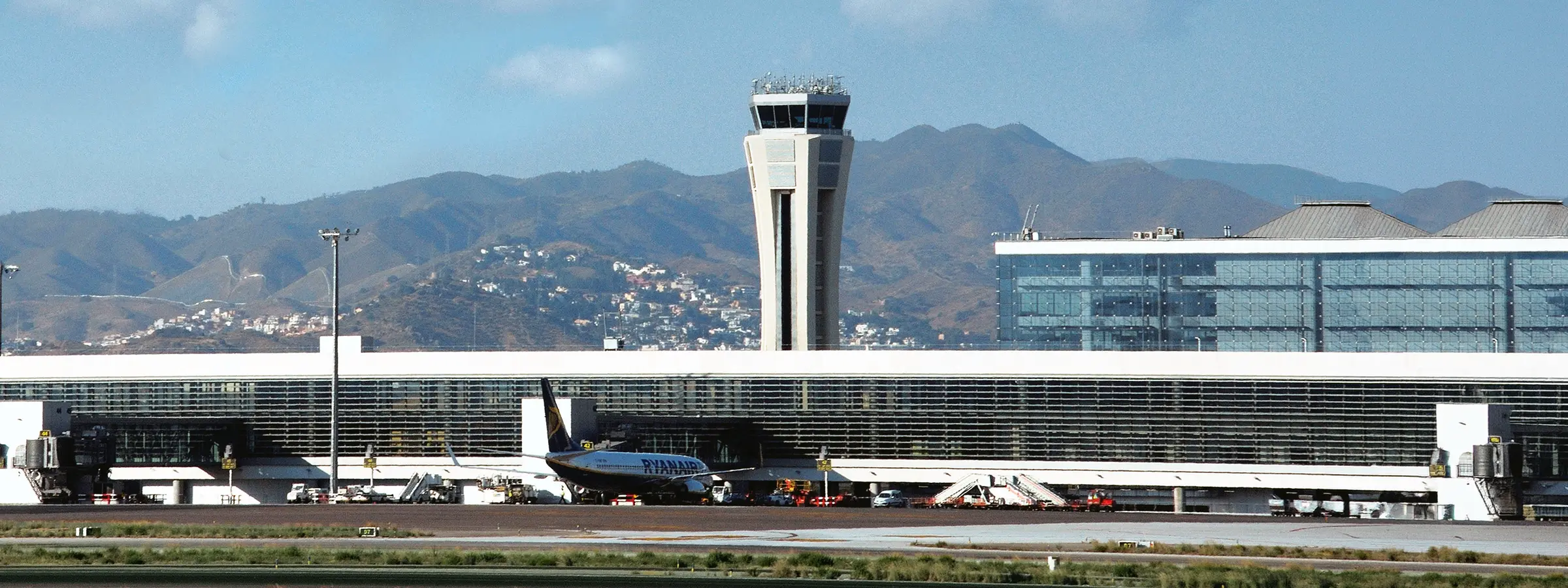
The CEUS UAS Test Centre is conceived as a facility for the performance of advanced testing of MALE (medium altitude, long endurance) and HALE (high altitude, long endurance) UASs. Cuenta con una pista pavimentada de 2.000 m x 45 m, una plataforma equipada con hasta 4 lugares para el establecimiento de estaciones de tierra, dos hangares y un edificio multifuncional. Además, también cuenta con instalaciones auxiliares, de mantenimiento, de suministro de combustible, de seguridad, etc. Gracias a su complementariedad con INTA-CEDEA el centro está autorizado para hacer uso de una de las áreas de vuelo restringidas más grandes de España, con salida directa al océano Atlántico y sin límite en altura.
IMPORTANT NOTE: References to texts and graphic content relating to the TARSIS solution are merely reviews of the historical trajectory of projects carried out by AERTEC in the past. Currently, TARSIS is not a product owned by AERTEC, nor does AERTEC conduct business as an OEM.