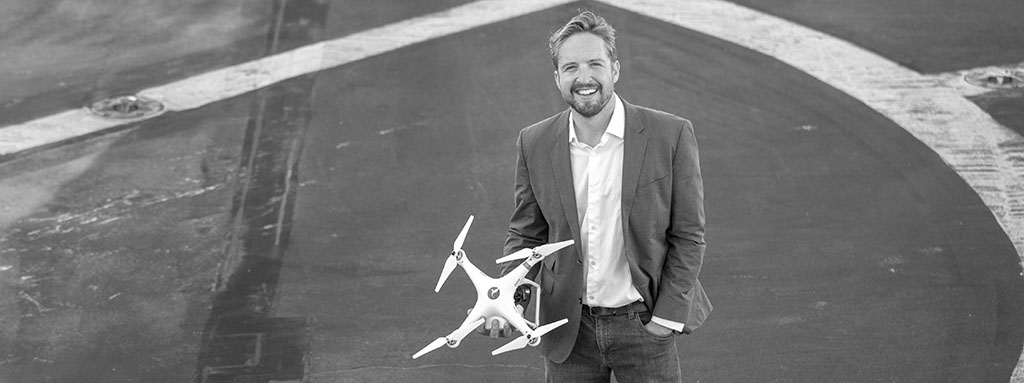
Jonathan Evans is the President of the Global UTM (*) Association, a non-profit organisation based in Lausanne, Switzerland. He represents organisations in 15 countries and 7 activity groups: Air Navigation Service Providers, UAS manufacturers, UAS operators, UTM software providers, infrastructure providers, regulators and academic experts.
"It is important that the industry provides governments and drone operators with a unified vision and interoperable tools.

The Global UTM Association was officially established in July 2016 in Lausanne. Why did the need arise to create such an institution in Switzerland?
There had previously been an international conference in Geneva, also in 2016, which brought together air navigation service providers, civil aviation authorities, drone manufacturers and telecommunications infrastructure operators, as well as data and software providers, to discuss the development of UAS (unmanned aerial systems) traffic management. At the end of the meeting, and despite the common objectives, it was clear that each participant understood UTM (Unmanned Aircraft Traffic Management) in a slightly different way. It is important for the industry to provide governments and drone operators with a unified vision and interoperable tools. This is where the idea of creating the Association was born. We chose Lausanne as the venue because of its proximity to EPFL, a leading technical university specialising in robotics.
What are the main objectives of the Association?
We have 3 main objectives for 2017. First, to publish a high-level UTM architecture by the end of March. This roadmap will allow us to share a common UTM concept and language. From there, we can move on to the two other key aspects: drone registration and data sharing. Registration is the first step in identifying drones in flight. It is essential for public safety and acceptance, as well as for any networked infrastructure, that we know what is flying over us. The exchange of data (the common protocols by which these systems communicate) will be invisible to almost everyone but will allow drone operators easier integration with UTM-compliant systems for air traffic management worldwide.
What can we expect from the General Architecture Working Group?
UTM does not consist of a single piece of equipment or a single piece of software, but rather a set of tools and stakeholders that interact with each other to inform pilots about flight conditions, authorise operations and track drones. As a system of systems. The General Architecture Working Group defines the different parts involved and their roles.
Switzerland is developing a truly remarkable commercial drone cluster and investing heavily in R&D projects in the sector. Are you aiming for a leading position in Europe?
Yes, indeed. Swiss universities have done a great job in promoting the transition of the sector. NCCR Robotics, a national centre composed of multiple research groups spread across Switzerland, has been crucial for the development of the ecosystem. Highly innovative companies such as senseFly, Flyability, Verity Studios, Fotokite and others have benefited from Swiss research support. These companies do not compete with DJI in the prosumer space (producer + consumer). They target very specific audiences. Swiss companies have always proven to be considerably stronger in responding to business versus consumer needs.
What is the current Swiss legal context regarding drones?
Swiss regulators have taken a very pragmatic and flexible approach to drones. They have devised a risk-based philosophy that allows many operations to take place, as long as they do not pose a danger to people or infrastructure, in the air or on the ground. They also enforce existing privacy legislation, for example, rather than creating new drone-specific laws. This favourable environment has undoubtedly played a key role in the development of the drone industry in Switzerland.
Does the Global UTM Association consider the search for a balance between private and public funding as one of its main functions?
The Global UTM Association has a non-profit professional character and, as such, must be funded by industry. We do not rule out applying for grants if we believe we can add value to a public project, but the Association must always retain the ability to function without public funding.
The Global UTM Association attended the Global Robot Expo robotics fair in Madrid, what was the main purpose of its participation?
The Global Robot Expo in Madrid was a great opportunity to meet and exchange ideas with experts related to UTM in other sectors. We cannot work in isolation. Drone traffic management is part of a much larger trend. Whether they operate on land, in the water or in the air, we are going to see more and more intelligent robots around us. Some refer to this phenomenon as the Internet of Things on the moveothers such as autonomous vehicles.
(*) UTM is the acronym of Unmanned Aerial System Traffic Management o Unmanned Aerial Systems Traffic Management.