Ana Laverón is Professor of Spacecraft at the University of Barcelona. ETSIAE (Escuela Técnica Superior de Ingenieros Aeronáuticos y del Espacio de la Universidad Politécnica de Madrid) and Director of E-USOCThe European Space Agency's (ESA) Spanish Operations and User Support Centre.
"The International Space Station is a key element in research into the effects of microgravity and space radiation on people, living organisms and space systems, so I think it will continue to operate for a long time to come.

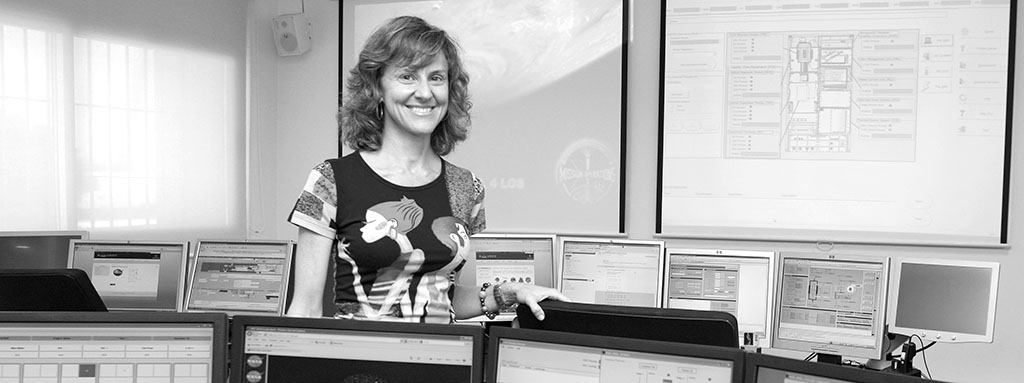
Since 2006, he has headed the E-USOC, the European Space Agency's Spanish Operations and User Support Centre. Where has his research been directed over the years? What projects are you currently working on?
In the group we have several lines of research, one of which is very well established on the stability of free-fluid interfaces, within which we have recently been able to carry out an experiment in a parabolic flight campaign to study how to orient the liquid/gas interface by applying vibrations. We are currently analysing the results obtained. In addition, in this same line, we are collaborating with other European groups to study various instabilities in the dynamics of fluid surfaces subjected to vibrations. Another line we have been working on in recent years is the attitude control of satellites using fuzzy logic, which is a type of control that is not yet used in space missions, but which is used to control simple devices on the ground. A third important line in the study of the application of phase change materials in microgravity conditions for the thermal control of satellites. We recently conducted experiments in a parabolic flight campaign on this topic, and are now analysing the results, and studying more complex configurations.
In addition to the above, we have operated 13 fluid physics and metal alloy solidification experiments on the International Space Station in the last 10 years. Of these, 7 have been operated in collaboration with NASA, within their Microgravity Science Glovebox (MSG) laboratory. The rest are at ESA laboratories in Columbus.
Spanish research in the aerospace field continues to contribute a great deal to international-level projects, despite the lack of resources for R&D&I...
The level of Spanish professionals and researchers in the aerospace area is very high, thanks to which we have an excellent reputation that allows us to continue working on international projects.
Particularly in the area of Space, we are fortunate to be able to collaborate with many international groups through the European Space Agency (ESA). The existence of ESA and Spain's participation in its programmes opens up enormous possibilities for collaboration. But it is necessary to increase investment in its programmes, as there is a lot of untapped potential.
In addition, it is necessary to increase investment in research through the National Plan, which has suffered brutal cuts since the beginning of the crisis. Scientific groups are at a clear disadvantage compared to the level of resources available to our European colleagues. So far, an enormous effort has been made to maintain active lines of research, but the results cannot be maintained if the situation is not reversed.
Spain is becoming increasingly important in the space sector. Do you think it is necessary to create a Spanish Space Agency in the future?
Undoubtedly. Spain has a weight in the European space sector that makes it essential to create a Spanish Space Agency to defend the interests of the Spanish sector against those of other countries that do have a Space Agency. It is necessary to have clear and sustained policies over time, and for this a body of this type is necessary.
We have been hearing for some time that it is going to be created, but it never arrives, and it is increasingly necessary, because this is a sector that is clearly expanding.
The ETSIAE is one of the best university centres for the training of aerospace engineers in Europe, with great projection in a sector that increasingly demands this type of profile. What differentiates an aerospace engineer trained at the ETSIAE from other universities?
At ETSIAE there has always been greater academic rigour and training in fundamentals than in most other European universities in the sector. This greater theoretical rigour means that engineers graduating from ETSIAE are better able to tackle new problems with guarantees of success. In addition, this mastery of the fundamentals makes greater innovation possible.
In 2009, you became the first woman to hold a chair at the School of Aeronautical and Space Engineering, which was a real milestone. The gender imbalance is sadly common, especially in engineering degrees. Have you seen the number of female students in your classrooms grow over the years? What advice would you give to young women who want to start this type of studies?
Yes, since I joined the school, the number of female students has increased, but I think the increase is much smaller than it should have been. The percentage of female students in the school is around 20%, which is clearly insufficient, because it indicates that a lot of female talent is being lost.
I encourage young women who are interested in this area not to be swayed by statistics, but to do what they really like. They are just as capable as their peers to succeed in engineering.
But, what I believe is that it is necessary to transmit a message of equality from the beginning of school education, and a huge effort must be made to put an end to sexist messages in advertising. Without that, change will be very difficult.
It has also successfully led several research and experiments for the International Space Station, which is the best example of international cooperation in the field of space, and which for the time being will continue to operate until 2024. What do you think will be its future after that date, and how could its hypothetical disappearance affect aerospace science?
The lifespan of the International Space Station has been extended numerous times over the years, which means that the necessary maintenance has been carried out to keep it operational. This maintenance has included significant changes to the Station.
I believe that, at the present time, the Station is an essential element in research into the effects of microgravity and space radiation on people, living organisms and space systems, and I think it will continue to operate for a long time to come. At some point, the Station will cease to be used as a space science laboratory, but I hope that this will be because another system has been identified to replace it. I am convinced that the Station will not be decommissioned until a system capable of meeting the R&D needs it offers has been put in place.