Colombia plans major airport upgrade: Master Plan 2055 will transform José María Córdova into one of the most modern hubs in the Americas
El Aeropuerto Internacional José María Córdova (SKRG), principal terminal aérea de Antioquia y segundo aeropuerto más importante de Colombia, se prepara para una transformación sin precedentes. La Aeronáutica Civil, junto con AERTEC Solutions y ESI Consulting —estas dos últimas agrupadas en el Consorcio Aeropuerto Rionegro 30— ha concluido la actualización del Plan Maestro 2055, un documento que redefine la infraestructura, la capacidad y el rol estratégico que tendrá este aeropuerto en el panorama continental.
A project that comes at the best possible time for Latin American aviationa
Latin America is experiencing one of the strongest periods of aviation growth in the world. Recent reports from ALTA and ICAO confirm that the region has already exceeded pre-pandemic traffic levels and is maintaining sustained growth — above 8% annually in several markets — thanks to the expansion of the low-cost model, the opening of new routes and operational modernisation.
Colombia, in particular, has become a regional benchmark. In 2023, it exceeded 50 million passengers carried, reaching historic figures and consolidating itself as one of the most dynamic markets on the continent. In this context, José María Córdova emerges as a key hub connecting South America with North America and the Caribbean, reinforcing its role as Antioquia's strategic gateway to the world.
An efficient airport that has already reached its operational limit
The Master Plan's diagnosis is clear: although the airport operates at high levels of efficiency, the current infrastructure has fallen short in the face of rapid traffic growth. The 3,440-metre runway, the apron with 24 positions and the 17 boarding bridges are saturated at peak times, especially with wide-body aircraft. The passenger terminal —27,500 m²— shows congestion in critical processes such as check-in, security screening and baggage delivery.
The baggage handling system (BHS) operates at its maximum capacity, handling 2,400 bags per hour, and internal road access is regularly congested. The cargo terminal, although efficient, requires greater refrigeration capacity and a specialised logistics centre, which is vital for flower exports, accounting for more than 90% of the airport's international cargo.
Growth towards 2055: an airport for 42 million passengers
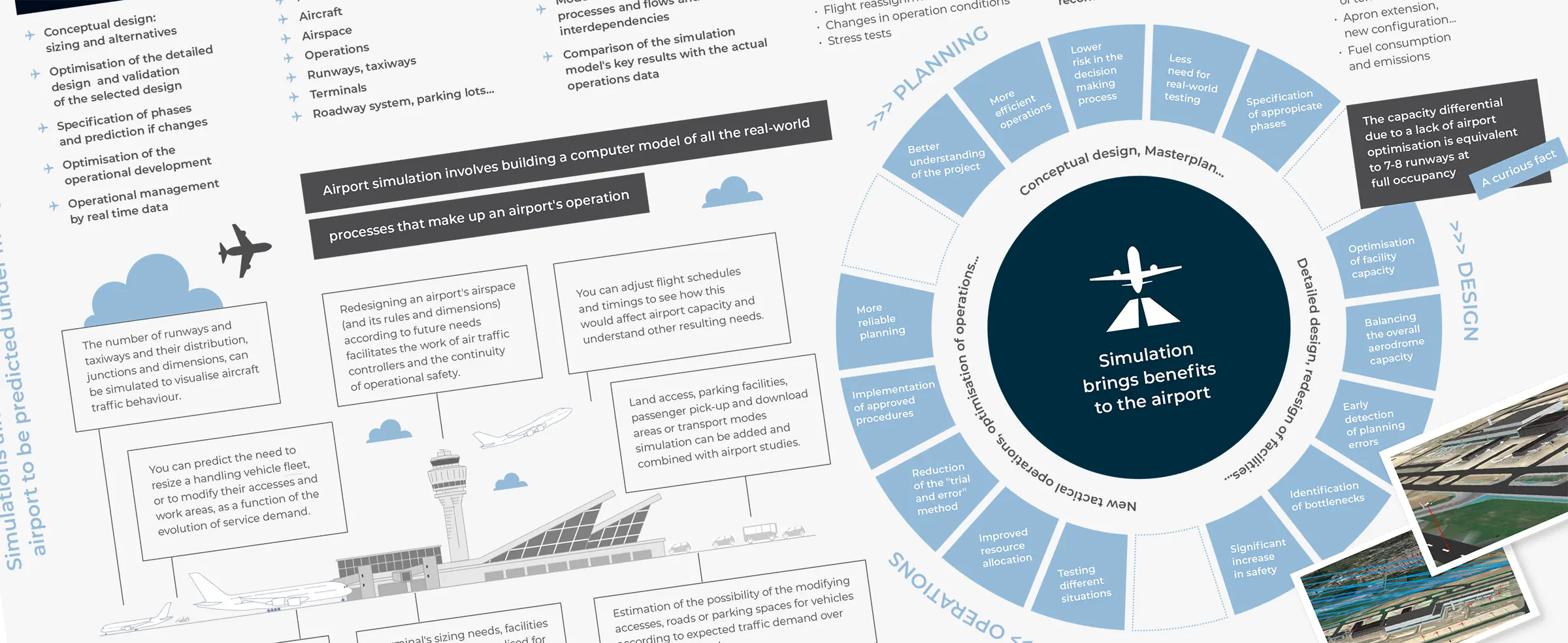
The demand studies used—bottom-up and top-down models, AirTOP simulations, and FAA methodologies—project average annual growth of 4.5% in passengers and 3.5% in operations. José María Córdova will grow from 14 million passengers in 2025 to 42.7 million in 2055, exceeding 200,000 tonnes of cargo transported per year.
Growth will be driven mainly by connectivity with North America and South America, which will account for 70% of new flows. In the domestic market, routes such as Bogotá, Cali, Cartagena and Barranquilla will continue to see the highest demand, while low-cost airlines and new regional operators will expand supply.
The 2055 Master Plan defines a progressive evolution in three phases:
Phase 1 – Up to 22 million passengers
Operational improvements to the current terminal, expansion of platforms, new fast exit lane, road improvements and acquisition of land for the next phase.
Phase 2 – Up to 30 million passengers
The most decisive stage:
- New 4,000-metre parallel runway (RWY 01R–19L).
- New 268,500 m² midfield terminal between runways.
- New commercial and freight platforms.
- New control tower, SEI station and complementary services.
Phase 3 – Up to 42 million passengers
Final expansion of the terminal, development of an advanced logistics area and creation of a vertiport for urban air mobility, integrating emerging technologies.
The future terminal between runways will have 87 parking positions, 31 of which will be contact positions, fully segregated flows, biometric systems and APM connection. Its design incorporates energy efficiency and water management criteria to ensure operational sustainability.
A project that repositions Colombia on the airport map of the Americas
The estimated CAPEX amounts to 21.6 trillion pesos (2024 values), distributed among land acquisition, terminal and access works, platform, runways and auxiliary systems. Land-side works account for 55% of the budget, while air-side works account for 22%. Due to the complex topography of the surrounding area, earthworks constitute one of the most significant components of the total cost.
José María Córdova will not only expand its capacity, but also strengthen the national airport network, boost the economy of the San Nicolás Valley, and promote interoperability with Olaya Herrera Airport and future advanced air mobility systems. The study's final recommendations include optimising land access, strengthening environmental criteria, and managing growth in stages according to actual demand.
At a decisive moment for Latin American aviation, the airport will take a leap forward that will position it as one of the most modern, efficient and strategic hubs on the continent, ready to respond to the technological, operational and commercial demands of the next three decades.
Key topics related to this news item: