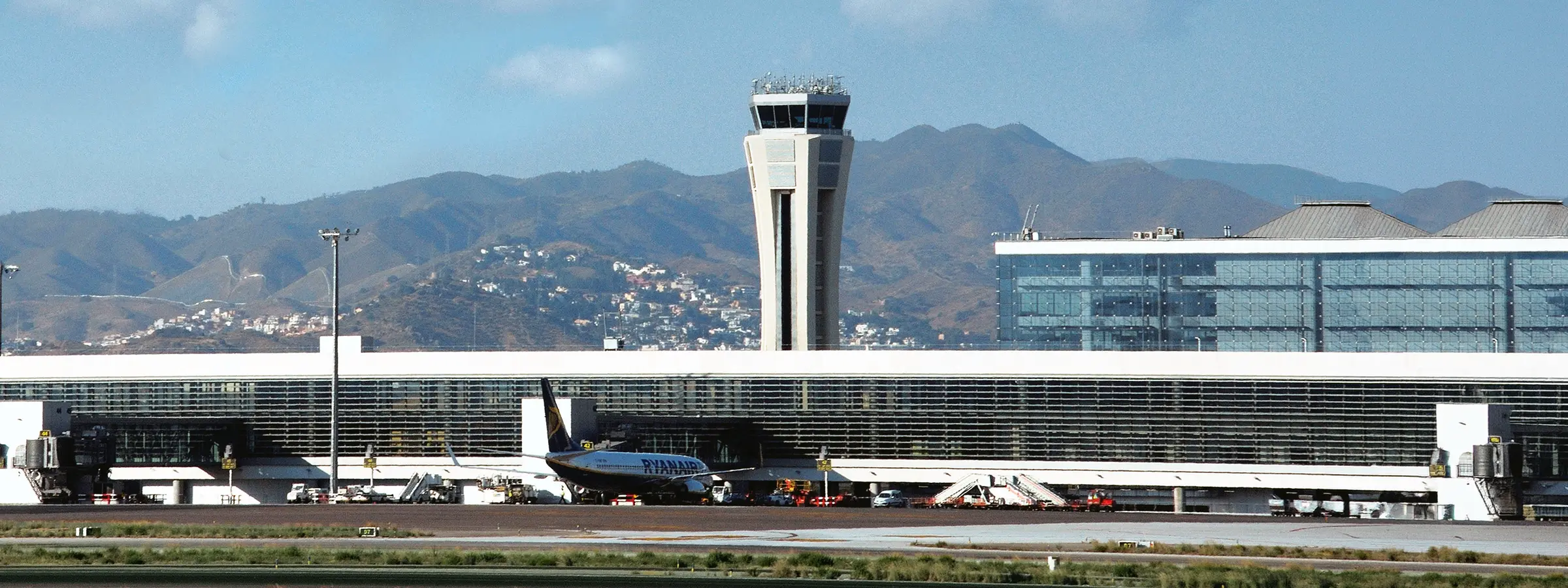
If we look north from Malaga, approximately 1,800 kilometres away, we might well be able to glimpse the keep of the castle of the town of Stafford, located on a small hill in the English countryside.
From here we can look out over much of the green horizons that make up the East Midlands. A place where the average monthly temperature ranges from 2 to 21 degrees Celsius, and rain falls almost every week of the year.
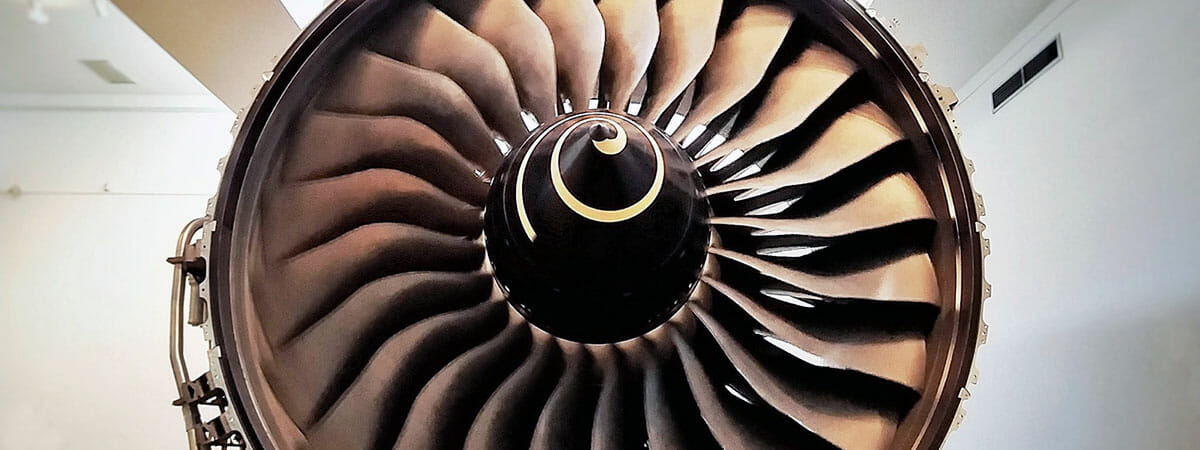
One of the first Trent 900 engines to be developed for the Airbus A380 is now on display at the Airports, Navigation and Air Transport Museum in Malaga. This is its interesting history.
It is this permanent rainfall that shapes the small streams that make up the River TrentThe UK's most important waterway, and the natural border between the north and south of England, is one of the most important in the UK.
Many attribute a Celtic origin to the toponym Trent, the meaning of which could well be "flood", something to which the people of Malaga are also accustomed by the river Guadalhorce.
In its course, curiously to the north, the River Trent flanks the town of Derbyimportant railway hub and Rolls-Royce company headquarters.
The Rolls-Royce company was founded in 1906 by Henry Royce and Charles Rolls, engineers, inventors and industrial entrepreneurs in the automotive world, and in the case of Charles Rolls also an aviator.[1].
In 1914, Rolls-Royce produced what was to become the its first aircraft enginethe EagleThe V-shaped twelve-cylinder combustion engine, capable of developing an output of 225 hp, equipped British aircraft in World War I.
Three decades later, in the 1940s, it left its factory the first production turboreactor, the RB.23 WellandThis was followed by new radial compressor and later axial compressor models.
At the end of the 1940s, the RB.80 emerged from the drawing boards, first axial flow turbofan and just over 76 kN of thrust.
The RB.80 definitely ushered in a new era in aircraft propulsion technology, transforming the original closed combustion cycle engines into the new continuous-flow engines.
To name the reactors, British engineers sought an allegory that would identify with the new propulsion technology, and found in the flowing of rivers the perfect metaphor for continuous-flow engines. From this concept were born the names of the Wellandof the Derwentthe Neneor the Avon.
In this case, it was the nearby river Conwy, a Welsh place name which in Anglo-Saxon diction is called Conway, that was used to christen the new design: the Conway. RB.80 Conway.
Half a century later, in the mid-1990s, new requirements from the aerospace industry, especially Airbus, came knocking on Rolls-Royce's door for to promote the design and manufacture of a new engine.
The new engine was to equip what was to be the largest commercial aircraft on the marketeventually christened the A-380. It was now the nearby Trent River that gave its name to a new generation engine family.
The Trent 900which is the case here, inherited the development of its predecessors, the 700, 800 and 500, and not only has it meant a scientific and technological challenge of the first magnitudebut also industrial. Rolls-Royce is joined on this frontier of propulsion know-how by the Spanish company ITP, Industria de Turbo Propulsores, which manufactures the low-pressure turbine; Hamilton Sundstrand, which produces the engine's electronic controls; Avio S.p.A., which produces the gearbox module; Marubeni Corporation, responsible for various components of the engine; Volvo Aero, which supplies the intermediate compressor cavity; Goodrich Corporation, which supplies the engine's electronic controls; and Volvo Aero, which supplies the intermediate compressor cavity, responsible for the gearbox module; Marubeni Corporation, responsible for various engine components; Volvo Aero, which supplies the intermediate compressor cavity; Goodrich Corporation, for various fan components and sensors; and US-based Honeywell, responsible for the pneumatic systems.
The programme also includes Samsung Techwin, Kawasaki Heavy Industries and Ishikawajima-Harima Heavy Industries, an example of the globalisation of international aerospace technology development.
The Trent 900
At 5478 mm in length and 2950 mm in diameter, the Trent 900 is a propulsion giant, a high bypass ratio turbofan (8.5-8.7:1), with an overall pressure ratio of 37-39:1, characteristics that allow it to achieve thrust between 300 and 400 kilo Newton. Its diameter is equivalent to the fuselage of a DC-9 aircraft..
The Trent 900 made its first power-up on 18 March 2003 and first flight on an A-340 flying test bed on 17 May 2004, obtaining EASA certification on 29 October 2004 and FAA certification on 4 December 2006.
His first flight in A-380 MSN001registered F-WWOW, was carried out on 27 April 2005.
Of the various engine types of the Airbus 380, the Trent is equipped with the 841, 842 and 843F models, all capable of a cruise speed of 0.85 Mach.
And of the many technological contributions of the Trent 900 perhaps the most important are the reduction of fuel consumption, NOx and noise emissions.
The fan's 24 titanium fan blades incorporate a new sweep design that reduces the effect of shock waves when the fan tip rotates at supersonic speed. In colloquial terms, they can withstand the equivalent force of hanging 9 buses on each blade.
The fan casing is also made of titanium, replacing the traditional Kevlar.
The LP (fan) compressor consists of one stage, the IP compressor of 8 stages and the HP compressor of 6 stages, feeding an annular combustion chamber.
The single-stage HP turbine is counter-rotating, which allows it to improve combustion efficiency by 2%The specific power consumption is 16 g/kN-s. The IP turbine is also single-stage and the LP turbine is five-stage.
The dry weight of the engine is 62
46 kg.
From Toulouse to Malaga
It was October 2005 when one of the British Trent arrived in the UK to the Airbus facility in Toulousewhere the brand new engine was mounted on one of the A-380 test aircraft that the European manufacturer had prepared, the MSN002.
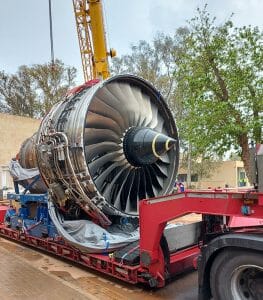 On 25 October it made its first test flight and in the following months it changed aircraft models (MSN002, MSN007, MSN002, MSN002, MSN004 and MSN001), as well as wing positions (from one to 3, to 2, to 3 and back to 2).
His last flight was on 3 July 2017.The company had 529 flights to its credit, as well as almost a hundred other ground operations, for a total of 1796 hours and 19 minutes of operation in its 724 ignitions..
After its final descent from the wing of MSN001, the engine was left to await a bleak future of disassembly for this jewel of 21st century engineering.
But chance, and above all the interest of a young engineer from Malaga, Álvaro Rojas Zamora, in this "old" propeller, opened up a future full of admiration in an aeronautical museum.
It was the first rainy days of autumn 2018 when the possibility was raised that the Trent 900 engine could come from Toulouse to Malaga.
A practically impossible project at the time, strangely enough. 100 years after another feat that had already aeronautically linked Toulouse to Malaga.
It was in 1918 that the engineer and industrialist Pierre Georges Latécoère imagined an airline that would fly from Toulouse to Casablanca, with stopovers in Barcelona, Alicante and Malaga.
The challenges were so considerable that the technicians consulted advised against the project, forcing Latécoère to utter a phrase that has become famous: "I have redone the calculations over and over again. The project is unfeasible. There is only one thing left: to make it possible..
It was with this same conviction that Álvaro Rojas, a Rolls-Royce aeronautical engineer, was the architect of the crazy proposal. On 30 November, he presented the British company with the first proposal to send the Trent 900 to the Malaga Museum.
At the same time, the first steps were taken in Malaga with the main Spanish aeronautical companies that could collaborate in the project to transfer the engine, but unfortunately they did not bear the desired fruit.
The whole of 2019 passed without the project being able to make much progress, and in March 2020 the COVID 19 pandemic brought the project and the whole world to a complete standstill.
Reactivated in the spring of 2021, Aena alone began the steps to make what still seemed to be a dream come true.
Reports, mails and calls marked the first half of 2021, until all the necessary mechanisms could be articulated between Rolls-Royce and Aena so that the acceptance, transfer and reception of the Trent 900 engine at the airport could take place. Malaga Airports, Navigation and Air Transport Museum possible.
A whole race of technological, logistical, construction, design, administrative, legal and, of course, financial hurdles lay ahead.
Over the course of more than six months, the tireless work of the Friends of the Museum Association, Aena professionals and Rolls-Royce technicians shaped what was still a dream.
Finally, more than three years after the start of the project, the Trent 900 was packed, fitted and secured to a special vehicle and on the morning of 7 April 2022 it set off for Malaga.
The last flight of the Trent
On Friday, April 8, against all odds, the company in charge of transporting the engine announced that it was in the middle of the Castilian plateau. If everything went smoothly, it would be in Malaga on the morning of Saturday the 9th, four days ahead of schedule!
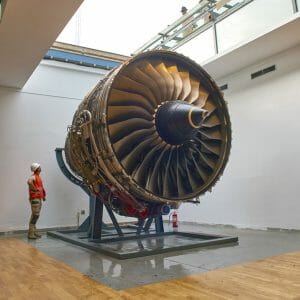 The reaction of the Friends of the Museum was swift, and in just a few hours the arrival of the engine was arranged, which made it possible for the huge special transport truck and its guide vehicle to enter the Museum square safely with its precious cargo.
On 12 April the activity started early at the Museum. At 7:00 a.m. the company BTG Construction and Engineering started the work of dismantling the roof of Hall 3. An hour later, two companies from Malaga joined in, Metal and Forging, y Raimundo Cranes and in unison the technicians of the British company Rolls-Royce Technical Support. All of them are the architects of the success of the project thanks to their professionalism and good work.
In a commendable joint effort during 10 uninterrupted hours, the Trent 900 was able to make what has been its last flight, to land in this unique Malaga museum on the banks of the Guadalhorce river.
Since this spring Malaga has a new cultural and technological gemBut beyond its public display for the delight of aeronautics enthusiasts, the main shared objective between Rolls-Royce and Aena is to promote education in science and technology, to bring aeronautics closer to young people and to inspire their creative work, tasks on which Rolls-Royce and Aena have been working for many years. Airports, Navigation and Air Transport Museum since its creation more than 25 years ago.
[1][1] Charles Rolls holds the tragic honour of being the first Briton to die in an aviation accident with a motorised aircraft, a Wright Flyer with which it flew near Bournemouth on 12 July 1910, and whose tail broke off in mid-flight.