Observing distant galaxies with a telescope from Earth, even on a clear night, is like looking at an object against the light and through a glass of dirty water. If you are lucky, you may be able to recognise the object, but you miss many important details.
Any telescope based on Earth is continually subjected to oxidation, humidity, dust, movements of the earth's crust, clouds, diffractions due to temperature changes at different heights in the air, deformations of the lens and its structure due to gravity, vibrations due to winds and temperature differences between day and night, etc. The The list of drawbacks is endless. To eliminate all these difficulties in observing the universe, it has been decided to send the telescopes into space, thus eliminating the bandage of the Earth's atmosphere and at the same time moving them as far away as possible from our gravitational field, thus providing a much more stable and benign environment for observation.
After the successful experience of the Hubble mission, which is still active, the James Webb will be a new milestone in space telescope technology.
The first space telescope was launched into orbit in 1968. It was the Orbiting Astronomical Observatory OAO-2 Stargazer launched by the United States (the OAA-1 did not become operational due to technical problems after launch). It was very rudimentary (4 television cameras) and therefore of limited observing capacity by today's standards, but tremendously ambitious for its time. This telescope captured Ultraviolet (UV) radiation which is largely absorbed by the Earth's atmosphere and therefore justified mapping space at that frequency. The OAO-2, despite its limitations, made several advances in astronomical models at the time (it showed that stars are actually hotter than previously thought, that comets are surrounded by gigantic clouds of hydrogen and that their nuclei are often made of ice) and, of course, it began to lay the foundations of space telescope technology.
The Hubble missionin 1990 was a new revolution in space science. It was finally possible to make observations with a much longer range due to the size of the telescope and in a wider range of spectra: UV, visible and Near Infrared (NIR). This mission has confirmed the age and expansion rate of the universe, the existence of black holes at the centre of most galaxies, the size and mass of the Milky Way, and so on. It has also had continuous upgrades and improvements that have allowed it to significantly extend its service time (such as the well-known intervention to correct the optical defects of its main mirror).
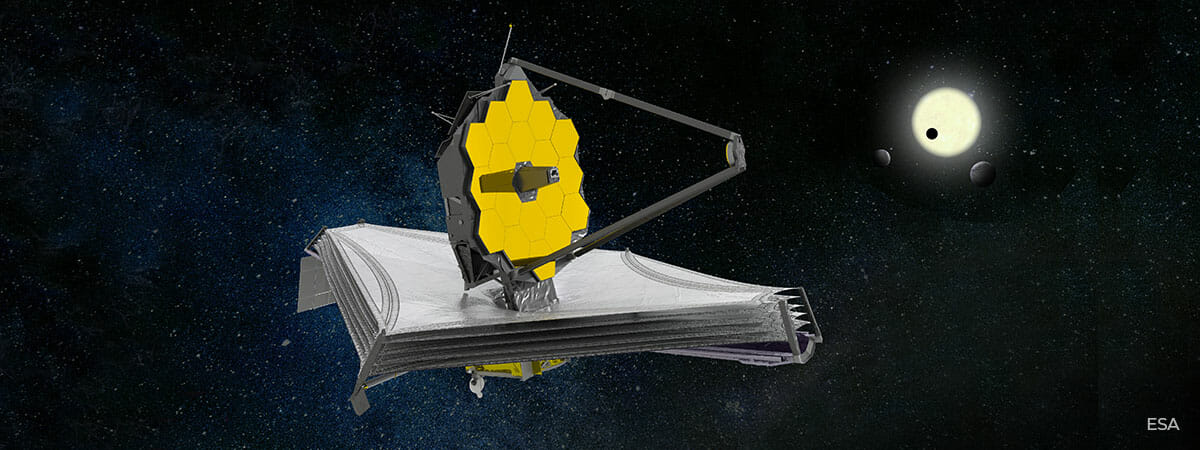
The mission James Webb Space Telescope (JWST) is a new quantum leap in the evolution of space telescopes.. In this case, a new record in telescope size. The James Webb's main mirror is 6.5 metres (huge compared to the Hubble telescope, which was "only" 2.4 metres). This size of mirror, consisting of 18 hexagonal elements, can so far only be achieved by folding it into several sections and putting it into orbit.
The mission is very ambitious. It is expected to collect data that will allow validate a large number of hypotheses of high relevance to our understanding of the Universe.The most important of which are those related to their origin, such as the following:
- Detection of the first stars and galaxies born at the observable frontier of the universe (protogalaxies formed just 300 million years after the Big Bang) that will refine current theories of their formation.
- Origin of Quasars and supermassive black holes.
- Birth of stars and planets. Detection of concentrations of stellar dust that is the breeding ground for the accumulation of hydrogen to test theories of star and planet formation.
- Study of exoplanets in unparalleled detail. Especially the composition of their atmospheres by analysing their spectrographs as they pass in front of their star. This will allow a precise mapping of where in the universe conditions for life exist. (For more details on exoplanet searches, see the article "Exoplanets")
To carry out this ambitious project, the JWST has the following four very high-sensitivity main camera subsystems on board:
- NIR Cam. Captures images and spectra at the optical edge of the IR (Designed by the University of Arizona).
- NIRSpec IR spectrum capture for the study of distant galaxies (made by ESA).
- MIRI (Mid IR Instrument) Imaging and spectrum capture at longer IR wavelengths to penetrate the dust layers that cover most distant galaxies (ESA+NASA development).
- NIRISS Magen and spectrum capture (manufactured by the Canadian Space Agency)
As can be seen from these sub-systems, JWST is primarily focused on image capture and infrared (IR) spectra. This is due to the expansion rate of the universe. More distant objects move away from our point of view at a higher speed and therefore the radiation reaching us from them is highly distorted towards longer wavelengths such as the IR (Doppler effect).
For this reason, sensors must be kept cool and hidden from any unwanted IR sources. To prevent IR contamination, several solutions have been adopted. The most striking is a shield of 5 layers of aluminium silicate, each as thick as a hair's breadth, but with the surface area of a tennis court. This shield will block all radiation received from the direction of the Sun, the Earth and the Moon while at the same time reducing the temperature of the telescope itself to no less than 36K (as close as one can get to absolute zero by passive means).
The shield is so complex and fragile that it takes 2 weeks to deploy (in fact, it is this folding/deployment that has repeatedly delayed the mission because, if the shield is not deployed correctly, the entire mission would be seriously threatened).
The full deployment of shield, mirrors, antennas, solar panels, etc. will take 160 days. after "parking" in its orbit. This is intended to ensure that each action is followed by a period of rest to dissipate mechanical vibrations and temperature to allow the next action to be carried out with the delicacy and precision required for this purpose.
Another of the main solutions that have been adopted to enable long-range and high-resolution observations is to place JWST at the Lagrange 2 orbital point.. Lagrangian orbital points are inherently stable (to varying degrees of stability) and are determined by the gravitational interactions between the Sun, the Earth and the Moon. In particular, the Lagrange orbital point 2 (L2) is around the Sun, but it accompanies the Earth in its translation at a distance of 1.5 million km (i.e. the JWST does not orbit the Earth but the Sun, but it will do so at the same angular velocity as the Earth, so it will accompany the Earth during its translation).
The distance of L2 is 4,000 times greater than the Hubble orbit and therefore it will not be possible to make repairs by shuttle to extend its lifetime as was done with Hubble.
Therefore, the operational life of the JWST is estimated to be between 5 and 10 years.. This duration will be determined by the amount of fuel it consumes to correct its position at L2 and avoid "slipping" out of it.
So it is quite likely that JWST will not last as long as the long-lived Hubble (which is still active and has been in service for more than 30 years) but it will certainly shine brightly ...albeit in the infrared.