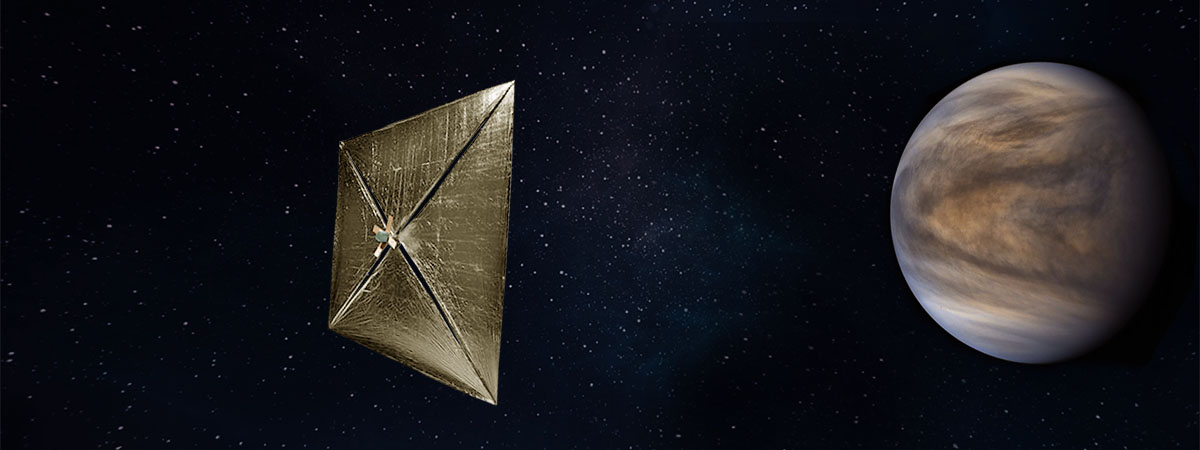
IKAROS (Interplanetary Kite-craft Accelerated by Radiation Of the Sun) was a JAXA-designed demonstrator satellite (Japanese Aerospace Exploration Agency) in order to demonstrate the latest techniques of propulsion by solar sail. In 2010, this mission began its journey to the planet Venus to test this new concept that provided both a new concept and a new way of life. electrical power for equipment as propulsive power.
The main objectives of IKAROS were: the deployment of a large solar sail (200 square metres), the generation of power through the solar cells located on the sail membrane, demonstration of the feasibility of the photon propulsion technique, as well as the demonstration of GNC (guidance, navigation and control) techniques that address the small but constant accelerations caused by this type of system.
The Ikaros probe was the first spacecraft to demonstrate the feasibility of solar sail propulsion and power generation.
The concept of a solar sail is analogous to that of a ship's sail except that, instead of generating momentum by harnessing the kinetic energy of the air above the canvas, it uses the kinetic energy of the air above the sail. collision of photons emitted by the Sun on a reflecting membrane. According to this, the more photons the membrane of the sail is able to reflect, the more thrust the aircraft will receive. Since this thrust is very small, the dimensions of the membrane have to be large in order to be able to propel a spacecraft. With this technology a system could travel without consuming fuel as long as it is capable of generating sufficient power and can steer the sail in the right direction to follow a given trajectory.
In reality, this idea was born from a theoretical point of view several decades ago, but encountered many technical obstacles such as the materials to be used, the way to deploy the membrane or the attitude control of the membrane. To overcome some of these problems on the Ikaros mission, JAXA designed a solar sail concept with a square shape and no rigid support structure, attached to the satellite body by ropes. For the deployment of the sail, the centrifugal force generated by four masses (in total 2Kg) located at each vertex of the membrane was used. This force was maintained, once this deployment phase was completed, to maintain the shape of the sail. This is why attitude control was one of the most critical systems of the mission. Traditional means (chemical propellants) induced oscillatory movements of the sail relative to the central body, and control by photons was also complex because the membrane did not remain rigid against solar pressure forces.
The membrane, which weighed around 14 kg, was made up of four trapezoidal parts in which the following were installed solar cells capable of generating up to 500W of power occupying only 5% of the membrane surface. It also had a dust detection system and reflectivity control equipment. The rest of the surface was occupied by a layer of polyimide (7.5µm thick) covered by a layer of vaporised aluminium (80nm thick). The polyimide coating gave the sail high thermal, chemical and mechanical resistance and a very light mass.. The aluminium layer was responsible for reflecting as much light as possible to achieve thrust.
The IKAROS probe had a total mass of 308Kg and consisted of a cylindrical-shaped body with a diameter of 1.6m and a height of 0.9m. It was launched on 20 May 2010 from the IKAROS launch site. Tanegashima Space Centerone of Japan's space research and development facilities. On 10 June of the same year, the membrane deployment was completed and on 23 July it was verified that the attitude control system was working perfectly and that the satellite was being propelled by the solar wind. Seven months later, in December 2010, JAXA declared that the successfully completed the experiments IKAROS was to carry out and went into hibernation mode. However, it was decided that the mission would not end at that time. In August 2013, the satellite was still gaining speed (+400m/s) from the solar sail. On 23 April 2015, after almost 5 years of its nominal mission, IKAROS woke up for the fourth and last time, transmitting the last data, which would be important to better design the model of space navigation by sail. On 21 May of the same year, JAXA was unable to establish communications and the mission was terminated.
To this day, IKAROS has been the only space vehicle capable of generating propulsive power by means of a solar sail to be able to travel between two planets. This is why the success of IKAROS lies not only in the speed achieved by the satellite or in the promising results obtained, but also in the number of possible lines of research that may arise from this mission and the possible future missions that will try to advance in the field of fuel-free space propulsion.
The JAXA, Japan Aerospace Exploration Agencyis now at the forefront of space vehicle propulsion by solar sail. This agency was born on 1 October 2003, the result of the union of three Japanese aerospace organisations: ISAS (Institute of Space and Astronautical Science), NAL (National Aerospace Laboratory) and NASDA (National Space Development Agency of Japan). It was created as a central agency to support all aerospace development in the country.
JAXA has successfully launched eight Japanese astronauts into space and has been involved in several international programmes, including the ISS (International Space Station), for which it developed the KIBO laboratory or Japanese experiment module. It is currently involved in collaborative space exploration programmes such as the Gateway programme, which aims to put a station inhabited by humans into lunar orbit without interruption; the SLIM (Smart Lander for Investigating the Moon) programme, which aims to demonstrate a high-precision lunar landing system; and MMX (Martian Moon Exploration), which will be able to bring back to Earth the first samples from Phobos, the largest moon of Mars.