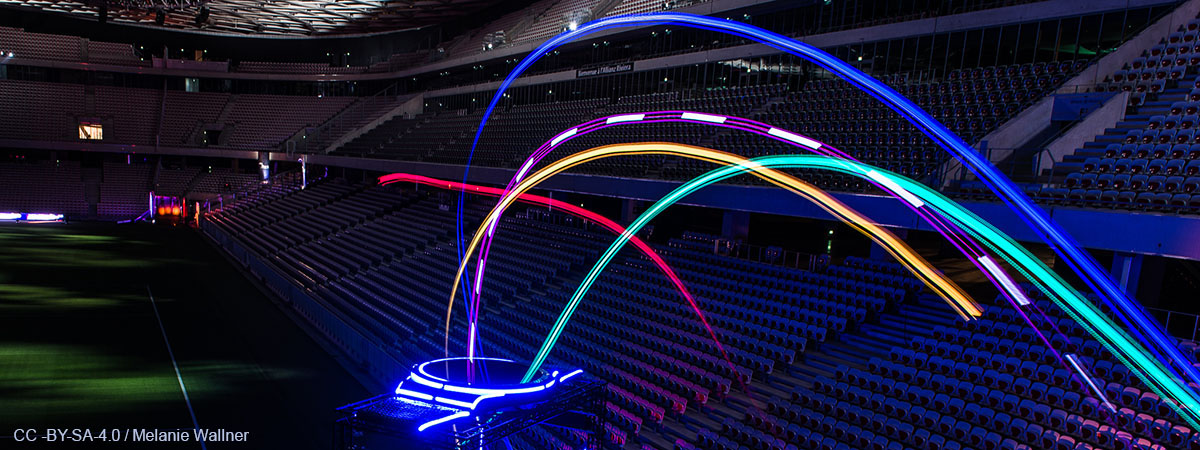
The drone racing, o FPV drone Racing (where FPV stands for first-person view or first-person video) is a form of sports competition in which drones compete at high speed on prepared obstacle courses. The participants These craft are steered by cameras fitted on the drones themselves.The pilot can see them on a screen installed on glasses or monitors as if he were on board the aircraft.
Drone applications are growing every day in all sectors. One of them, drone racing, also has high technological demands.
As in the case of motor racing, there are competitions all over the world, and it is the competitive element that has led many people to take an interest in this field. Significant prize money is on offer, which justifies the fact that investment in technology is significant. The interesting thing about this recent competitive sport is the variety of technological and audiovisual opportunities that are presented, encouraging creativity in this field, in which new designs for control systems, power, durability, data transmission, weight reduction, aerodynamic designs, etc. are developed,
Let's talk about some of the most common technical characteristics of these types of drones.
Racing drones due to their light weight can accelerate and manoeuvre with great speed and agility. Unlike those dedicated to video or photography, racing drones are designed to move forward as quickly as possible, rather than hovering steadily. While photography drones typically have four motors arranged in an X-shape, evenly spaced, racing drones typically have four motors arranged in an H-shape, designed to propel the drone forward rather than upwards. The shorter diameter 3-bladed or 4-bladed (rather than 2-bladed) propellers allow for greater acceleration and manoeuvrability.
The controls are extremely sensitive and require a trained pilot to operate them with short reaction times.
The sizes of racing drones range from 180 mm with 4" blades for indoor use to 250 mm with 6" blades which are the fastest drones normally used, although for freestyle, 220 mm with 3 x 5" blades are preferred.
They have smaller motors with plenty of power. The fastest drones, weighing just 798 grams or so, can complete laps at speeds approaching 290 km/h.
These drones are made of carbon fibre, strong and lightweight and can take a lot of impacts without damaging the equipment, making them more cost-effective.
They carry two cameras, one for on-board recording at 4K 60fps resolutions, and one for real-time video transmission for control with the goggles. There are goggles on the market that can be used at both 720p / 60fps and 1080p / 30fps resolutions, some also transmit in 4K when the aircraft is in close range, with an extremely low latency of only 40ms.
This camera system is called "Persons view", and this low latency creates an experience where the pilot feels as if he or she is actually in the drone, giving greater control than in the traditional way. There are even high-end goggles that incorporate a system that allows you to control the orientation of the camera on board by simply moving your head.
The FPV camera latency processing all the information from the image sensor is an important detail, the faster the processing, the lower the latency and the better the control over the machine. A latency delay of 100ms when the drone is flying at 50mph can mean that your drone will travel approximately 2 metres before the pilot receives the image, so control may have been lost before the pilot realises.
An important factor in transmission is the actual transmitter bandwidthThe higher resolutions require higher bandwidth.
The antennas are located at the bottom of the drone to ensure 360º coverage. They are used omnidirectional and directional gain antennas togetherdepending on the location of the drone, as the directional antenna obtains maximum transmission in one direction and the omni-directional antenna allows transmission in all directions.
The lenses of these cameras can be changed to choose the field of view (FOV), adjusting to the specific needs of the field. Depending on the focal length of the lens in millimetres you will have different angles of view. If we take into account that the human eye has a focal length of approx. 22 to 24 mm with a horizontal peripheral angle of view of about 140 degrees with binocular vision, with these lenses we can achieve angles higher and lower than human vision.
In this table you can see the equivalence between lenses and field of view (FOV) degrees:
LENSES - FIELD
1.2 mm - 185 degrees
1.7 mm - 170 degrees
2.1 mm - 165 degrees
2.5 mm - 147 degrees
2.8 mm - 130 degrees
3.0 mm - 127 degrees
4.0 mm - 88 degrees
6.0 mm - 78 degrees
The FPV camera image sensor affects the performance of the camera.. For FPV cameras, CMOS and CCD sensors are used. CMOS cameras are usually lighter and use less energy, which is only really important for some micro drones. However, if there are vibrations on board, the jelly effect is generated, which makes it difficult to see. CCD cameras do not have this problem and have a wider dynamic range, so they can work better in bright light and shadow conditions.
Most drone pilots use CMOS cameras due to their wide availability and cost.
It is also worth noting that there are already some 3D FPV cameras that consist of two cameras side by side to allow the illusion of 3D depth while flying, taking the sense of reality and control to the extreme.
Combining technological innovation with fun has led to a tripling of drone sales in the last two years, and many private companies have started to develop new technological designs. Although this increase was initially slowed down due to the regulations for use that were appearing in all countries, it has subsequently increased again due to the professionalisation of the sector, which is otherwise necessary.
This makes this discipline a testing ground to further develop new ideas and innovations that can then become part of larger projects, such as UAS for border control, security and emergency, facility maintenance, smart cities, etc.
It is very likely that in the coming years we will see an increase of these technologies in our cities, in addition to the acceptance by society of the integration of this equipment in normal life, as we can already see in traffic control, location and rescue of people, fire control, etc.