Both are well known major private initiatives which, for many years now, have been efficiently driving the aerospace industry, and which are already world famous: Blue Origin and Space X. They are the two best known, but it must be said that they are only the most famous companies in a world where there is more and more business entrepreneurship, both private and public-private, which undoubtedly makes this sector one of the most promising and most promising in the 21st century. One indicator of this fact is the large number of start-ups that have emerged in recent decades in the aerospace sector, many of them supported by the governments of their countries of origin.
A project with great ambition and a contained budget, it has shown that the space race can be approached in a different way.
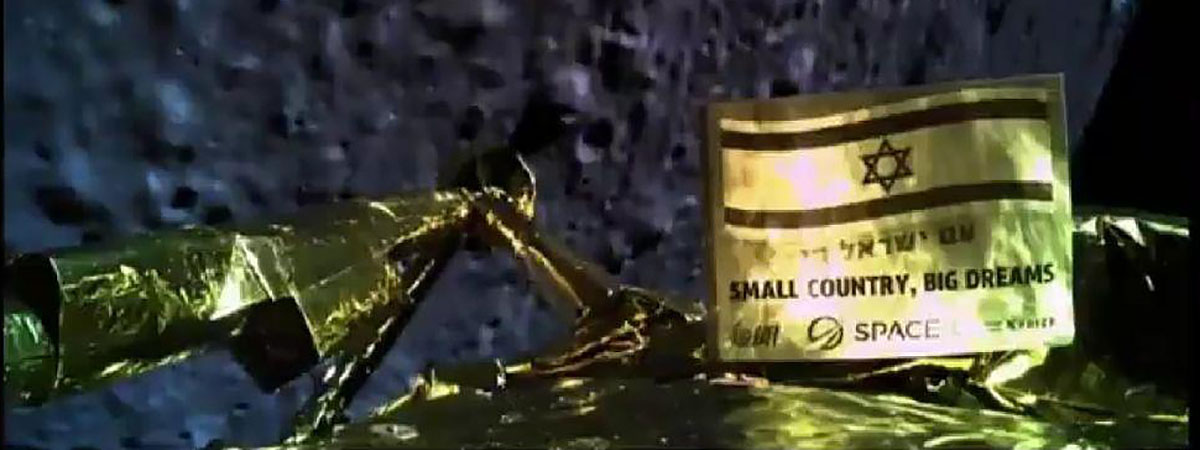
Although not as well known as the two aforementioned initiatives, a good example is the SpaceILThe project, a private, non-profit organisation, was born almost out of nothing, but in a short period of time it achieved a great deal. Who would have thought that these three Israeli engineers' innovative idea would go so far. Indeed, Yariv Bash, Kfir Damari and Yonatan Winetraub were the promoters of an initiative that they submitted to an international competition, the so-called Google Lunar X Awardwhich offered a reward of USD 30 million in prize money for two purposes: making getting to the moon easier with long-term business models focused on lunar transport and, on the other hand, inspiring the next generation of scientists, engineers and entrepreneurs in STEM (Science, Technology, Engineering and Mathematics) disciplines.
Following its submission to the competition, SpaceIL began to receive private funding almost from the outset and obtained the interest of the Israeli administrations, obtaining the support of the Israeli Ministry of Foreign Affairs for its technical development. Israeli Space Agency and other public entities in that country.
The project took a relatively short time to develop. Although the Google Lunar X prize was not awarded, they had already secured enough backers and continued to raise enough funding to consider launching in 2019.
The launch, curiously contracted to SpaceX, took place on 21 February 2019. Inside the Falcon 9 shuttle was a secondary payload - along with two other satellites - the lunar lander that was christened "Bereshit". (Hebrew for Genesis), weighing some 585 kilograms and approximately two metres in diameter. Part of its cargo was a capsule containing digital discs with children's drawings, songs and images of Israeli symbols and a Torah (Hebrew Bible).
Unfortunately, a series of unforeseen events caused the space module to crash into the moon shortly before it was due to land. After investigation, the company reported that it was due to a malfunction in the main engine, which they had tried to reset and restart but failed to do so in time to avoid disaster.
Although it did not achieve the moon landing, the final balance of this adventure was very profitable and full of achievements.
On the one hand, SpaceIL was the first private company to orbit the moon and touch the lunar surfaceThis is yet another example of the emergence of non-public initiative in the world of space exploration.
Similarly, its Israeli origin made Israel the seventh country to orbit the moon, after Russia, the United States, Japan, China, the European Union and India. It also made Israel the fourth country to attempt a soft landing on the lunar surface, although it failed to do so in a controlled manner.
From the point of view of resources, it is worth mentioning both the low budget The cost of the module was less than 100 million dollars, as was the exclusive group of fifty engineers who designed the module. It was a very novel approach that made the lunar adventure much more economical than those of any other country to date. The efficiency of the few resources employed made the venture very profitable from the point of view of media and national impact, having placed an Israeli company among the group of countries with space exploration capabilities.
We must also not forget the social impact of the event. It has been estimated that 90 percent of the Israeli population followed the moon landing attempt live on the internet, in addition to millions of fans around the world. And especially the impact it had on many thousands of children, since from the very beginning the project had a great educational orientation and material and human resources were devoted to ensure that the SpaceIL project was also of great importance as a pedagogical project.
The future looked bright as, with the backing of the Israeli government, SpaceIL has already begun planning a second mission to the moon. This was announced in April 2019 by Morris Khan, a South African billionaire and SpaceIL's main financier. However, in June of that same year, the company issued a statement announcing that this second attempt would not be carried out and that, foreseeably, it would not be carried out, I would use the knowledge gained for a more ambitious mission..
Other countries with resources, including most European countries, should consider more seriously the promotion and sponsorship of similar projects. The space race is now in a new and exciting phase. where new actors will become major players. And we already know that the innumerable resources and opportunities that space will provide will be accessible to nations that have the capacity, experience and technologies developed for the purpose. Either you are there or you are not.
May these brilliant initiatives become inspirational muses for humanity for the great work that will be the conquest of the solar system.