The aerospace industry is one of the key players in exploring the limits of human knowledge and its evolution may lead to humanity's greatest discoveries. Our environment in the vastness of the universe is studied by robotic explorers, more commonly known as space probes.
The aerospace industry, especially astronautics, will continue to grow to delight us with new possibilities, technologies and knowledge.
These artificial devices are designed to withstand radiation, pressure and high velocities in extreme environments, using the most advanced feasible technology available at the time. This requires large financial investments for their manufacture, launch into space, use and maintenance. Space probes give us the possibility to sample, measure, photograph and analyse the dust and gases of other worlds.
For humankind, space probes are very useful tools with disparate functions. For example, the space telescope HubbleThe Hubble Probe, named after the astronomer Edwin Hubble, considered the father of observational cosmology, floats comfortably in Earth's orbit, while the Hubble Probe, named after the astronomer Edwin Hubble, is in orbit around the Earth. Deep Impact I was sent in 2005 on a suicide mission against the comet Tempel 1 to study the composition of their interiors. Other probes are sent far from Earth, to planets such as Mars, Jupiter, Saturn or their moons, in order to capture images and analyse them from their orbits, even landing on their surfaces in search of samples to study their composition, geological processes and to analyse similarities or differences with our planet.
The aerospace sector, more specifically astronautics, is responsible for the execution of programmes of space agencies such as NASA, on the part of the USA, or INTA on the part of Spain.
In December 2009, a Delta 2 rocket carried the WISE (Wide-field Infrared Survey Explorer), a probe armed with a 4-million-pixel telescope that observes the sky at four infrared wavelengths and is creating the most detailed infrared photograph of the universe to date.
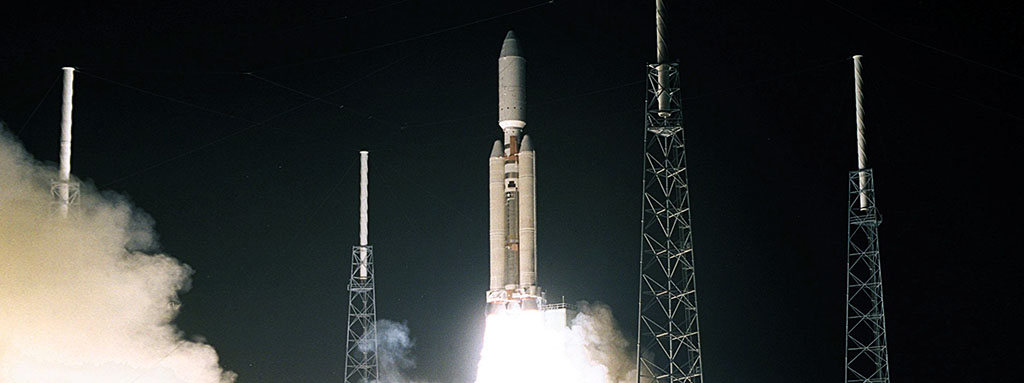
For all of human history, there was no solid evidence that liquid water existed anywhere else in the universe besides Earth, until a sophisticated space probe reached the planet Saturn during a mission in 1997. The spacecraft Cassini travelled almost 645 million kilometres in four years to begin a spying mission to discover Saturn's secrets. This probe not only studied the planet and all its moons, but was also able to observe the rings in detail, discovering Enceladus in the E Ring, one of Saturn's moons, where geysers were observed spewing liquid water that freezes out into cold space, creating the ice particles that form Saturn's own ring.
But the discoveries of Cassini They didn't stop there. It had to make use of its best and most sensitive instrumentation to study Titan, although larger than Mercury it is another moon of Saturn. Titan has a very dense atmosphere that has already been seen by the space probe Voyagerin 1980, on its way to the outer solar system. It photographed Titan and showed that the moon's dense atmosphere is made up of hydrocarbons such as methane and ethane that create a dense photochemical haze, making it impossible to see through. 25 years later, Cassini launched its probe Huygens and penetrated the dense atmosphere to land on Titan's surface, discovering large hydrocarbon lakes fed by liquid methane storms, which could harbour simple life forms similar to the single-celled organisms that inhabit the depths of Earth's oceans.
Most of the Earth's methane is gaseous, known as natural gas, and comes from decaying organisms.
The aerospace industry has made great strides in space probes. In 1960, the Ranger Programme with the launches of the first US probes with the mission to photograph the Moon and analyse its surface with a view to the development of the Surveyor y Apollo. Only 2 years later, we got the US probe Mariner II flew over Venus. Although the first probe to land on Venus was not American, but Soviet, the Venera, in 1970, from which we learned that our neighbouring planet did not resemble Earth, as it is too hot (around 460 degrees Celsius at its surface) and its conditions are too extreme to support any form of life.
But there are even worse conditions on the outer planets, or exoplanets. Reaching them requires more than just a large rocket. The biggest problem for the probes is the fuel to reach their destination. Using a rocket burns a lot of fuel, and if it runs out, the probe will be unusable. But there is a solution inherent in the structure of the cosmos: gravity. In the early 1960s it was discovered that we can use the gravity of the planets to help propel spacecraft further and further through the solar system. This technique called "gravity assist" works like a virtual engine that harnesses the immense gravity of planetary bodies to propel a spacecraft along a planned trajectory. CassiniFor example, it used these gravitational impulses to reach Saturn's moons.
Space exploration in the 21st century is poised to send probes even beyond the outer planets of the Solar System, to distant stars, but "gravity assist" does not allow us to get there. Deep space travel requires another, more science-fictional method of propulsion: the ion thruster.
An ion engine is like a "mini linear accelerator".
The ion engine replaces the chemical fuel with an inert gas such as xenon, which is electrically charged and ionised, causing an electric field to accelerate the ions in a directed manner, resulting in propulsion. These engines produce very slight thrusts, but they work for several months at a time and make the spacecraft move faster and faster. They have already been tested with the Deep Space I in the late 1990s, and more recently propelled the Hayabusa from the Japanese Aerospace Exploration Agency and helped it land on an asteroid. Ion engines have arguably revolutionised deep space exploration.
But this is only the beginning, as it is still being developed. VASIMR (VAriable Specific Impulse Magnetoplasma Rocket). This evolved ion engine has an added radio wave generator and a second stage. It works by applying electromagnetic energy to the plasma, creating a very powerful magnetic field that fires the plasma at very high speeds. It is estimated that using this technology it will be possible to send a probe far beyond our Solar System, opening the doors of deep space to exploration.
At the moment, we can observe extrasolar planets, especially Earth-like planets that are in the habitable zone of their star. This is one of the objectives of the probe. Keplerequipped with a telescope with a 95 million pixel resolution camera to observe transiting planets (a technique for searching for exoplanets that consists of measuring the variation in the brightness of a star to see if there is a planet orbiting in front of it, which would cause the star to dim).
It seems that we will soon have the technology to analyse the chemical composition of exoplanets, whether or not they have atmospheres, continents and oceans, water on the surface, and so on. This will be possible thanks to the space telescope James Webb, with 4 times the optical capacity of a telescope Hubble. This telescope will allow scientists to observe small molecules in the atmosphere of a planet similar to our own that could be thousands of light years away from Earth.
Space exploration is still very young. In this century, humanity is set to witness great and amazing discoveries. The aerospace industry will continue to grow to delight us with new possibilities, technologies and knowledge. In particular, astronautics, with large-scale experimental projects and objectives, unimaginable a few years ago, that will never cease to amaze us.