Advances in technology, competition - but also collaboration - between space agencies and the emergence of private initiative are exponentially improving the prospects for space travel. Today we are able to keep satellites in orbit, land on icy comets, receive signals from a spacecraft at the edge of the Solar System and even take those who can afford it up to contemplate the darkness of outer space and the curvature of the planet. All these challenges are space missions.
Every spacecraft mission is a precision exercise involving many disciplines of knowledge and where zero risk does not exist.
In order to define what a space mission it is necessary to establish where space begins. Its delimitation has become a topical controversy because some tycoons are trying to promote their companies as pioneers of space tourism by means of a race to the top marketing campaign. Whatever the limit - from the thermosphere, at 80 km, or from the Kármán limit, at 100 km - it can be considered that a space mission is a flight to fulfil certain objectives beyond that line that divides our everyday blue-sky world and space.. A very broad definition ranging from a low-orbiting Earth observation satellite to the Voyager probes on their way to other star systems. It also includes the International Space Station or Space X's launch of a sports car, which is currently orbiting the Sun.
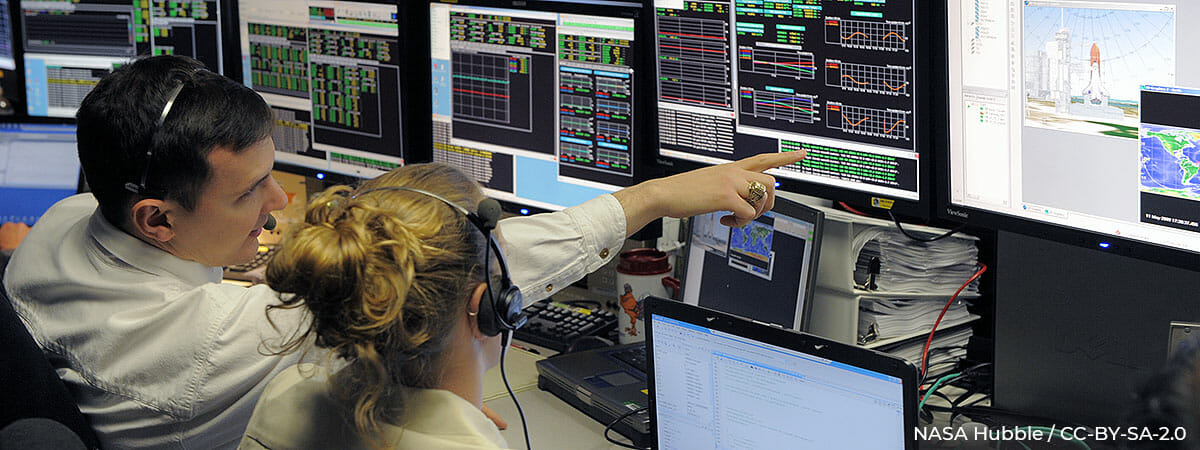
The realisation of space missions generally requires close collaboration between one or more space agencies and the industryThe complex tasks of designing, assembling, testing and testing of the ships and the one known as mission analysis. All are pre-launch phases except the last one, which is the monitoring and decision making that will govern the life of that spacecraft.
We often wonder how a spacecraft can visit four outer planets and travel more than 20 billion km through space for 40 years, much of it with only a small amount of fuel left over. Or how a large number of satellites, in the Earth's gravitational environment, can coexist in the same area and achieve their objectives. Or how they avoid collisions with each other or with space debris objects, such as inactive equipment or metal fragments resulting from fatal collisions (which have in fact occurred and must be prevented from happening again, as a single collision generates thousands of such fragments of all sizes).
All this is possible thanks to mission analysis and the orbitographywhich studies trajectories of objects in gravitational fieldsThe new system, generally adapted to small masses such as spacecraft moving around colossal elements such as moons, planets or the Sun. It allows engineers to know the ideal time window for launching a spacecraft with far-ranging claims - such as Voyager 1 and 2, Pioneer, New Horizons - so that it is able to intercept the giant outer planets on its way and take advantage of its enormous mass to gain inertia. This process is called gravitational assistance and is based on the exchange of energy between the two bodies: a huge one, the planet, and a much smaller one, at least twenty orders of magnitude smaller, the spacecraft.
By means of this manoeuvre - pure celestial mechanics, whose mathematical basis, like all orbitography(1)is described in the Newton's equations of Universal Gravitation 1687 - the ship receives some of the energy from the massive object and slows it down slightly.(2). If the execution is accurate, the change of direction and the increased speed will make the journey much more efficient. But if it is not, the spacecraft will take a different direction and may even be thrown out of the plane of the Solar System.
Thanks to gravitationally assisted voyages we know much more about, among other things, the outer giant planets. Voyager 1 visited the gas giants, Jupiter and Saturn, discovered new moons and uncovered unknowns of the known ones, those we have seen from here. Voyager 2, in addition to that, reached the ice giants, Uranus and Neptune, for the first and last time, provided the only in-situ photos in existence and discovered again other moons with astonishing characteristics. The moons of these planets, mainly some of the gas giants like Enceladus or Europa, are candidates for harbouring life. They have oceans of water under their ice caps, complex carbon molecules bubbling up through their cracks, and tectonic activity - in some cases, like Io, volcanic - has been observed on their surfaces. Given the strong interest in returning to explore them again, major space agencies are already conducting missions such as NASA's Juno and ESA's Juice.
The mission analysis is also fundamental to calculate how much energy needs to be applied to correct for the effects of the dragThe Earth's orbiting satellites are resisted by the atmosphere. Although it is not dense at these altitudes, it is capable of slowing down and, as a consequence, modifying the orbit. The way to express this autonomy is the so called deltaVThe concept is very common in aerospace engineering and represents the equivalence between the amount of fuel and the ability to modify the speed of the aircraft.
On the other hand, it is equally essential for launches, their stages and transition orbits, which require maximum precision. To take those tourists who want to contemplate the curvature of our planet, or to land on the moon, Mars or a comet, a landeras in the case of Philae from ESA's Rosetta mission.
All of these missions will be continued and many more are planned, so the aerospace industry is expected to grow. Companies with expertise in air navigation, defence systems and software development are favourably positioned as providers of mission analysis solutions.
There is much to do and much to experience in space exploration. In fact, we have only just begun.
(1) With the exception of regions very close to the Sun or other objects.
(2) Although insignificant, a planet decelerates when it pushes a ship. Obviously, only the effects on the ship are far-reaching.