We already know that Mars is the only known planet inhabited entirely by robots (see the article "Mars is the only known planet inhabited entirely by robots").Water on Mars")..., but as of this year (2019) there is also the circumstance that our beloved Moon is known to be inhabited by space bears.
But let's start at the beginning...
On 22 February 2019, IAI (Israel Aerospace Industries) and SpaceIL launched their Beresheet (Genesis) mission, along with a communications satellite, aboard a SpaceX Falcon 9 rocket from Cape Canaveral with a total budget of about USD 100 million.
A space mission that ends in catastrophe may be the origin of another mission designed to exploit the salvageable results of the first.
The lunar lander consisted of 150 kg of empty equipment (almost 600 kg with fuel), including a magnetometer to measure the local magnetic field and a laser reflector for precise measurements of the distance between the Earth and the Moon, as well as other "exotic" items, such as the "lunar archive" module. This module, funded by the Arch Mission Foundation, consisted of a package of biological material intended to be stored as an emergency biological reserve in case life disappeared from our planet.
The mission entered lunar orbit on 4 April this year with the intention of landing at Mare Serenitatis a week later, where it would remain active for just a couple of days to conduct its science experiments. As the equipment was planned without thermal control, most of its systems would degrade after those two days due to their own operational heating. The laser reflector would be the only element that could continue to function for decades due to its simplicity and passive operation.
For a successful moon landingThe spacecraft must complete the complicated descent phase from a stable lunar orbit to the surface of our satellite without fail. During this phase, it is necessary to reduce the velocity relative to the lunar ground from about 8,500 km/h (orbit velocity) to zero. This phase is often quite critical, because changes of just a few tenths of a second in the firing times of the retro rockets that slow down the spacecraft mean a large difference in position and velocity at the point of contact with the ground. Such changes can therefore mean the difference between a smooth landing and a catastrophic and violent total destruction of the spacecraft.
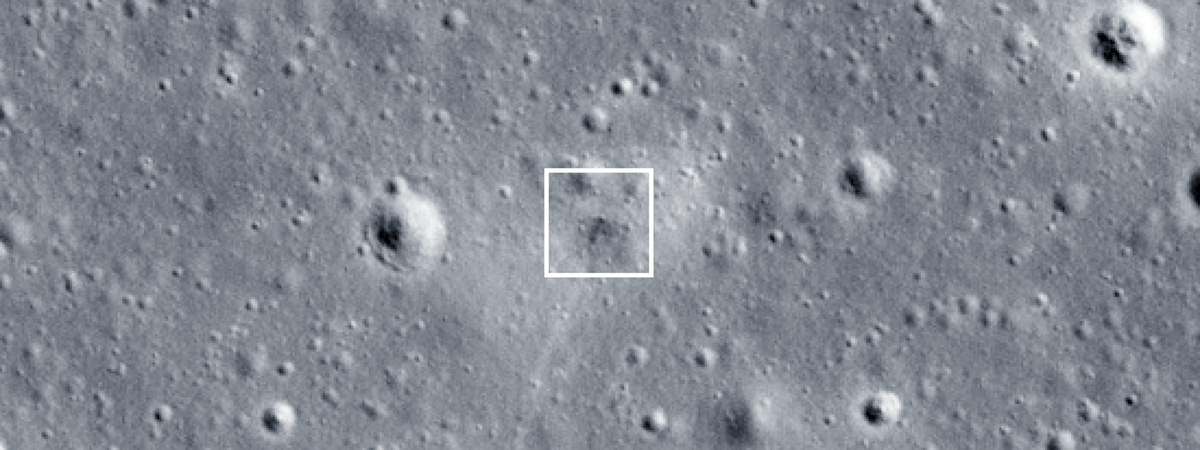
Unfortunately, just during this phase, two catastrophic failures were linked to each other: the spacecraft's inertial unit (the sensor that monitors that the deceleration is proceeding at an appropriate rate and in a manner compatible with a safe take-off) failed for a few seconds, resulting in the shutdown of the rocket. At the same time, communications with Earth were briefly cut off, preventing manual reactivation. When communications were restored, the rocket could be started and descent rate and altitude telemetry were obtained. Unfortunately, nothing could be done... The descent rate was too high, and the remaining distance to the lunar surface was too short. Impossible to slow down in such a short time and space. The spacecraft would crash irretrievably into the lunar surface. So the ship proceeded to do the only thing that could be done in such a situation seconds before its inevitable destruction: it was made a selfie. Indeed, the images transmitted just before the collision are very... shocking.
But the incident doesn't end there: the Arch Mission Foundation module also contained a collection of thousands of live tardigrades which have certainly survived the impact and are now scattered over the lunar surface.
These tardigrades are microscopic multicellular creatures that are extremely abundant and present in almost every habitat on our planet. Because of their subjectively plump appearance and stubby legs, they have been called "water bears" since their discovery (hence the title of this article).
The reason these "bears" were chosen as part of the mission is that they are the most resilient living creatures known to man.. They can survive in a so-called "undetectable metabolism" state for tens of years in the vacuum of space at temperatures ranging from -273 °C (near zero Kelvin) to 150 °C and withstand radiation doses 100 times higher than those that would kill any other living thing. Their resuscitation occurs when environmental conditions return to a normal level for them.
The tardigrades now on the moon were travelling in a state of dehydration that is quite normal in their life cycles to overcome unfavourable conditions. However, the main impediments to their resuscitation on the moon are vacuum (i.e. lack of liquid water available for resuscitation) and radiation (which will slowly kill the survivors). Subsequently, the absence of food would prevent any reanimated survivors from thriving and reproducing.
This has caused controversy and has prompted several groups to announce legal action. against the mission operator on the grounds of the possible environmental impact of this biological "spill". However, at the legal level, there are no proceedings that can even be raised. All indications are that these are simply public exposure manoeuvres. On the one hand, the only laws in force on our satellite are those prohibiting nuclear proliferation and armament (1967 Outer Space Treaty). On the other hand, it is highly unlikely that the tardigrades will come out of their lethargic state without outside help. Not to mention that huge quantities of all kinds of terrestrial bacteria have most probably already reached the lunar surface from previous missions (bacteria that travelled inside lunar capsules or probes, or human intestinal bacteria that may still be lethargic among the packed and abandoned faeces of the Apollo mission).
What can be positive is that this failed experiment becomes part of a future experiment. to collect the wreckage and test the survival rates of these crashed bears, as happened when the Apollo 12 mission landed on the moon in 1969 close to where the Surveyor 3 mission landed two years earlier, to collect its camera and bring it back to Earth. On arrival, it was discovered that the camera was covered with Streptococcus mitis who were revived after a two-year round trip to the moon and back, exposure to vacuum, extreme temperatures and intense radiation.