Years ago, while working on the construction of an in-flight refuelling aircraft, I was told a comment that has stayed with me: "The two most difficult things you can do with two aircraft in flight are: to walk out of one window, jump onto the wing of the other aircraft and enter through another of its windows; and to refuel in flight". This comparison, still made as a joke, captures the great technical and operational complexity which involves carrying out a airborne fuel transfer. Ironically, and incredibly, the first in-flight refuelling brought the two together: on 12 November 1921 Wesley May, flying in a Lincoln Standard biplane piloted by Frank Hawks, grabbed a can of fuel, climbed into a Curtiss JN-4 flying above him piloted by Earl Daugherty and managed to pour 18 litres of fuel into its tank. It was the fascinating era of the aviation pioneers, and the achievement was just one more of the many daring stunts with which they wowed the public. The first refuelling with operational interest was carried out shortly afterwards by the US navy on 23 June 1923 using a hose that allowed the fluid to pass through by gravity.
In-flight refuelling is one of the most difficult and risky operations both technically and operationally.
All aircraft, in general, need fuel for propulsion. This fuel usually to be charged and consumed to near exhaustion on every journey. At the departure airport itself, tanks are usually filled as little as possible in order to reach the destination safely, since the lighter the aircraft, the lower the operating cost. The amount is calculated by multiplying the length of the journey with the average consumption per km and adding a small percentage as a safety margin for unforeseen events. This is done for most civilian flights since destination and consumption are usually known in advance. However, in the military field there are other types of requirements, such as patrol flights where the aircraft must remain in flight as long as possible without returning to base, or missions requiring extending autonomy beyond the capacity of the reservoirs. This type of operation makes it necessary to design a replenishment system in flight.
In any refuelling there are two roles, the aircraft that provides the fuel, called a tanker, and the aircraft that receives the fuel, normally smaller, although not necessarily, as it can be another tanker or even larger, as in the case of a bomber.
Generally, aircraft carry fuel inside their own wings. The point of this is keeping the centre of masses as balanced as possible to ensure good airworthiness. In addition, being a fluid, to control the load sharing must be distributed among several interconnected but independent tanks. As for the fuel that tanker aircraft transfer, it can either come from the same tanks they have for their own consumption, or incorporate additional tanks, usually in the cargo hold.
There are TWO METHODS different ways of dispensing fuel:
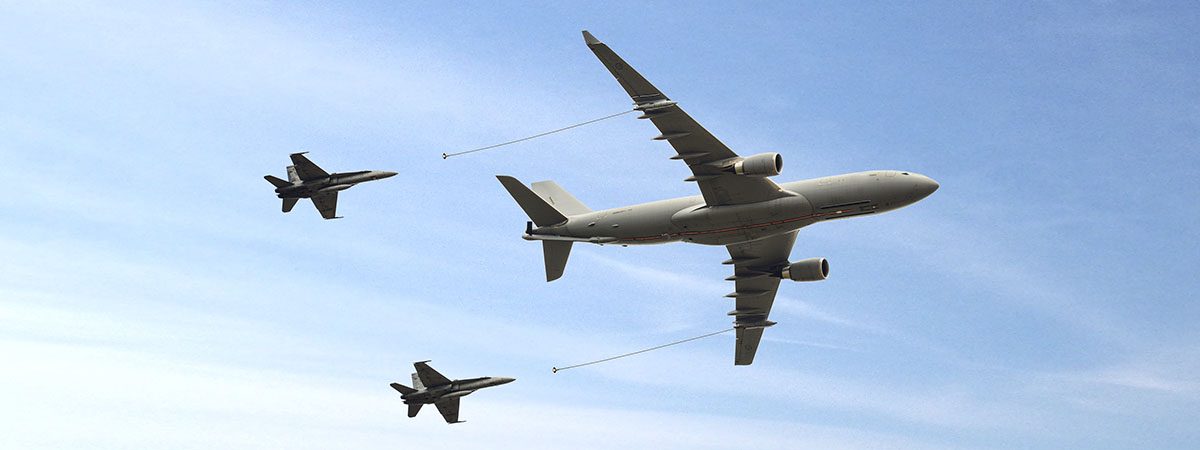
– Pod, hose and basketpod: This system has aerodynamic containers on the outside of the tanker aircraft called pods. Upon activation by the crew, they release flexible hoses that hang freely against the direction of flight. The hoses end in baskets that provide aerodynamic stability and serve as a funnel that helps the receiver to attach to a pole or mast. For aerodynamic reasons this pole can be retractable and removed only for the refuelling process.
The pods have traffic-light type signals, i.e. amber, red and green lights that serve to communicate the refuelling phase. There is usually one pod on each wing, allowing two aircraft to be refuelled simultaneously, and there may even be a third hose, which hangs from the central fuselage. The length of the hose can vary between 15 and 30 metres, and the flow rate between 1500 and 2000 pounds per minute. The longer the hose length, the less aerodynamic impact on the receiving aircraft, but also the lower the transfer rate.
This refuelling system is standard for small aircraft such as fighters and helicopters, which are, incidentally, the most frequent recipients of in-flight refuelling.
– Boom pole (boom)A rigid, telescopic tube attached to the rear of the centre fuselage. To operate it, it is pulled downwards, similar to the opening of a compass. In this position it can also extend or retract. Because of its size, it is subjected to such high aerodynamic forces that it requires control surfaces in the form of fins, fixed or movable, like a mini-aircraft. Its complexity requires a dedicated operator to control its movement and actuation, increasing operational costs.
The telescopic part of the boom is inserted into a hole called UARRSI (Universal Air Refueling Receptacle Slipway Installation) on the receiving spacecraft. The coupling is a very delicate operation because of the danger of damaging the rigid components of both ships.
Only one pole is available per aircraft, so only one aircraft can be refuelled at a time. The length of the pole is shorter than the hoses, between 10 and 15 metres, and wider, allowing for higher transfer rates, about 6000 pounds per minute.
This system is common for large aircraft such as airliners, patrol aircraft, bombers, etc. It is also suitable for fighters, although they do not take full advantage of it because they only allow a rate of around 3000 pounds. It cannot, however, be used for helicopters.
Having explained both systems, it should be pointed out that they are compatible, so they are usually combined.
In terms of the shape and other systems of a tanker aircraft do not differ much from those of a normal aircraft. In fact, it is often decided to modify, to a greater or lesser extent, existing programmes in order to provide them with the refuelling function. Sometimes even existing aircraft are modified.
Finally, I will mention some of the most famous tanker aircraft:
- The first to be fitted with a pole system was the Boeing KC-135 StratotankerThe Boeing 367-80 (similar in appearance to the 707) was developed for the US Navy in the 1950s and was so successful that it is still in use today.
- In the 1980s, McDonnel Douglas created the KC-10 using the DC 10-30 as a basis. Sixty aircraft were produced, also in service.
- The most recent highlight is the MRTT (Multi Role Tanker Transport), created by Airbus on the basis of the A330-200 passenger aircraft, which is being exported, apart from Europe, to countries such as Australia and the United Arab Emirates.
- The latest to arrive - the first unit was delivered in January 2019 - is the model KC-46A. Boeing has designed it on the basis of the 767 for the nearly 200-unit contract with which the USAF intends to renew its tanker fleet. It competes with the MRTT for the current market and we hope, as is often the case in aeronautics, that this will be an obstacle to new developments and innovations.