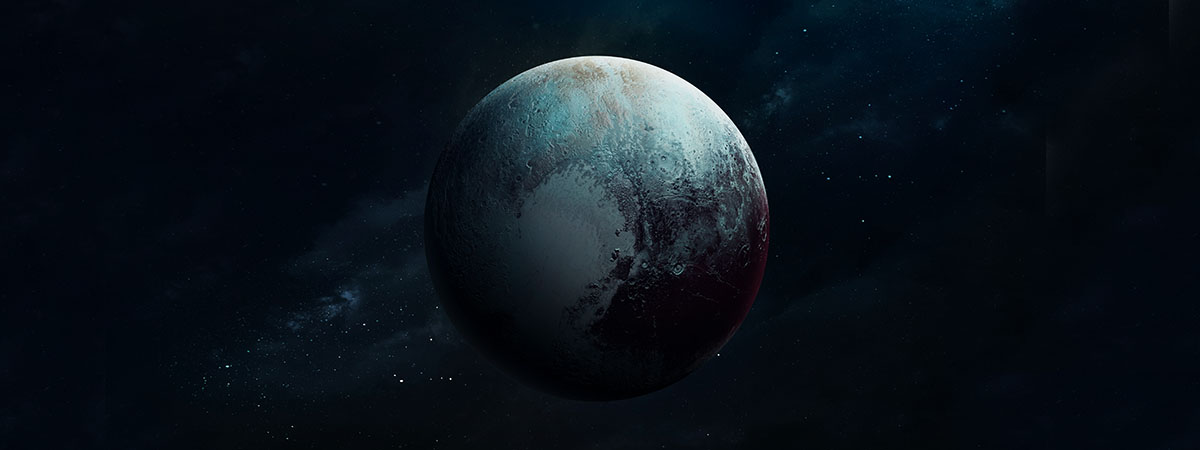
As is well known, Pluto was discovered in 1930 and ceased to be considered a planet in 2006, when the International Astronomical Union withdrew that title because it did not meet the minimum requirements for a planet. But what few people know is that, in that way, Pluto is not a planet at all, Pluto also became the first and best known Kuiper Belt Object (KBO). to which thousands and thousands of other objects were then added..
The Kuiper belt is a cloud of debris left over from the early formation of our Solar System consisting of tens of thousands of objects (of which only about 2,000 have been catalogued).000) of different natures and sizes orbiting in a discoidal formation around our Sun with an enormous extension whose inner perimeter starts at a distance of 30 AU (1 Astronomical Unit or AU is the average distance from the Earth to the Sun) and whose more defined outer perimeter ends at 50 AU ...but the belt continues in extension gradually losing density up to distances of more than 1,000 AU. A high percentage of KBOs are bodies of water ice and methane larger than 100 km in diameter that originate from most of the short-period comets that probably gave rise to the formation of our atmosphere and our seas by impact with our planet.
Pluto was considered a planet from its discovery in 1930 until 2006, when it became the first object in the little-studied Kuiper belt.
Since the prediction of the existence of the Kuiper Belt in 1951 and its subsequent confirmation in 1992, it has become clear that the orbits of several outer KBOs do not match the predictions made with the most advanced means of observation, measurement and calculation and that these orbits strangely adopt a very unusual eccentricity format while also aligning themselves preferentially in a particular direction against a more uniform distribution. The improbability of these orbits forces us to to consider the existence of a relatively massive and undetected body whose gravitational influence over billions of years has been deforming the orbits of tens of KBOs, arranging and stretching them to where they are now.
The most accurate simulations suggest that these orbits could be explained if a super-planet of 5 to 10 Earth masses were taken into account. with an extremely eccentric orbit of 300 to 700 AU, highly inclined with respect to the plane of the rest of the planets and with a duration of 10,000 to 20,000 years. The characteristics of this orbit make it impossible to detect this body directly at present.
Its origin is uncertain, but several possibilities are considered:
One of these, perhaps the most widely accepted, is that formed at the same time as the rest of the planets in an area close to the Sun. but in a relatively unstable orbit that eventually succumbed to interaction with Jupiter or Saturn and was ejected into its current stable orbit, which is so distant and lonely that it has since stopped growing by accretion (capturing matter from its surroundings), preventing it from becoming another Jupiter and is no longer affected by the rest of the planets in the Solar System.
Its peculiar orbit is also thought to be explained by the possibility that it may have been a solitary pose originating in another solar system but expelled from it (by the same mechanism discussed above) and subsequently captured by our Sun.
But the latest theory is that it is not even a planet. Some astronomers think that could be a primordial black hole the size of a football ball.
These primordial black holes are a hypothetical class of black holes formulated by Stephen Hawking in 1974. They formed fractions of a second after the Big Bang and are the prime suspects for concentrating the dark matter in the universe that is known to exist but has not yet been located. Due to Hawking's radiation, many of them are breaking apart until they disappear, but in the process they can acquire any size since they are not subject to the minimum possible size (Tolman-Oppenheimer-Volkoff limit) of 12,000m in diameter that applies to black holes formed from a star of 2.2 solar masses (the smallest size of star that can become a black hole).
Unfortunately, black holes, by definition, are invisible in all radiation spectra and cannot be directly detected. like a star or a hot nebula, but because of the effects they produce around them. If, in addition, they are tiny in size then the chances are reduced even further. Nevertheless, many black holes have been detected (although all are large and none are primordial) through the gravitational waves they produce in their collisions (at least 10 binary black hole systems have already been detected by this recent method), through the altered orbits of nearby bodies, through the accretion discs generated when they devour a neighbouring star, and so on.
If Planet 9 is a primordial black hole, it can most likely be detected by observing how it deflects the orbit of a comet, since it moves in an area where such objects are abundant.
On the other hand, there are also astronomers who believe that the data predicting the existence of Planet 9 is merely the product of an artefact. due to the technical limits of current observational capacity and to possible statistical biases in the processes of cataloguing celestial bodies when focusing on specific areas of space.
In any case, it is always worth getting to know our solar neighbours better (you never know what might be lurking in the dark) so there are already several lines of research to confirm the existence (or non-existence) of Planet 9 and, if it exists, to characterise its nature.
The most immediate initiatives will take place in 2023 when the Transitioning Exoplanet Survey Satellite (TESS) which is designed for the detection of exoplanets but which has a high probability of providing details also in this case (more about the TESS project in the article Exoplanets).
In the same year, it is also expected to be operational the Large Synoptic Survey Telescope (LSST) located in Chile (and with a high manufacturing contribution from Spain) which is specifically designed to scan large areas of space and compare them over long periods of time, allowing the detection of small objects within our Solar System, such as distant comets, that may be influenced by a primordial black hole.
So, it remains to be seen ...from 2023, you may be given the news that our Solar System has a new planet ...or maybe even its own primordial black hole.