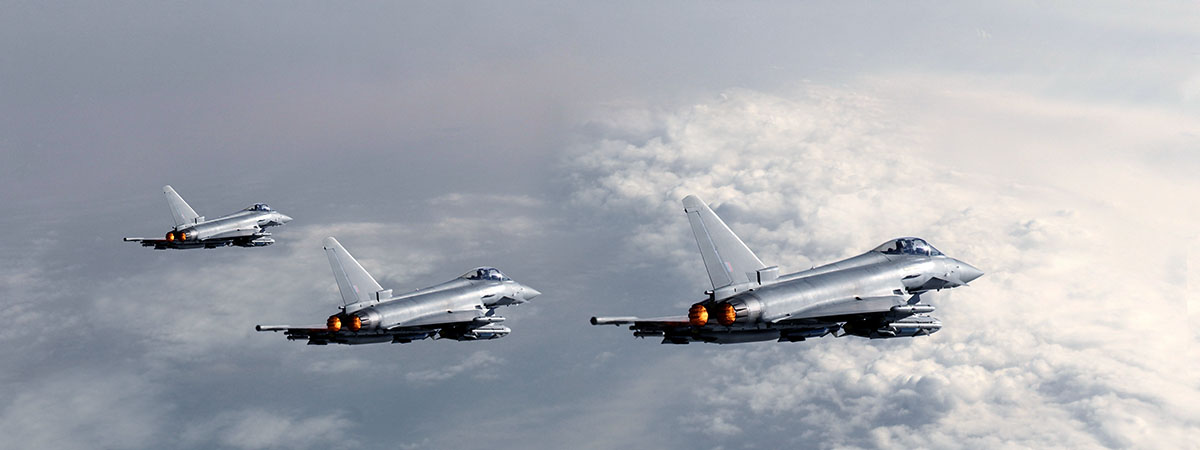
On 21 December last the Italian and Swedish Defence Ministers and the UK Secretary of State for Defence signed a trilateral Memorandum of Understanding to formalise their cooperation in the development of the new TEMPEST programme, which focuses on the development of a future combat air system. This programme includes the design and production of a new generation fighter to replace the Eurofighter currently in operation in Italy and the UK and the Swedish Gripen.
Defence policy has always been a strategic value for nations and one of its current pillars is to have an effective and technologically advanced air defence system.
This announcement comes just a few months after France, Germany and Spain have taken a further step in the development of the NGWS programme (Next Generation Weapon System) formalising the start of Phase 1A which de facto initiates the first activities of the different technological pillars that make up the overall system.
From the point of view of the resource efficiencyFor many readers, this duplicity of initiatives made up exclusively of European countries may be difficult to comprehend. under a purely economic-industrial criterionBut there are factors of many different kinds that influence a decision that commits a large part of the defence resources of a country, or a grouping of countries, over several decades, as much or more than pure efficiency.
The last few months have been a time of great health hardship, but if we go back a little further we can say that this is probably the most politically turbulent period since the end of the dispute between the two traditional military blocs of the 20th century. We are now living in a Europe that has been dealt a severe blow by the tortuous process of the Brexit It will take a long time for the old continent's new relations with the UK to settle down and for a quantitative analysis to be made of how the departure of a partner with such weight in the region's politics and economy has affected the parties.
For its part, the United States has toughened its foreign policy during the outgoing president's term, which has not helped much to maintain global stability, and China is beginning to suffer the same problems that capitalist countries experienced years ago with the application of restrictive tariff policies by the rest of the world towards its products. On the other hand, Russia, the Middle East and South America remain relatively unstable areas in many respects. These are the turbulent times we are living through, which have not been felt so strongly on the world stage for several decades.
Defence policy has always been a strategic value. that each nation, on its own or in supranational organisations, has attempted to use to maintain or increase its position of global relevance. As part of this game of superiority, the first announcement, and then the launch, of the great Defence programmes that periodically seek to evolve the operational capabilities of each country. to respond appropriately in the event of a conflict. Currently, one of these major programmes is the development of these new air combat systems the core of which is the development of new-generation fighters, i.e. combat systems that incorporate among their functionalities high electronic warfare capabilities, advanced artificial intelligence systems, low observability technologies (ELOT), use of mixed reality in their vision systems, integration with unmanned vehicles or decentralised command and control capabilities. These new aircraft are expected to be available for service from 2040 at the earliest.
Over the last few years, some countries have been announcing the launch of new investments, with varying degrees of intensity, focused on these new generation programmes, but in recent months the moves have been much more intense. Both the United States with its Next Generation Air DominanceThe Chinese, like China working on the successor to the Chengdu J-20 aircraft or Russia with its new MiG-41 have confirmed their intention to equip themselves with fighters with these new capabilities as soon as possible. Admittedly, each of these initiatives is currently in the process of different degrees of technological maturitybut they are all moving forward slowly, with solidity and determination. In this context, Europe, with France at the forefront, has this time reacted in time and has seen the importance of positioning itself quickly and taking a position of technological leadership in the development of these key systems for the strategic preponderance of the old continent during the second part of this century.
Asked about a possible integration of both programmes In the future, the responses from each side are diametrically opposed, with Dirk Hoke, CEO of Airbus Defence and Space, commenting that "... the future will be a long way off.Keeping two programmes in Europe could be a bad solution for both the UK and the EU, repeating the mistake of the 1990s of Europe having three fighter aircraft developments in parallel: Eurofighter, Gripen and Rafale."The UK comments that the duality of programmes adds a degree of competitive pressure on industries without creating a monopoly on the supply of fighter aircraft.
Only time will tell who was right.