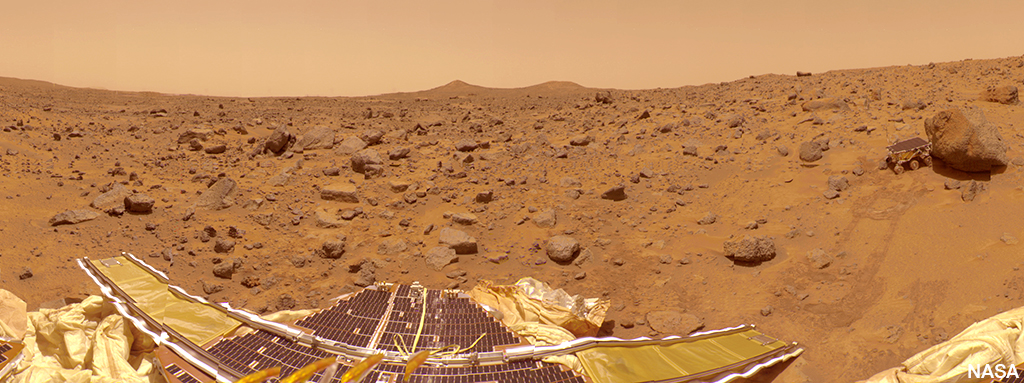
Since the probe Curiosity was sent by NASA to Mars in 2011, many governments and private companies have fantasised about the possibility that in the not-too-distant future they will be able to to make excursions to the red planet or even live there..
But is the human species really prepared for living on Mars? Because when we talk about “living”, we have to talk about colonising Mars...
«As far as the technology is concerned, we are closer to Mars today than we were to the moon when President Kennedy set that goal in 1961».»
In order to survive, human beings need two fundamental elements, among others, which are water and oxygen. Of the former, promising underground accumulations of water have been detected, although it is in solid form. To extract such water would require extensive studies of the regional geology and soil to assess its quality and potential for extraction, which would take considerable time, effort and dedication. However, this is something that NASA is willing to do, just as it has shown its willingness to “create” the second element, oxygen, since it does not exist on Mars.
The oxygen would be created by NASA's famous machine, called the MOXIE (Mars Oxigen In situ Experiment) from carbon dioxide found in the atmosphere from the planet. With a power output of 300 watts and a production rate of 10 grams per hour, MOXIE would collect CO2 from Mars' atmosphere, compress it and subject it to an electrochemical process to produce oxygen by electrolysis (decomposition of a substance in solution by the application of an electric current). But it should be remembered that this is only a test. To be useful to a community of people, this machine would have to be resized to produce more oxygen.
Once we had oxygen and water, we would need another fundamental factor to be able to live on the Red Planet, and that is food. It is not logical to think of transporting food from our planet to Mars, but to collect it there, on the surface or in lava tubes, by means of the use of greenhouses that allow control of temperature, humidity, light and other parameters that the plants would need to develop.
For the time being, it seems that tomatoes, rye or carrots could be planted, plants that have already been experimented with in soils of similar composition. However, although Mars has phosphorus, potassium, nitrogen and iron, scientists need to make further progress in collecting and using water more efficiently. On Earth, we already have advanced experience in the field of water harvesting. smart greenhouses.
Other aspects to be taken into account in an eventual colonisation of Mars would be the power generation (which seems feasible to be collected through solar panels), preparation against the terrible air storms generated on the red planet or protection against solar radiation and low temperatures.
Let us imagine for a moment that we had all of the above, that we had water, oxygen and food to survive. According to expert analysis, the base camp should not be on the surface, but in the lava tubes. that have been proven to exist, thanks to images captured on the surface of Mars, where colonists would be better protected from the sun's radiation, drastic temperature changes and aggressive storms. This is where they suggest common areas such as crew sleeping quarters, laboratories and greenhouses should be built.
To conclude, let us mention a reflection made by Michael Griffin, former NASA administrator: «In terms of the necessary technology, we are closer to Mars today than we were to the Moon when President Kennedy set that goal in 1961». It's a comment that makes those of us who believe that one day we will be able to live permanently on Mars dream.