The aeronautics industry began its love affair with the composites, or epoxy matrix composites with carbon fibre reinforcement, more than 25 years ago, seemed to have found the ideal material for the manufacture of aircraft structural components. We are talking about a material that weighs only about 17 kN/m3 (1700 kg/m3), i.e. up to 37% less than aluminium (2700 kg/m3), and which also does not corrode or suffer fatigue, so the reasons for this romance are more than justified.
The increasing incorporation of composites into new generations of aircraft will lead to the construction or transformation of new manufacturing and assembly plants.
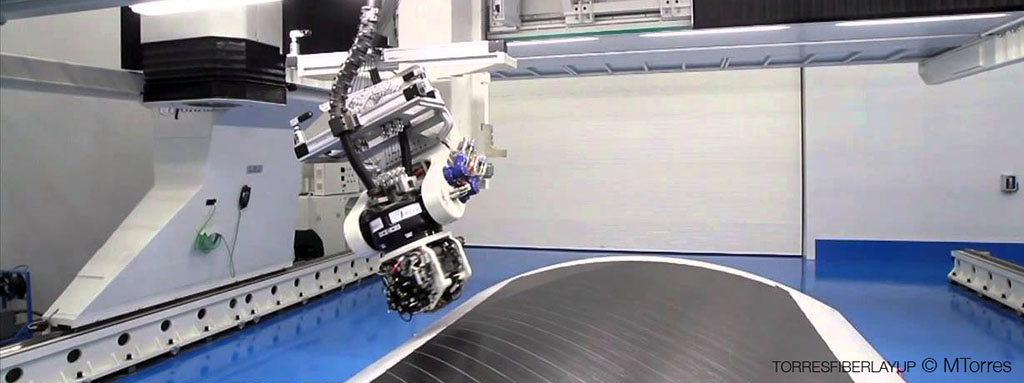
At first, it started out timidly because it was an expensive material to manufacture and complicated to handle. That is why it began in the field of military applications, as is usually the case with technological innovations. Although its use became "popular" some time ago, extending to civil aviation, it must be taken into account that, even today, the coils of composites prepreg must be stored at around -19 °C and have a handling life of 200 hours from the time they are taken out of the freezer. But recent advances in the development of new equipment and manufacturing techniques have dramatically expanded the field of application of these materials, making it possible today to manufacture parts of great geometric complexity and with productivity rates of more than 100 kg/hour. The result is that can nowadays be manufacturedfor example, A350 wing skins of 35 x 6.8 metres, and virtually any part of the fuselage, wing or stabilisers of the new generations of aircraft in composite, with great savings in weight and number of parts to assemble. In addition to the aforementioned Airbus A350, Boeing produces the 787 Dreamlinerwhich are currently the two largest commercial aircraft manufactured in more than one 50% in the world. composite.
Parallel to this development, new investments are being made all over the world in facilities to participate in this boom in new generations of aircraft.
As facilities that must house the most avant-garde processes of such technologically advanced industries as aeronautics and aerospace, their design is required to be at almost the same level and attention to the smallest detail. It is vital that such projects are led by a professional with cross-disciplinary knowledge who can bring together the needs of manufacturing equipment suppliers and ownership, and design an optimal customised solution.The project will be carried out by a coordinated team of specialists and experts.
The number of steps in the manufacturing process and the size of the parts mean that many millions of euros are spent on halls whose surface area is measured in hectares. Yes, in tens of thousands of square metres.
Among the challenges to be met by the team responsible for the design and organisation of the factory, it is worth highlighting the following:
- Establishment of a layout with intelligent logistical flows between all workstations, providing for the use of automated internal transport systems and minimising distances and transit times.
- Integrated inventory management systems with real-time traceability of raw materials, tooling and work in progress.
- The creation of huge enclosures subjected to strict conditions of temperature, humidity and particle concentration (cleanrooms or clean rooms) that operate efficiently and effectively.
- Design of fully open-plan structures with large spans in economically acceptable ranges.
- Design of special foundations for equipment with stringent deformation requirements (Automated Fiber Placement - AFP; Automated Tape Laying - ATL) and large loads (Autoclaves)
- Large industrial installations designed specifically for the specific manufacturing equipment to be supplied, with optimisation criteria and reducing energy consumption through high efficiency.
In the coming years, improvements are expected in the manufacturing technology of aircraft components from compositesuch as non-autoclave curing procedures (out of autoclave) or the possibility of making increasingly complex components from a single part through improvements in moulding and robotisation techniques. The conclusion is that, Today, the major civil aviation manufacturers, Boeing and Airbus, are clearly aiming for ever lighter aircraft structures, in which the increase in the proportion of composites is a key issue. But it is also important to note that this objective is shared by other aircraft and spacecraft manufacturers, so we find a market where there are opportunities to explore and exploit.