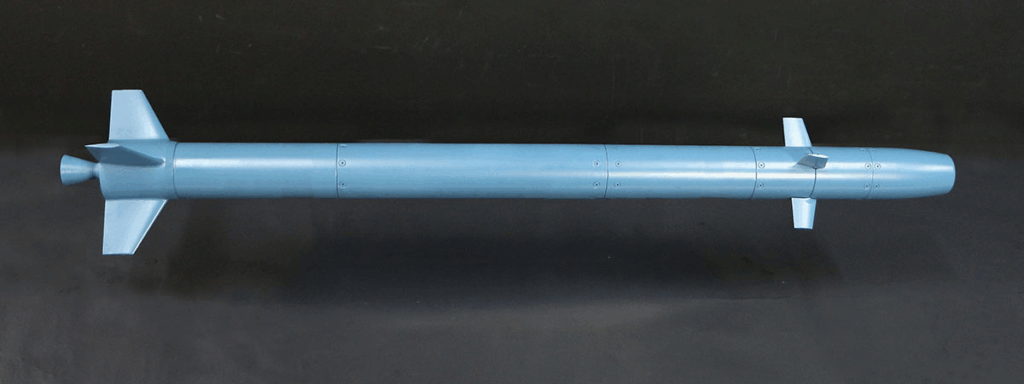
Missiles can come in many different shapes. Some are long and thin, others shorter and thicker; some have large fins, others small, and some even look like small planes with wings. Why aren't they all the same? The main reason lies in the aerodynamicsthe discipline that studies how air affects objects moving through it.
Let's take a simple look at why missiles need to be stable to fly well and how proper aerodynamic design achieves this.
The Need to Fly Straight: Stability
A missile must follow a predictable route to reach its target; it cannot just bounce around uncontrollably. That's why it needs to static stabilityIf it is deflected by something (such as a gust of wind), it should have a natural tendency to return to its original trajectory.
Think of an arrow. It flies straight ahead, with its tip in front, thanks to its tail feathers. Or the case of a weather vane, which always orients itself with the wind. Missiles use similar principles. They need a way to keep pointing in the right direction as they fly.
To understand how this stability is achieved, we need to know two key imaginary points on the body of the missile:
- Centre of Gravity (CG): This is the balance point of the missile. If you could support it on one finger without it falling over, you would be touching its centre of gravity. It is the point where, for all practical purposes, we can consider all its weight to be concentrated.
- Centre of Pressure (COP): When the missile flies, the air exerts forces on each of its surfaces (drag, lift, etc.). The centre of pressure is the imaginary point where the resultant of all these aerodynamic forces can be considered to act. It is like the "centre of thrust" of the air on the missile.
The Golden Rule (very simplified) of Static Stability tells us that, for a missile to be stable and tend to fly straight on its own (like the aforementioned arrow or weather vane), the Centre of Pressure (COP) must be located behind the Centre of Gravity (CG).
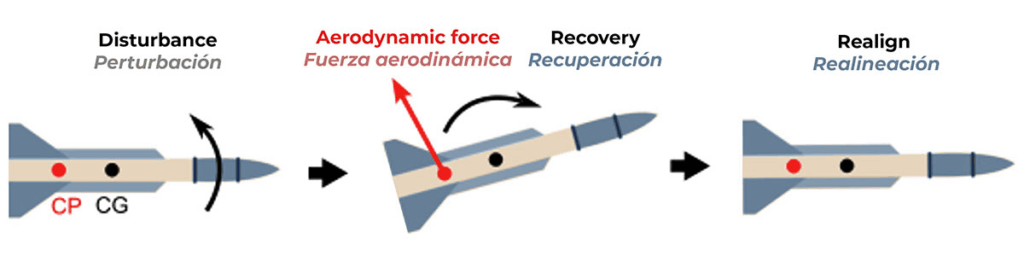
What is the reason? Imagine that the nose of the missile is deflected slightly upwards. The air now "hits" the missile from a slightly lower angle. As the point where this force acts (the CP) is behind the point of balance (the CG), this force creates a restoring twist or "torque" that tends to push the tail upwards and therefore lowers the nose. The missile corrects itself and realigns itself with the direction of flight. If the CP were in front of the CG, that same force would increase the deflection, causing the missile to become unstable and start to spin.
This is where the fins come into play, especially the tail fins. Their main job is to add aerodynamic surface area to the rear of the missile. This moves the Centre of Pressure (COP) rearward, ensuring that it is behind the Centre of Gravity (CG). Think of a dart; at the back it has a feather to move the CP back, and at the front it usually has a metal section near the tip to move the CG forward. If either of these elements were missing, the dart would not be able to fly straight.
Beyond Flying Straight: Dynamic Stability and Control
Certainly, it is not enough for the missile to shop to straighten out during its trajectory. Imagine the case of a car with worn shock absorbers: after passing a pothole, it keeps bouncing for a while. Similarly, a missile needs dynamic stabilityi.e. the ability to quickly damp any oscillation after a disturbance, returning to its trajectory in a smooth and controlled manner. The design of the fins and the overall shape of the body also influence this characteristic.
Now, if a missile is designed to be stable and fly straight, how does it turn and pursue a moving target? This is where the control. Stability ensures that you maintain the desired direction, and the control system allows you to change that direction when necessary. The most common forms of control are:
- Movable flaps: They can be moved to redirect the airflow to guide the missile.
- Vector thrust:Some missiles can move the engine nozzle to use the gas jet as a "rudder".
Why are there missiles with so many different geometries?
The variety of geometries is due to the fact that each missile is designed for a specific missionand this requires different aerodynamic characteristics:
- Speed: Missiles flying at supersonic (faster than sound) or hypersonic (several times the speed of sound) speeds need very sharp, streamlined shapes to minimise air resistance and manage shock waves. Their fins are usually smaller, thinner and with particular shapes (such as arrows or deltas).
- Manoeuvrability: An air-to-air missile that must chase an agile fighter needs to be able to turn sharply. It will often have relatively large control fins or canards (close to the nose) for quick response. Sometimes, some natural stability is sacrificed to gain agility, relying more on active control systems.
- Scope: A cruise missile flies long distances, often at lower (subsonic) speeds. Therefore, it often has wings (like an aeroplane) to generate lift and fly efficiently, saving fuel. Also, their noses are usually more rounded than in the case of supersonic missiles.
In short, the shape of a missile is not accidental. It is the result of apply aerodynamic principles to achieve a balance between stability (flying straight), control (being able to turn) and efficiency (adapted to its speed and mission). The distribution of the different aerodynamic surfaces is key to ensure a specific distance between the Centre of Pressure and the Centre of Gravity. Differences in speed, manoeuvrability or range explain the great diversity of designs we see.
Next time you see a missile, look at its shape and fins - now you know a little better why they are different in each case!