The story aeronautics is full of initiatives, experiments and developments that, with hindsight, seem far-fetched. But there they are. In fact, it is surprising how the human mind is capable of awakening the most bizarre ideas in times of crisis and, especially, in times of war. A clear example of this fact was the project called "Project Pigeondeveloped in the United States during World War II with the aim of advancing the field of guided systems.
The use of pigeons to guide bombs during the last world war seemed a pipe dream until their feasibility and effectiveness was demonstrated.
Wars, much to our regret, are as a rule a field in which the technology development is exponentially ramped up, where being one step ahead of the opponent makes all the difference and where having a proving ground for less humane ideas is relatively easy.
During World War II, achieving a guided bomb was a utopian goal; computers were still large, heavy machines that were impossible to fit into any kind of bomb. In 1943, the United States, in its quest to achieve a more accurate pump guidance system than traditional methods, he contacted psychologist and inventor Burrhus Frederic Skinner and awarded him a contract under the name "Project Pigeon".
Years earlier, Skinner had contacted the National Inventors Council to show the progress he had made in pigeon research, but at the time it seems that he did not raise the necessary interest for the national defence agency.
Skinner's idea was to introduce pigeons into the heads of the bombs so that, by means of a sighting device, a monitoring device and appropriate training, they would be able to guide a bomb towards a certain targetthat is, to turn them into kamikaze pigeons. On paper, a trained pigeon was far superior to a human being in this task. They have better eyesight and reaction capabilities than humans, not to mention collateral advantages such as being able to differentiate colours, not getting dizzy and being small in size.
The project had two challenges to overcome, one of which was the complete training of birdswhere they would be subjected to different tests and phases, while the other main challenge was the development of the passenger compartment and control device of the pump in question.
The training began with a squadron of 64 pigeons. The target for the actual tests was to be a white triangle on a green field in Florida, so Skinner would leave the birds for 36 hours without food and then put them in a box and show them white triangles on green paper. This was coupled with the delivery of a few grains of food. It did not take long for the birds to associate the relationship and peck at the white triangle with such ferocity that stronger sheets of paper had to be used.
In the next phase, a projector with an image of the target moving on a projection screen, i.e. a mini-cinema for pigeons. The screen had an electric mechanism which, when pecked on, opened a trap door and dropped a few grams of food. This worked until the birds realised that it made no difference which part of the screen they pecked on to open the trapdoor that provided them with food. Skinner solved this problem by introducing a double beam of light at right angles to the target, so that the peck would have to break both beams to obtain its desired prize.
Subsequently, the constancy of birdsThe bombs were not fed without a minimum number of pecks on the target, resulting in an intensity of four pecks per second for two minutes, which would ensure constant guidance of the alleged bomb.
The final test consisted of an operator with a manually moving image, so that the pigeons could not follow any patterns that the projected images might have and had to perform the exercise in a real and totally random way.
The 64 pigeons that underwent this training passed with flying colours.
In addition to all the previous phases, the pigeons were subjected to physical tests that could stun them or divert them from their objective, as could happen on a real battlefield: from flashes and flashes to the sounds of explosions in close proximity, pressure variations, vibrations, pure oxygen, change of G-forces centrifuging them as if they were astronauts, etc.
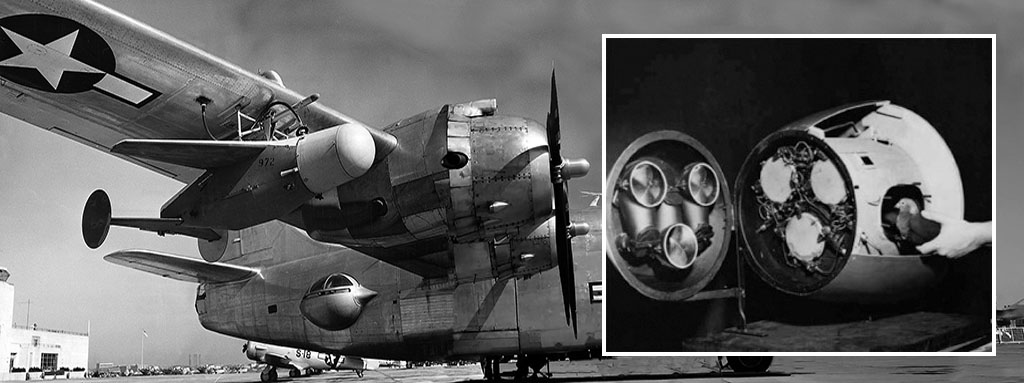
On the other hand, the pump head was designed as an enclosure where they could house three, five or seven birds, each with a visor linked to the visor of the other pigeons, and in turn, mechanically connected to the aerodynamic control surfaces of the pump. In this way it was possible to ensure that if any pigeon deviated from its task, the rest could continue on course. Let's not forget that as it was a mechanical system, coordination was needed and it depended directly on the strength of the peck they developed.
As a final test, with the pump head designed, it was decided to intersperse male pigeons with female pigeons to see if at any point either gender abandoned their task. This was not the case, the birds again performed the perfect exercise, the 36 hours of fasting outweighing any other animal desire.
When enough research had been done, Skinner was invited to conduct a demonstration by the Office of Scientific Research and Development in Washington, D.C. The demonstration was a success. However, in 1944, to the relief of the pigeons, the project was cancelled on the pretext of allocating funds to more immediately applicable research. In addition, by the end of 1943, the Germans had once again gone ahead with a radio-guided bombing attack.
Today Skinner's prototype bomb is on display at the National Museum of American History in Washington D.C. For his part, Skinner decided to keep the pigeons he had trained with such dedication, which he put through the same tests years later, having ceased training altogether. The pigeons again hit the target proving that the psychologist's work had been worthwhile.