During the 1970s, with two severe oil crises, Western countries saw the need to reduce their energy dependence on oil. It was in this context that the term "energy efficiency" began to be coined. energy efficiency. The measures taken then were relaxed in the 1980s with the fall in oil prices. However, governments and society were already conscious of the need to reducing dependence on fossil fuels, y maximising energy efficiency in all systems requiring oil and oil products for their operation.
At present, it can be said that a jet-powered aircraft, operated at 70%, consumes the same amount of fuel per seat-kilometre as a utility vehicle operated at 30%.
The Aviation industry has been at the forefront of technological innovation during the 20th century, making air transport a mass and growing phenomenon. However, this technological improvement has not always translated into improved energy efficiency, as evidenced by the introduction of the first jet-powered aircraft in the 1950s. These aircraft, despite better flight performance, consumed more fuel than piston-engined aircraft.
Over the past 50 years, it has improved the energy efficiency of the reactors by 70%The new technology, combined with other technological improvements (aircraft systems, air traffic control, improved runway operations) have contributed to a significant improvement in fuel consumption.
Today, in global terms, it can be said that a jet-powered aircraft, operated at 70%, consumes the same per seat-kilometre as a utility vehicle operated at 30% and, paradoxically, the same as the old piston-powered aircraft of the 1950s.
ICAO, in its publication ICAO Environmental Report 2013 confirms that this trend in energy efficiency improvement is set to continue over the next decades. By 2030, the agency predicts, a 35% improvement in the fuel consumption of jet aircraft will be achieved over the average fuel consumption in the year 2000.
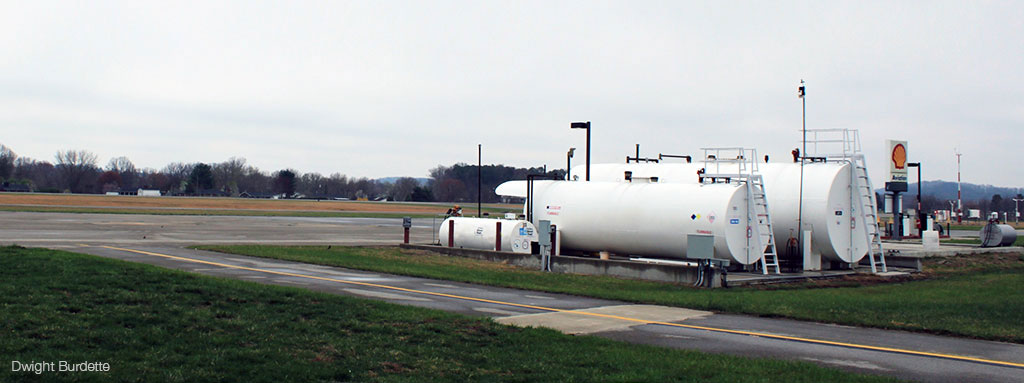
The airports are no strangers to improvements in aircraft fuel consumption. The airport facility that best reflects these trends is the fuel farmsalso known as Fuel Farms.
The fuel farms are one of the airport's most critical facilities. They are designed to withstand several days of demand without external fuel supply. A failure at this location can ground aircraft with consequent damage to passengers.
If ICAO trends in jet upgrades are confirmed, airport fuel farms will undergo significant changes in demandeven with large increases in passenger traffic.
To exemplify this, an analysis is made of a fictitious airportThe airports are expected to double their traffic demand in the next 25 years. Therefore, in 2040 it would reach a traffic of 30 million passengers.
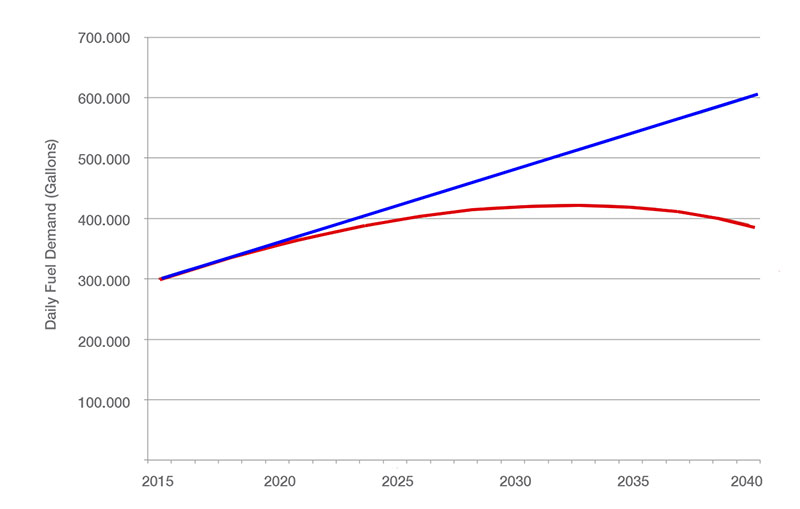 For the year 2015, we assume a daily demand of 150,000 gallons of fuel in the fictitious airport.
If aircraft energy efficiency did not improve during those 25 years, fuel consumption at the airport would double as traffic doubles, i.e. from 150,000 gallons in 2015 to 300,000 gallons in 2040 (blue line in the graph). This would force the airport to double the capacity of the fuel farm and all its facilities.
However, thanks to the expected improvements in aircraft consumptionIn this case, a situation like the one shown in the red line can occur: a higher energy efficiency emissions from aircraft can cause fuel demand at airports to drop significantly, even with large increases in passenger traffic.
This situation poses a sizing dilemma fuel farms: Provide facilities according to current aircraft consumption or according to future consumption.
Following one trend or the other will necessarily have an impact on many of the economic and management aspects of airports (design, planning, construction and maintenance of storage infrastructures, as well as the sizing of the associated safety and operational measures). Knowing with certainty, or at least with a solvent approximation, what the fuel consumption is going to be in several years' time and, consequently, the necessary infrastructures, is a great help for the forecast accounts of any airport entity.
For the time being, the most widespread and reasonable solution is to leave the Fuel Farms in spacious areas of the airport and with the capacity to expand, in order to gradually adapt progressively installations, if necessary, to the demand for fuel.