The pioneers of aviation observed and tried to emulate the flight of birds by constructing surfaces that took advantage of air currents to generate sustenance. Wings play a fundamental role in today's aircraft and are perhaps the most studied part of the aircraft throughout history.
Back in the 19th century, a pair of French engineers, Alphonse Pénaud and Paul Gauchot, patented the design of a tail-less aircraft powered by two propellers. It was essentially the concept of a flying wingFixed-wing aircraft without auxiliary surfaces such as horizontal stabilisers.
Wings play a fundamental role in today's aircraft and are perhaps the most studied part of the aircraft throughout history.
But it was not until after the First World War that the United States, Germany and Russia developed an intense programme of studies on the different functionalities that could be obtained with wings. Designs such as the tilt-wing for vertical take-off, variable geometry wings for improved aerodynamics at high and low speeds, and the inverted arrow wing for increased lift and manoeuvrability at low speeds appeared.
Some of these ideas, such as the flying wing, were developed into the famous US Northrop B-2 Spirit bomber, which appeared in the wars in Kosovo, Iraq and Afghanistan. So did the tilt-wing with the Bell-Boeing V-22 Osprey with almost 20 years of service used by the Japanese and US military. However, others, such as the inverted arrow design, were considered impractical until the late 1970s, when research was carried out on the composite materials for the wings as they could not withstand high speeds.
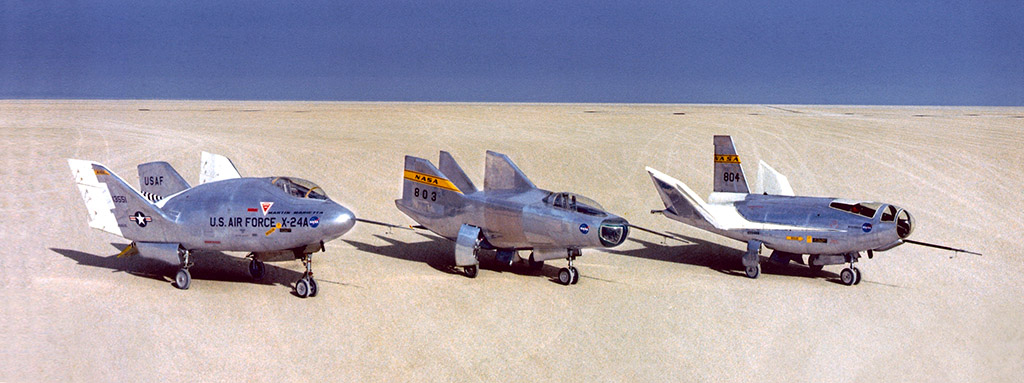
However, one of the most curious designs in relation to the role played by wings on an aircraft came with the Martin Marietta X-24A, a aircraft with air-suspended airframe which did not need wings to stay aloft. It was used by NASA in the 1960s, during the development of space "warfare", to investigate re-entry into the atmosphere. Another innovative design was provided by the Boeing X-50 Dragonfly a rotary wing aircraft developed to demonstrate that a helicopter rotor could be stopped in flight and act as a fixed-wing, enabling the transition between fixed-wing and rotary-wing flight.
In short, different designs for different functionalities with the same protagonist: the wing.