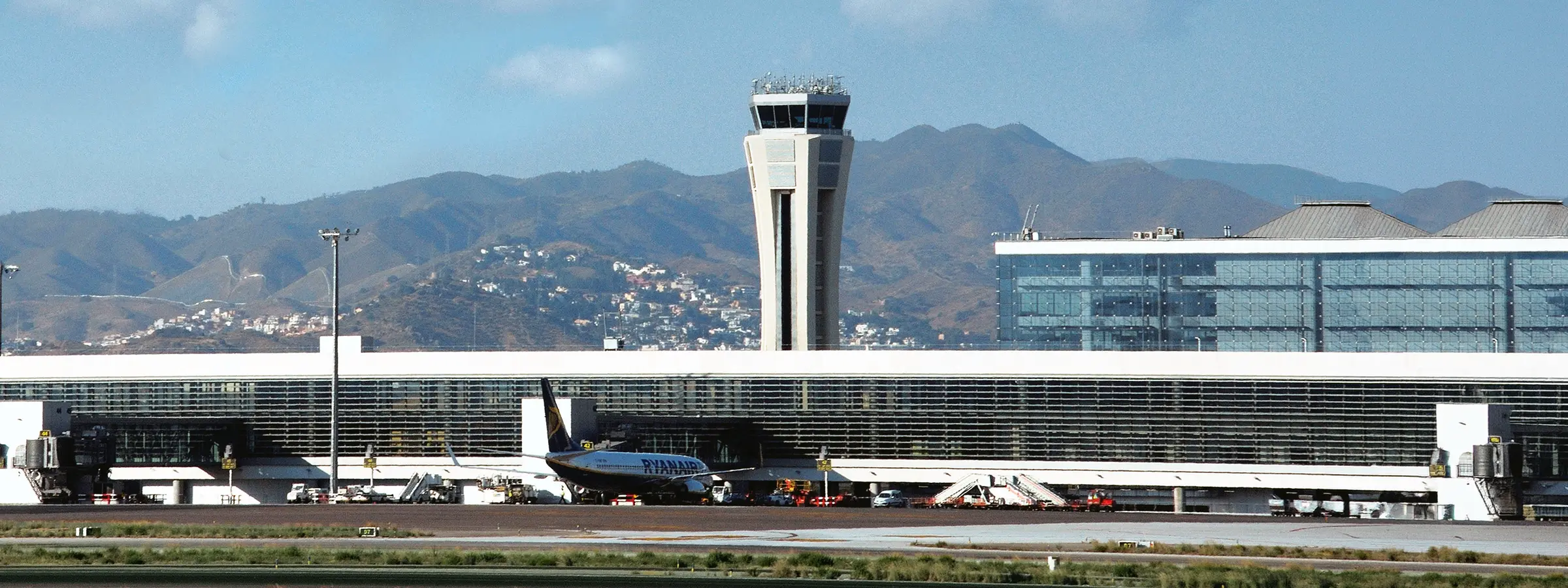
Each airport control tower is an opportunity to integrate technology, landscape and architecture into a single structure that expresses mastery, visibility and the future.
From a conceptual point of view, a control tower is, above all, a structure that elevates the air traffic controller's position to ensure a continuous, unobstructed view of the airfield. This function—seeing and controlling—has shaped the design of these buildings from the outset, accompanying the technical and operational evolution of aviation.
The installation of a tower follows a precise logic: its location, height and geometry are defined by visibility studies that guarantee visual control of approaches, take-offs, landings and taxiing. At the same time, its status as a vertical landmark requires constant verification with regard to obstacle limitation surfaces, which regulate the physical and radio restrictions of the environment. This tension gives rise to a balance between operational efficiency and formal restraint that has shaped its architectural expression.
Beyond its form, the tower is a highly technical infrastructure. Service continuity is an essential criterion, which translates into energy redundancy, precision and autonomy. The facilities—which integrate air navigation and control systems—far exceed those of an administrative building and define an architecture where reliability and safety are inseparable.
Over time, and in the face of the increasing homogenisation of terminals, towers have taken on a symbolic role. Their evolution reflects technological and regulatory advances, but also different ways of relating architecture, infrastructure and place, consolidating themselves as identity markers of the airport and urban landscape.
The origin of control towers
Its development is linked to that of civil aviation, when an elevated position to supervise operations and coordinate communications became essential. At the first aerodromes (1910–1920), supervision was carried out from the ground, balconies or rooftops, using hand signals, without specific buildings or technological integration. The modern tower appeared when control became institutionalised: it incorporated an elevated cabin, all-round visibility, defined technical spaces and, progressively, radio and radar.
Although there is no absolute consensus, it is generally considered that the first tower proper was the one at Croydon Airport (London, 1920), designed specifically for civil air traffic control.
At the same time, other precedents emerged: Le Bourget (Paris, 1923) incorporated an elevated structure into its terminal; Tempelhof (Berlin) developed observation platforms on the roof; and American aerodromes such as Cleveland Municipal Airport (1929) and Chicago Municipal Airport incorporated dedicated control cabins. These examples marked the transition from improvised posts to specialised architecture.
At this initial stage, a functional logic prevails: elevation to ensure visibility, glass enclosures and a minimum operating volume. This consolidates the ‘shaft + cabin’ typology, geared towards direct observation of the flight field.
With the increase in traffic between 1930 and 1950 and the introduction of radio, radar and taxiway control, the tower became defined as technical infrastructure. Examples such as Schiphol (Amsterdam, 1949) and Idlewild/JFK (New York, 1950s) introduced greater heights, panoramic cabins and a more complex spatial organisation. Fundamental criteria were established: 360° visibility, ergonomics, sound insulation, structural stability and environmental control.
Consolidation of architectural language and transition to remote models
As airports grow in scale and complexity, the tower consolidates its dual role: critical infrastructure and identifying feature. Technical parameters are set, such as sufficient height, panoramic cabin, volume for radar and communications, and a structure capable of minimising vibrations and ensuring insulation and thermal stability.
Architecturally, the tower evolves from a functional device to an infrastructural landmark. The tripartite typology—technical podium, structural shaft, and cabin—is stabilised, while concrete, steel, and glass express technological precision and urban presence. Visibility is integrated into the formal language through glass envelopes and vertical geometries.
In addition to its operational function, the tower acquires symbolic value: its elevation expresses centralised command and acts as a visual reference point for the airport. Its hybrid nature — command, surveillance, technology and ergonomics — requires a specialised design, with a strategic location, an enclosed cabin and an insulated shaft. It thus becomes a synthesis of architecture and engineering.
In recent decades, the Remote and Virtual Tower (RVT) model has emerged, transferring control to remote centres equipped with cameras, sensors and panoramic screens, already operational at low-density European aerodromes. From an architectural point of view, this means that the physical tower is no longer essential: the airport can be reduced to sensory nodes while control is centralised in a Remote Tower Centre.
This change does not eliminate the architectural dimension of air traffic control, but rather transforms it: the tower goes from being a vertical object to a distributed infrastructure, where digital systems and operation centres are gradually replacing the traditional control room.
Evolution of a model
The evolution of the tower—from the first visual cabins to remote models—highlights its hybrid nature, where critical infrastructure, architecture, and institutional representation converge. Its design requires a strategic location, sufficient elevation, a panoramic cabin, robust systems, and a stable structure, but also an appearance that blends into the airport landscape.
In the current context, marked by digitalisation and Remote Tower Centres, air traffic control architecture is not disappearing: it is transforming. The elevated cabin can be replaced by sensory nodes and remote centres, while the demands for connectivity, redundancy and adaptability are increasing. This requires the design of towers and control systems with flexibility and consistency with the airport master plan.
For airport architects, the tower is a strategic element: it coordinates operations, security and public image. It is not an isolated building, but a key node in the system. Its correct design enhances operational efficiency and the perception of modernity, while its obsolescence compromises functionality and identity.
Ultimately, the control tower remains a symbol of dominance over air and land space, even as its form evolves. Each project is an opportunity to integrate technology, landscape and architecture into a single piece that expresses control, visibility and the future.
Key topics related to this post: Airport planning and design, Project management y Airport operations.