"It is very important to develop architectures that can help us in this task of achieving a sensible well-being without endangering the world. And to do that, society must understand that we have to invest in these aspects to really prepare a future, a decent future." / Iñaki Ábalos, 2015
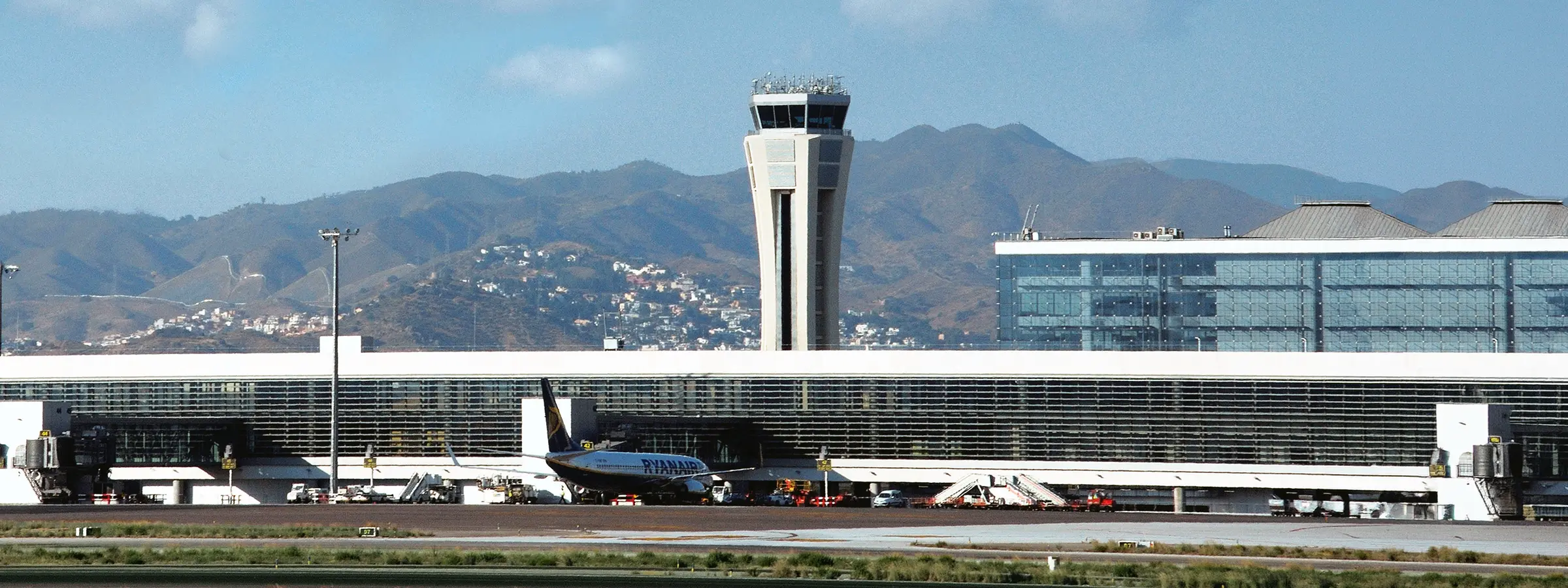
At the beginning of 2023, AERTEC's airport planning team eagerly began the drafting of a very special project: the functional design of Malaga airportled by the airport operator Aena.
It is about designing the future of our nearest airport. "Our company was born around it more than 25 years ago and it has been in El Rompedizo where many of the professionals who belong to AERTEC have been trained and gained experience.
The project consists mainly of calculating the needs of the airport's main systems with a view to 2050The following are the main needs: airfield, movement area, terminal area, landside development and access. Subsequently, give shape to these needs by "imagining" how these systems should grow and develop. Quite a challenge.
That is why it is worthwhile to take a look at the a look at the starting pointThe airport was built at the beginning of the current Malaga-Costa del Sol airport, which already processes more than 20 million passengers every year. It is always important to know the "why" of things. Knowing the history helps us, without doubt, to respect the "board" on which we propose our solutions.
From Latécoère to Ryanair. 100 years of air transport in Malaga
The location of the oldest airport on the peninsula that respects its original location was born from the intuition of an intrepid pilot in his quest to find safe landing areas on the Toulouse - Casablanca route (see post by Vicente Padilla). From that moment on - remember, 1919 - the activity around this improvised landing area, the farmhouse of El Rompedizo, has been frenetic for more than 100 years of history.
After the first landing of Latécoère and until the outbreak of the civil war, the Gallic aviator's airlines had a simple hangar that served as a shelter for passengers, mechanics and crew. In 1932, the state acquired the estate and the aerodrome became a national airport until 1937, when it was converted into an air base.
In 1946 the airport was opened to national and international traffic and all passenger services were provided in the air base premises until 1948, when it was inaugurated. the first civilian passenger stationThe project was the work of Luis Gutiérrez Soto - the architect of Barajas - who had designed it when he was a Captain in the Air Force.
Some images of passengers enjoying the terraces of the Gutiérrez Soto building show us the benefits of Malaga's climate. It is clear that the current security restrictions make it impossible to enjoy air travel in this way again. But there is no doubt that these open passenger terminal solutions are worth exploring in order to return in some way to these beginnings.
At the end of the 1950s, a phenomenon took place that completely transformed the physiognomy and scale of Malaga airport: the emergence of mass tourism. The growing influx of European tourists coming - mainly to Torremolinos - to enjoy the newly created paid holidays required a comprehensive refurbishment and meant the construction, in only 14 years, of 3 passenger processing buildings, as well as a completely renovated airfield.
En 1958 se pavimenta la pista existente – que contaba con una longitud de 1.200 metros- y, tan sólo un año después, se aprueba y realiza una ampliación hasta 3.200 metros, así como una calle de rodaje paralela a ésta. A partir de ese momento, el núcleo de las operaciones en tierra se traslada hasta hacerlo coincidir con el centro de la pista, aproximadamente a un kilómetro y medio al norte del área terminal anterior. En dicha ubicación se construirán un nuevo estacionamiento de aviones y la torre de control.
En cuanto a las terminales, desde 1958 hasta 1965, se construyeron varios módulos de barracones tipo ATUCAS of the Air Ministry. In 1968 a provisional terminal for international traffic and finally, the construction of the so-called modular terminal for non-scheduled traffic - the future T1 - which was inaugurated in June 1972. The design, the work of the architect Eduardo Aguirre, was identical to that of the terminal buildings at Palma, Girona, Alicante and Ibiza airports.
Ya en los años ochenta el persistente crecimiento de tráfico aéreo derivó en la construcción de un nuevo edificio terminal, el cual se inauguró en noviembre de 1991 con el nombre de Pablo Ruiz Picasso. La terminal – diseño del arquitecto Ricardo Bofill y que en el futuro se conocerá como la T2 – se adosa a la terminal de Aguirre mediante un módulo intermedio integrándose operativamente con ésta.
Igualmente, para completar el área terminal y paliar el déficit de aparcamientos, en 1995 entró en servicio un nuevo edificio de aparcamientos situado frente a la terminal Picasso.
Entering the new millennium, Aena begins an ambitious process of enlargement and remodelling of the airport. The Malaga Plan whose aim is to developing the airport's capacity to the maximumThe airport has a design horizon, according to the Master Plan updated in 2006, of 20 million passengers in 2017. Among its most significant actions are the new passenger terminal, called T3, the new car park building, attached to the existing one, the suburban train station that links the airport with the city centre and with Fuengirola and an important extension of the airfield.
The new T3, inaugurated in 2010, must be joined operationally to the existing ones, which are renamed T1 and T2 respectively. To this end, a transition corridor was built between T2 and T3, allowing internal circulation through the three buildings. The complex forms a single terminal area with capacity for more than 9,000 passengers at peak times. At the same time, opposite T1, a new car park building is being built with capacity for 2,500 vehicles.
For its part, the new airfield consists of a new 3,090-metre long runway, a parallel taxiway, four rapid exit taxiways and more than 150,000 square metres of apron, providing considerable aircraft parking capacity.
If we do not consider the two major hubs of our territory, Adolfo Suárez-Barajas and Josep Tarradellas - El Prat, nowadays Malaga-Costa del Sol airport is the main entry point for tourism in our country.. Estimates are still showing significant growth. Everything points to the fact that El Rompedizo will reach its maximum development around its 125th birthday. It will then be nice to say that AERTEC made an essential contribution to part of its history.
The information contained in this post comes almost entirely from the bibliography that the engineer D. Luis Utrilla Navarro has been developing for decades about Malaga airport. This brief summary is only a tiny sample of the enormous amount of information that can be found in Utrilla's books. In fact, I would encourage anyone who is curious to know every last detail about the Malaga aerodrome to take a look at this bibliography. Especially two of them:
- Utrilla Navarro, Luis (1999). Malaga airport, eight decades of air transport history. Ed. Aena. Malaga Airport.
- Utrilla Navarro, Luis (2010). Malaga airport architecture. Eugenesis, aesthetics and functionality of the new terminal building at Malaga airport. Ed. Aena, Malaga Plan.