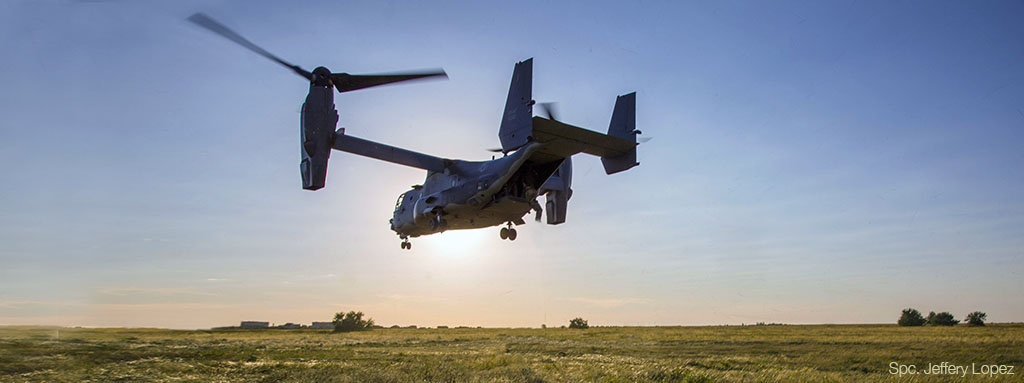
A convertible aircraft is an aircraft that is able to vertical take-off and landingThe helicopter, once it has reached a sufficient height and speed, can be used as a helicopter, move horizontally as a conventional aircraft. It is also known as a convertiplane or tilt-rotor aircraft. This concept whereby the propeller-rotors can change their position 90° to the fuselage acting as rotors in helicopter mode and as propellers in fixed-wing aircraft mode, is called VTOL (Vertical Take-Off and Landing).
VTOL aircraft arise from the need to shorten runways, as well as the possibility to have aircraft operationally available in any kind of terrain.
The need to shorten runways, as well as the possibility of Operational availability of aircraft in all terrain classesThe use of this type of technology, including on aircraft carriers at sea, was the driving force behind this type of technology.
The most famous convertible is perhaps the Bell Boing V-22, better known as the Osprey, in which an attempt was made to unify the manoeuvrability of the helicopter, its ease of vertical take-off and landing, with the speed of translation of the aircraft. This is achieved by changing the position of its propellers. Unfortunately, this model of aircraft is very expensive to manufacture and is expensive and complex to maintain. Operationally, although faster than similar aircraft, it is also less aerodynamically efficient, which affects its manoeuvrability and safety.
There are other experimental models whose design and tests were used to develop the qualities of vertical take-off and landing in a tilt-wing aircraft, some of them being the Canadair CL-84 Dynavert, LTV XC-142 or the Vertol VZ-2 (Model 76): Canadair CL-84 Dynavert, LTV XC-142 or the Vertol VZ-2 (Model 76).
Although at first these machines may have seemed rather fanciful, it was only a matter of time before they became a reality. If we take a look at the new concepts in aircraft modelling that the different aerospace companies are developing, we will have some idea of the aviation that awaits us in the years to come.
The Terrafugia TF-X flying car, a hybrid VTOL vehicle that runs on petrol and electricity, seats four and has two folding wings with two engines at each end, obtained the necessary documentation in 2015 to test-fly a mock-up, albeit without passengers or a pilot.
The American company Krossblade, introduced the SkyCruiser, a hybrid transport vehicleThe 8.4m long and 1.3m high, it takes off and lands like a helicopter. To do so, it extends its four rotors as if it were a drone and, once at altitude, its rotors fold up and it begins to fly like an aeroplane propelled by rear propellers, reaching up to 500 km/h. When on the ground, it transforms into a road-worthy vehicle by folding up and stowing its wings in the fuselage itself. The doors fold upwards to accommodate up to five passengers. At the moment it is only a prototype and while it is being marketed they are experimenting with the SkyProwler, a scale model of the same concept.
The transformable drones They are not new either - Google and NASA, for example, have their own drone projects for transporting people based on this concept.
The EHang 184 AAV (Autonomous Aerial Vehicle) is a drone of Chinese origin with a high level of maturity and is expected to be on the market imminently. It is electrically powered, has four thrusters and is large enough to hold a person weighing up to 100 kg inside its cockpit. Although it cannot be piloted from the inside, it can transfer the passenger to a specific location through the use of a mobile application. It has a range of approximately 20 minutes of flight time at a speed of 100 km per hour, which means short distances, but it can be quite useful for medical emergencies or tourist trips.
Finally, the Kitty Hawk Flyer, a ten-propeller drone sponsored by one of the founders of Google, was also recently unveiled, along the same lines as the vehicles mentioned above. According to its manufacturers, you can learn to fly it in a few minutes and you will not need a licence to fly it (although the latter is something that will obviously have to be defined by the aviation authority).
In short, the technology that until a few years ago seemed a chimera, typical of futuristic films, the reality shows us that it is possible to carry them out by means of small advances and a constant iteration that lead us to achieve, if not improve, the initial concept.
#uam