Virtually everyone on the planet Earth is familiar with the history of Apollo 11 including the names of its famous crew Neil Armstrong, Michael Collins, and Buzz Aldrin and of course the famous words spoken by Commander Armstrong on 21 July 1969 when man first set foot on the moon, but only a tiny part of the world's population would be able to name the last human being to set foot on the surface of our beloved satellite.
When the Apollo 17 mission was launched at the end of 1972, it was already known that it would be several years (decades) before a space programme of such ambition would be resumed.
After Apollo 11, NASA programmed 6 additional missions5 of them managed to land on the moon and the other one is the well-known story of Apollo 13 and its "moon landing".Houston, we have a problemThe "Moonwalk" was made into a film a few years ago. In total, 10 other astronauts besides Armstrong and Aldrin, all of them US nationals, had the privilege and opportunity to walk on the Moon during the period from 1969 to 1972.
It should be borne in mind that the latter part of the 1960s were years of economic bonanza and also of Cold War, where the US strategic priority was to achieving technological supremacy against the USSR. But during the following years the oil crisis, the satisfaction of having achieved the objective before the USSR and the need to devote economic resources to the Vietnam War, among others, The lunar research programme's budget was gradually reduced as a result of the until it was totally cancelled. In fact, there was an initial attempt by President Richard Nixon to suspend the programme after the Apollo 15 mission, although two additional missions were finally authorised.
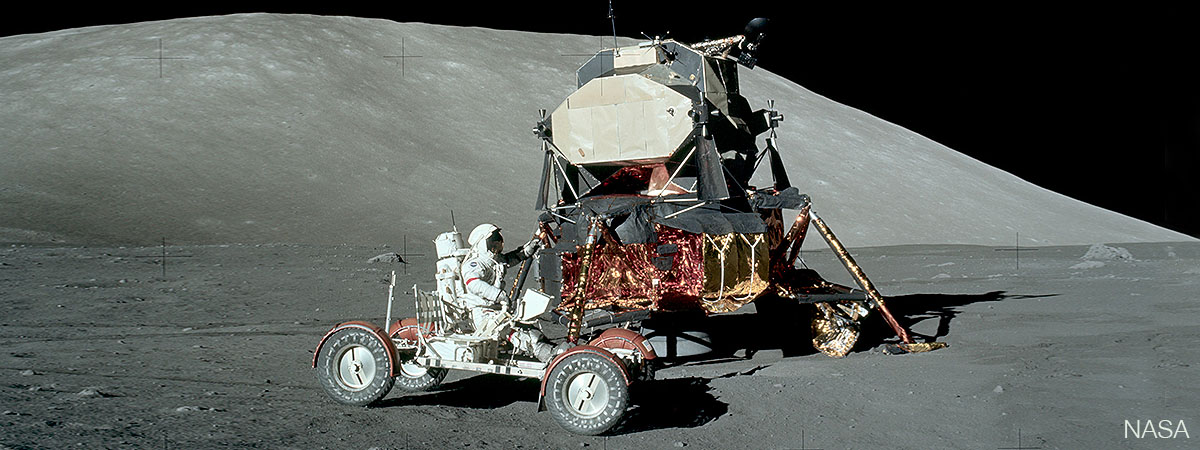
It was in this international and economic context that the mission was carried out. Apollo 17 at the end of 1972 and at that time it was already known that it would be several years, today we know several decades, before a space programme of such ambition would be resumed. The mission commander was Eugene Andrew Cernanan electrical engineer from Purdue University in Indiana (the same one Neil Armstrong attended, by the way) and a U.S. Navy pilot with more than 5,000 hours of flight time and 200 carrier landings.
At the age of 29, Cernan was selected to participate as an astronaut in the Gemini and Apollo space programmes and, three years later, due to a fatal accident involving the crew of the Gemini 9 mission while they were training, he was given the opportunity to be launched into space on the renowned Gemini 9A mission, becoming youngest American astronaut to be launched into outer space. On this successful mission, whose scientific objectives were to obtain zodiacal light and study micrometeorites, rendezvous and docking techniques were practised with a vehicle similar to the one later used on the Apollo missions, and Gene Cernan had the opportunity to perform an extravehicular activity (EVA) lasting approximately two and a half hours.
As part of NASA's rotational rotation of astronauts, Cernan had the opportunity to have participated as a lunar module pilot on the Apollo 16 mission, but he was ambitious and resigned in order to command Apollo 17. He was accompanied on this mission by Ronald E. Evans, another experienced astronaut who was in charge of the command module, and Harrison H. Schmitt as lunar module pilot, a scientist specialising in geology who replaced Joe Engle, pilot of the X-15 rocket plane, at the last minute and with considerable controversy at the time, who was the mission's incumbent.
The three crew members completed a three-day mission The first lunar surface duration was a complete success and set several records that still stand today, such as being the first night launch, the maximum number of hours spent by astronauts outside the Lunar Module performing experiments, the rover speed record, the first night launch, the first night launch, the first night launch, the maximum number of hours spent by astronauts outside the Lunar Module performing experiments, the rover speed record on the lunar surface at 18 km/h or that of the larger volume of rock and samples collected.
On his return to Earth, Cernan spent a few years collaborating in the development of the joint Apollo-Soyuz programme between the USA and the Soviet Union, which in 1975 achieved the docking of the two spacecraft in space for 44 hours during which five astronauts, three Americans and two Soviets, had time to exchange gifts, carry out various scientific experiments and even share a meal. Cernan eventually retired from NASA in 1976 and went on to hold various executive positions in large private corporations.
Perhaps Cernan's last words before boarding the lunar module near the Sea of Tranquility and leaving the satellite forever were not as inspired as Armstrong's first, for the phrase he left on record for posterity was "Today's American challenge has forged the destiny of tomorrow's Man"., but interest in his legacy has been stoked in recent years with his story being featured in several documentaries and his voice has even been incorporated into contemporary pop culture as part of the song "Contact"by the French electronic music duo Daft Punk.
For the past few years human interest in returning to the moon has been revived. and not only the US, but also other countries such as China with its CLEP programme".Chinese Lunar Exploration Program"The project, which has been active since 2007 and is now in its third phase of collecting and transferring samples to Earth, is scheduled for completion by the end of 2007. sending manned missions to the Moon from 2030 onwards So it is quite possible that Commander Cernan, who died three years ago without knowing his successor, will not have much time left to continue to enjoy his status as the last man on the Moon after his now distant walk on 14 December 1972.