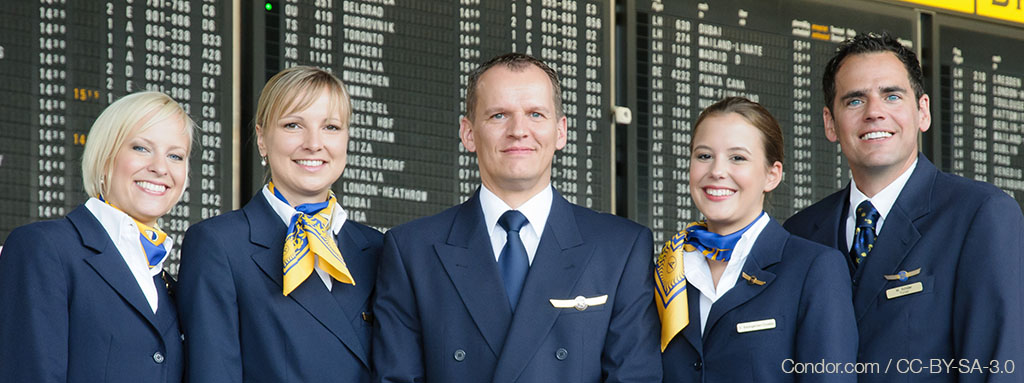
One of the best-known images of any airline is its Flight Attendants, commonly referred to as flight attendants. They are the friendly face we meet as soon as we arrive: they help with boarding and greet passengers as soon as they step on the plane, accompanying them throughout the journey and offering them information, drinks and food, but they are also a great way to help them with their luggage. The work of the MCTs goes much further. In order to obtain the qualification for this job, a wide range of knowledge about aviation and the needs that may arise in this context is required.
Being a cabin crew member is much more than being the face of an airline.
The first thing they must learn is the concept of aircraft and to be able to identify their different typesThey learn the main structural components of aircraft, their configuration, equipment and main instruments. They learn the basic concepts of aerodynamics and principles of flight, the basic movements and actions of an aircraft and its components for control and stability. They are familiar with the main functional systems of the aircraft, their location and use. They even receive practical piloting training for emergencies.
Their technical preparation includes knowledge of air navigationThey are trained in airspace, its classification and the functionality of its different areas, as well as the different phases of flight (especially the critical ones) and methods of action. They are trained in meteorology and its effects on aviation.
They are up to date on the most relevant institutions The EASA, EASA, EASA, ICAO; as well as the competent tasks of each one and the convention that frames the regulations on international civil aviation.
Apart from being informed about the contract of carriage by airIn addition to the conditions, carrier liability and aviation insurance, these workers must be able to help resolving common medical issues during the flight by applying the appropriate measures with the sanitary equipment available on board if necessary. They are trained to identify the physiological effects of flight They must be able to provide first aid in medical emergencies arising during the flight: guidelines for action in the event of asphyxiation (Heimlich manoeuvre), basic cardiopulmonary resuscitation (CPR) and defibrillator, oxygen administration, treatment of fractures, cuts or burns, etc.
In the event of a plane crash, they are the ones who indicate the guidelines to be followed.The emergency and triage of the wounded and their transfer are established. Another requirement is knowledge of concepts related to human and resource management factorsto help them analyse the main aspects of reliability, stress, fatigue and how to combat them.
They are also responsible for ensuring that the documents and manuals The operator must ensure that the relevant procedures are up to date with the modifications provided by the operator. Prior to each flight, a briefing meeting is convened to organise the duties and responsibilities of each cabin crew member and to review procedures in the event of an emergency.
With regard to the transport of dangerous goods by air in accordance with the regulations in force, they identify them, take the necessary precautions and take the necessary measures if they have been concealed in hand luggage.
They ensure that baggage and service items in the passenger cabin are stow safely to avoid risks to occupants by obstructing or damaging equipment or emergency exits in the event of an evacuation being necessary. They are responsible for the correct application of the general guidelines for action during landing, splashdown or depressurisation or in cases of survival in hostile environments (polar zone, desert, jungle and sea). To this end, they also carry out compulsory rescue training in aquatic environments, since their fundamental task is to save the passenger's life in the most critical situations.
In turn, they are responsible for security against acts of unlawful interference and for the implementation of existing regulations such as the NSP, NCP and NTP (national security, quality and training programmes) which establish common standards and detailed measures for civil aviation security.
They are trained in the fire fighting. They must be able to deal quickly with emergencies involving smoke or fire by means of protective equipment and the application of extinguishing agents, in which circumstances they will apply the relevant guidelines and measures for extinguishing or prevention; while frequently checking areas that are a potential source, e.g. toilets.
Therefore, being a cabin crew member is much more than being the face of an airline.. A flight attendant undergoes intensive and rigorous training in first aid and rescue and also receives instruction in aviation concepts and even piloting, as his or her main mission is to ensure the safety of each and every passenger.