Despite what you might think, origami have been flying through space for many years now.. This ancient art of folding, which we have used so much to create and play with paper aeroplanes, originated between China and Japan some 1400 years ago. Until relatively recently there were only a few hundred designs, but today there are tens of thousands, thanks especially to Akira Yoshizawa, a great master who already in the 20th century contributed thousands of designs to this art, generating a renaissance of creativity all over the world.
Origami is not just an entertainment technique, but a design philosophy that can significantly help aerospace development.
But origami goes beyond the leisure aspect that we all know. There are companies that are dedicated exclusively to the study and creation of designs for multiple technological sectors, managing to give any shape to a sheet using folding patterns.
The initial technique consists of transforming a flat sheet of paper into a shape with volumewith relatively little processing, just using folding techniques over a pattern of lines previously marked on a sheet, but there is more to it than meets the eye.
In addition to lines, there are lines, segments, angles, common points, polygons, plane and three-dimensional figures, coordinate systems, numbers and lengths. These are a design environment that brings together engineers, physicists, and mathematicians to develop patterns with which any shape of object can be created. You can sketch anything from the typical paper aeroplane, boats, animal figures, or more complex designs such as geometric figures, moving structures, folding designs and even stable mechanisms. All this without the need for joints, nuts or connections, simply by folding.
With these techniques applied, for example, to the medical field, incredible tools have been created, such as a forceps for laparoscopic operations capable of reducing the parts of its predecessor by 75%, which are also capable of changing shape and adapting better to the environment without having to change tools in the process. Smaller elements are also made, reducing the size of the space required for the intervention. A bellows has also been created, covering an intracorporeal catheter, which stretches and contracts without reducing the inner orifice, thus protecting the catheter that is introduced into the body, without leaving it uncovered at any time, without putting pressure on it in the process and supporting it all the way through.
The simple folding of a sheet makes it more rigid.. When applied to engineering, this reduces the volume of material needed to create any design. However, the biggest challenge in engineering is the bending of thick, rigid materials to reduce the size. These techniques are being applied to materials such as polypropylene, steel, graphite, aluminium, synthetic fibres, fabrics, and any material that can be made into a sheet.
In the field of electronics, it is used to create small automatic folding mechanisms on electronic boards or in the manufacture of nanoinjectors.
Applied to the environment aerospaceIn this way, we can see how these techniques have been used for years in many processes. For example, the discipline of origami is applied from the folding of aircraft life rafts (capable of being packed into a small space and unfolding completely in a few seconds), to emergency evacuation ramps, or even in innovative technological designs (as is the case of jet engine exhaust nozzles, which are capable of rapidly orienting themselves in different directions, expanding and contracting in a controlled manner, giving the aircraft great manoeuvrability).
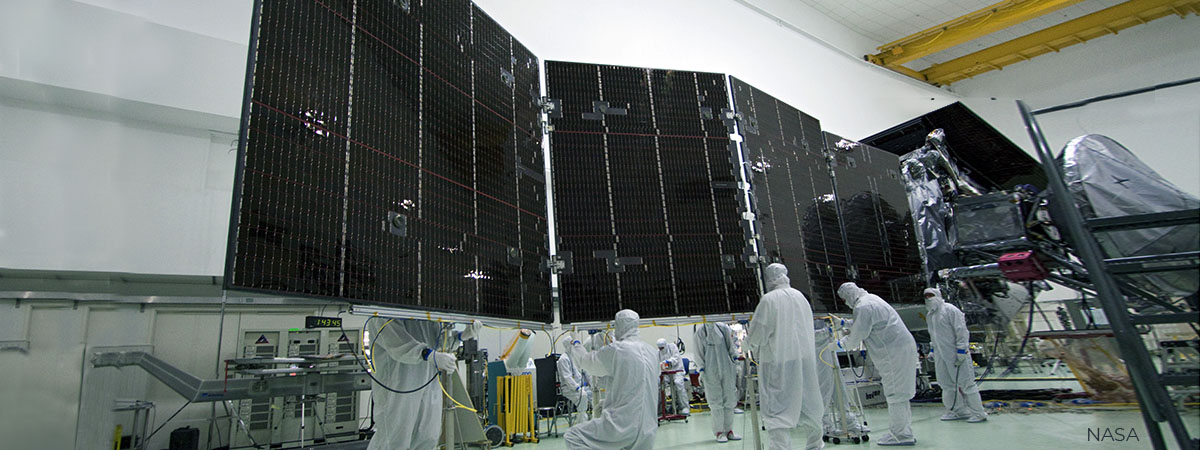
There are also implemented origami techniques in spaceAmong the most familiar are those used to safely fold and deploy solar panels on satellites. In 1995, the first origami was launched with the technique called Miura-oriIt consisted of a solar panel folded into a small space and capable of being rapidly deployed to power the satellite.
An even more effective design is now being worked on, called the Origami flasheris a folding pattern which allows large solar panels to be even more compact at launch and increases deployment reliability. This technique is being improved to achieve reduce the final size of the panels by up to ten times from their original size.
Origami techniques are already part of space telescope developments. This is the case of the James Webb Space Telescopein which 18 folding mirrors, composed of hexagonal beryllium parts, are folded to be sent into space.
These 18 mirrors form a total collecting surface of 6.5 m in diameter, which is a considerable increase over Hubble's main mirror, which is a single piece of 2.4 m in diameter. Since there is currently no rocket capable of carrying a single-piece device of this size, engineers, using origami techniques and patterns, have managed to fold these mirrors in a way that allows them to be transported and deployed safely. For NASA, achieving this feat is a milestone that paves the way for the development of larger, more complex devices to further improve the study of the universe.
With the scientific studies and the advances that mathematics is managing to incorporate in this art that has become a science, it will be possible to create any shape you need in space, with almost no assembly or tooling requiredonly by using folding. In practice, it is already being used in the design of future Mars exploration expeditions for the deployment of stable bases on Mars or in the design of solar sails. Engineers and architects are investigating how to fold different materials or metal panels for the construction of structures and the design of buildings and tents, which can house the space needed for future expeditioners.
All these developments and research make origami a technical possibility to be taken into account that opens up a whole world of imagination and an infinite number of practical applications in an environment in which space and the need to maximise the material resources available will be a great challenge to face.
Indeed, origami is not just an entertainment technique, but a design philosophy that can significantly aid aerospace development.