If we had to bet on the most famous sequence in the history of cinema, in many of the pools we would find the one in which Cary Grant is stalked by an aeroplane for almost 5 minutes of film. This one belongs to North by Northwest (North by Northwest) directed by Hitchcock. It all starts with someone wondering what a plane is doing spraying where there are no crops, and from there begins the endless chase of Grant until it finally ends with the plane crashing into a tanker.
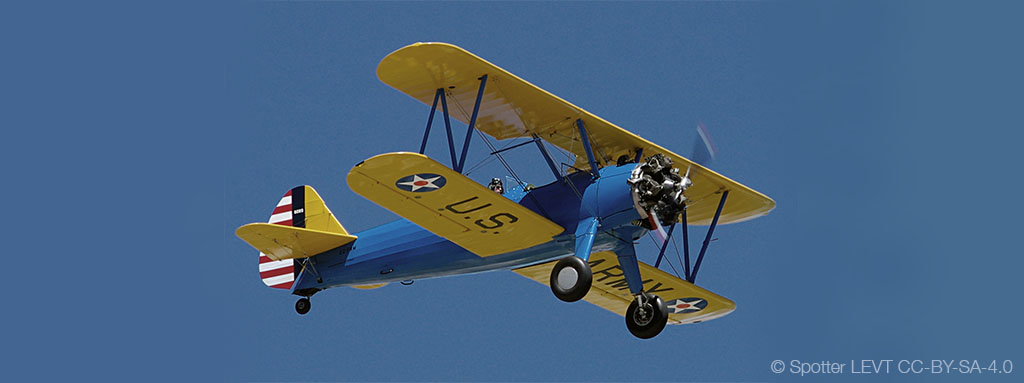
This aircraft is none other than the Boeing Stearman 75and in another great film, The English patient He is also used in an assassination attempt, but again fails to achieve his goal.
Despite being a supporting actor in several successful films, the Stearman 75 was largely unknown to the general public.
However, beyond being a mere killing machine, this biplane made of wood and metal is considered one of the greatest representatives of the Golden History of Aviation, standing out for its great manoeuvrability, responsive controls and flight safety, which led it to be the perfect military training deviceThe first of its kind, it was the key to the training of hundreds of thousands of pilots acquiring the basics of flying before making the transition to more powerful and modern advanced training aircraft.
These advantages, together with its low production and maintenance costs and the outbreak of the Second World War, meant that this model held the record (to this day) of the highest number of biplane sales in history of American aviation, with more than 8,500 units.
Once the war was over, and like Grant's failed assassin, the Stearman 75 was used mainly for spraying and planting, thanks to its very good qualities for the slow flight at low altitude. But it also had a great versatility to carry out other activities, such as the photographythe aerobatics or the wingwalkingThis activity, which consisted of doing all kinds of pirouettes and movements on the wings of the plane in mid-flight, was so popular at the beginning of the last century.
As a curiosity, due to its robustness and the possibility of taking off and landing on any type of surface and on very short stretches of land, this model was the first aircraft used to land on the deck of an aircraft carrier.
The Stearman 75 also appears in some of this century's films, such as the Pearl Harbourwhere it is featured in a couple of scenes (again fumigating), although the first of these, at the beginning of the film, is more famous for the director's great blunder of placing the scene in the year 1923, when this model was not produced until the mid-1930s.
Hitchcock was not spared from mistakes either, and during the scene of the plane crashing into the truck, it can be seen for a fraction of a second that the crashed plane is not a Stearman 75, but another similar model. Supposedly this was due to a lack of budget, but some say that the director wanted to keep it intact after many days of filming the aforementioned sequence.
This model, despite being a luxury supporting role in several successful films, was largely unknown to the general public. However, it deserved more recognition than it got, as it was a key player in several aviation milestones, almost completely conquering the skies of the United States, Canada and South America for several decades.