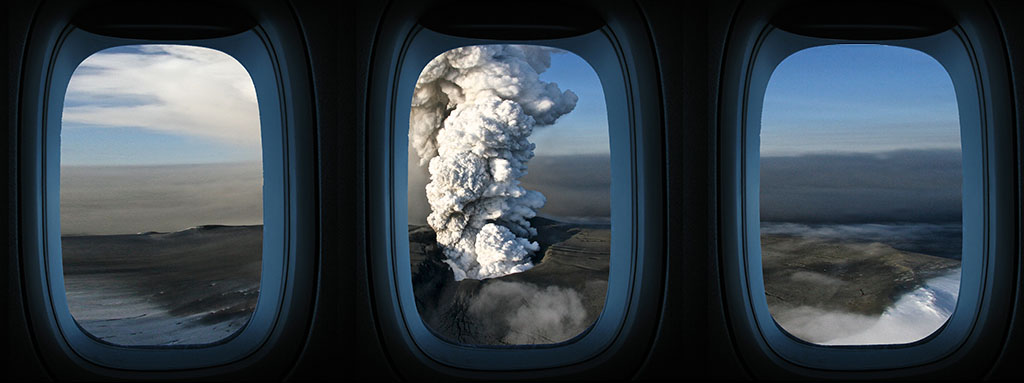
Los volcanes representan un riesgo potencial para la aviación que, a fecha de hoy, ya ha supuesto pérdidas millonarias debido a la necesidad de cierre de los espacios aéreos afectados por una erupción o las cenizas provinientes de ellas, pero, sobre todo, son eventos que es necesario prevenir para favorecer la seguridad de los vuelos.
En los últimos 50 años, más de un centenar de aviones comerciales han sufrido incidentes en vuelo a consecuencia de nubes volcánicas. Entre los percances más conocidos está el de un Boeing 747 de British Airways al que, en junio de 1982, se le pararon sus 4 motores a su paso por Indonesia. Otro 747 de KLM sufrió exactamente el mismo tipo de episodio sobre Alaska unos años más tarde. Los volcanes Galunggung y Redoubt fueron los culpables en cada caso.
Few spectacles in nature are as breathtaking as the eruption of a volcano. If the scene can be seen at night, believe me, it is one that is not easily forgotten. However, as in other facets of life, what brings us beauty on the one hand, threatens us on the other. For, in addition to the danger posed by the eruption itself, there is a risk that particularly affects the aeronautical world: ash clouds.
There is a recent episode that has enjoyed a prominence and follow-up never before given to this type of phenomena: The eruption of the Eyjafjallajökul volcano (Iceland) in 2010. But there are many others less relevant, such as those of Popocatépel (Mexico), Etna (Italy), Sangeang Api (Indonesia), Puyehue (Chile) or Ubinas (Peru), as well as dozens more, whose effects have been, among others, the suppression of aircraft flights in their vicinity due to the threat posed by ash emissions.
The case of the Icelandic volcano was particularly significant. It gave rise to to the further closure of airspace since World War II, with an impact on European airlines of 1.7 billion euros and an effect on global GDP of almost 5 billion euros.
Contrary to what some people think, the problem is not the remote possibility that the eruption will literally overwhelm an aircraft passing overhead, or that the heat of the molten lava (between 700 and 1,200 degrees Celsius) could melt any object passing vertically. It is unlikely that a plane will be allowed to get close enough to a volcano for any of this to happen. The danger we are talking about, and whose geographical scope can be continental in scopeis that of the ash expelled by the volcano.
But why can volcanic ash be dangerous for aircraft?
There are four main reasons:
- The ash can accumulate and melt inside jet engines, which exceed the melting temperature of the particles inside the engine. This can lead to the creation of new crystals which, if they adhere to certain parts of the engine, could cause its collapse.
- The ash is very abrasiveThe use of the engine, which can damage sensitive engine parts, can lead to the same result as above.
- They can cause erroneous readings of aircraft operation
- The invisibility of some ash cloudswhich, due to their low density or particle size, may not be perceptible to the human eye (their size usually ranges from 500 microns to 2 millimetres).
Not all volcanoes are potentially dangerous in this sense. The "Hawaiian" type, some of which are among the most historically active, do not emit ash. However, the "Vulcanians or Vesuvians"They are really threatening both because of the type of eruption and because of the usual emission of ash and other associated phenomena.
In view of the evidence of some aeronautical incidents, such as those mentioned above, caused by ash clouds, ICAO, in collaboration with WMO (World Meteorological Organization), established in 1987 the IAVW (International Airways Volcano Watch) to monitor the potential hazards to air traffic from volcanoes on a global level. Since that time, a series of operational directives and procedures aimed at minimising the impact of eruptions and increasing safety.
In the 1980s, the ICAO set up a specific monitoring office for volcanic phenomena.
Since the Icelandic volcano event in 2010, the ICAO has also mandated the IVATF (International Volcanic Ash Task Force) to assess the needs of civil aviation to anticipate such events.as well as to determine the necessary actions in each case. It also designated nine specialised zonal meteorological centres as volcanic ash control points (London, Toulouse, Montreal, Washington, Anchorage, Tokyo, Darwin, Wellington and Buenos Aires). These centres generally disseminate three standard types of information:
- Notice volcanic ash, VAA
- Graph volcanic ash, VAG
- Predictive model of its trajectory, HYSPLIT
In parallel to the work of official bodies, there are also companies that are devoting a significant R&D effort to the development of new and improved tools for early detection the possible presence of volcanic ash in the air and thus take preventive action.
A success story reseñable lo llevó a cabo un grupo liderado por Airbus en el que también intervinieron empresas como Easyjet o Nicarnica Aviation. Probaron con excelentes resultados un sistema denominado AVOID que, instalado en un avión, fue capaz de detectar la presencia de cenizas a 60 km de distancia por delante de la aeronave. Y no solo eso, sino que aportó anticipadamente datos sobre su densidad, concentración y movilidad. Disponer de estos datos con una antelación suficiente permite, no solo alertar a la tripulación sobre el posible riesgo, sino además, poner en marcha un protocolo adecuado que permita minimizar su afección al vuelo.
El sistema AVOID es un dispositivo que provee datos en tiempo real basados en un muestreo rápido sobre la proyección de imágenes de cámaras sincronizadas de infrarrojos. Una vez obtenida la información, se combina con información del GPS y los datos de velocidad del aire, con lo que se obtiene un mapa tridimensional de la nube de ceniza y su trayectoria prevista. Esta tecnología permite, en función de la concentración de cenizas, detecciones que oscilan entre los 50 y los 100 km, tanto de día como de noche. A velocidad de crucero convencional, esto permite una anticipación de 7-10 minutos al piloto de la aeronave.
R&D efforts are focused on obtaining predictive information on the nature and mobility of ash clouds.
This information is not only useful for the aircraft itself, which detects and processes it, but it can also be used to share with the zonal centres and thus keep other aircraft without the system informed.
Contrary to what some may fantasise, most natural phenomena cannot be mastered. Pero no cabe duda de que la tecnología y el conocimiento son factores clave para minimising its impact. For its part, the aeronautical industry has, among its priority objectives, to adopt appropriate measures in the fields of information, organisation, prevention and innovation in order to maintaining security at its highest level.