The typology "passenger terminal"has been in existence for a century. From the early days when an airport consisted only of a light hangar and an omnidirectional airfield to today's "airport cities", this infrastructure has undergone exponential development. Facilities serving the increasingly complex aviation industry are becoming larger in scale, more efficient and, of course, safer..
Washington Dulles and Stansted airports in London are role models for sustainable architecture.
But why are airports the way they are, and why do we often get the feeling that airport terminals are similar to each other? In my opinion, one of the main reasons is that airport operators are not very keen on experimenting with their resources. To start up an infrastructure as complex as an airport requires an enormous effort in technical, logistical, managerial and of course economic terms.. So, if experience shows that an organisational or functional scheme works, why change it?
Throughout these 100 years of evolution there have been disastrous experiences, changes motivated by the evolution of air transport, singularities applauded at the time of their inauguration but which in the end have not stood the test of time and, of course, masterpieces that have become icons replicated time and time again all over the planet. Sometimes in a literal and unfortunate way. Others, knowing how to understand the essence they conveyed and adapting it to a particular situation.
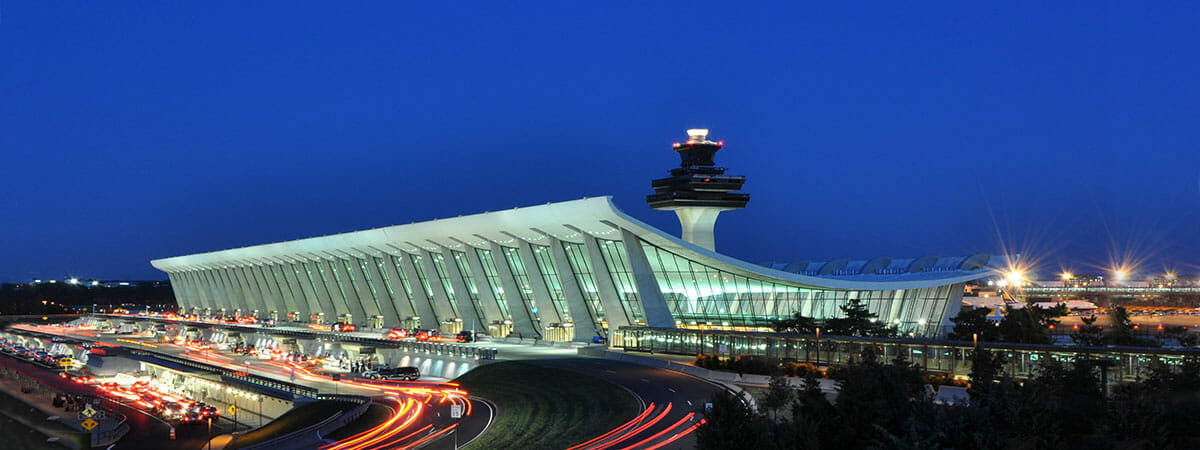
To this group belong two airport terminals that can be considered iconic: the terminal at Washington Dulles Airport, designed by the Finnish architect Eero Saarinen, and Stansted Airport, designed by Sir Norman Foster. The success of these two buildings - as well as making them models that we can look to in order to learn how to design more efficient airports - makes them sustainable in an "essential" way. as both buildings have been operating flawlessly since their commissioning several decades ago.
Washington Dulles. Eero Saarinen (1962)
One of the main challenges facing today's air terminals is the fact that they often become obsolete before they are even completed or any expansion is developed. In the middle of the last century this was due to the unstoppable growth of air traffic and the technology on which it relied. Each decade produced a technological leap which led to an immediate evolution in transport: ever larger, faster and more comfortable aircraft. These aircraft in turn demanded larger and more efficient infrastructures.
 On the other hand, advances in the field of aeronautics meant increasingly long-haul, international and intercontinental flights. Hence the need to incorporate border and baggage controls at terminals. As commercial aviation became more crowded, airports had to be equipped with more comfortable and spacious areas to accommodate the passengers who were to travel. Let us not forget that, at the beginning of this great adventure, flying was terrible in terms of comfort. Well, Washington Dulles pioneered both innovative solutions and a "scalable" organisational set-up..
In the late 1950s (more than 60 years ago!) the Finnish architect Eero Saarinen was contracted together with the engineering firm Ammann & Whitney to develop the passenger terminal of what is now the company's fifth hub. United Airlines busiest airports and one of the busiest airports in the country, with more than 125 destinations.
In addition to its design, which combines simplicity and spectacularity, this project deserves to be studied for the architect's desire to provide innovative solutions - which still work today - to the fundamental problem of a terminal: passenger flow. Since its opening in 1962, the main terminal building has remained largely intact, accommodating successive extensions that have doubled the length of the original structure.
One of the key aspects of the innovation of this terminal was the use of transport vehicles, known as mobile halls. These 'vehicles', resembling a kind of giant luxury coach, transported up to ninety people from the terminal to their aircraft. The inclusion of these mobile lounges was a revolutionary approach to airport circulation, allowing Dulles' design to dispense with the multitude of gates that cluttered most previous terminals.
In addition, and as a result of a thorough study of several nearby airports, the aircraft parking area was optimised, as well as the mobility of the airport staff.
The image of the building manages to become iconic in a simple way, with an aesthetic based on the aeronautical world which, at the time, represented a clear break with the rigidity of the modern movement.
As a curiosity, the terminal of Dulles has appeared in many films set in Washington. Seven Days in May, Die Hard 2, Airport, Forces of Nature and The X-Files are some of them.
Stansted Terminal. Foster & Partners (1991)
The second example marks an important turning point in the design of passenger processing buildings: Stansted, on the outskirts of London. This terminal, with its careful architectural design, solves in an integrated way the most important issues of a building of this type: layout in the environment, functional programme, technological possibilities, future interior transformations, etc.
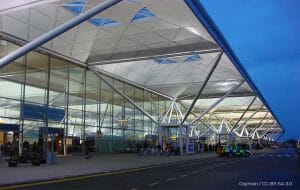 Foster's virtue was to achieve all of the above through an extremely simple approach. Suddenly he bypassed almost half a century of airport design, returning to a seemingly simple container which housed everything needed to carry out all the processes. A container protected by a roof made up of twenty-two lowered domes under which both the air side and the land side of the terminal were organised together.
The entire programme takes place on a single floor The passenger enters from the check-in area, accessing the check-in area, passport control and boarding lounges, being aware at all times of their situation with respect to their final destination: the aircraft parking apron, which is visible at all times.
Unlike most contemporary airports, there is no possibility of disorientation. For the first time there is a real intention to place the passenger at the centre of the design, giving them absolute freedom of movement and total clarity of vision.
Innovation also lies in two simple, interlinked decisions: making the most of the scarce natural light available The project also freed up the traditionally saturated level of the false ceiling, creating a lower level through which the installations' conduits run. In this basement is located the SATE and an area is fitted out to house a railway station. Both resources are commonplace nowadays, but at the time they proved to be very novel - and rightly so, given the paradigm it has become. Moreover, it is the changing but constant light that gives a poetic dimension to the intervention while providing a more than significant advantage in terms of efficiency and, therefore, economics: maintenance costs, according to the designers and operators of the building, turn out to be of the order of half those of any other British terminal.
Stansted can therefore be considered pioneer in its position at the forefront of sustainable architectureThe energy-efficient building. While Foster's studio was designing this building, the European Parliament was first enunciating the concept of an energy-efficient building. sustainable development.
Let us also consider the fact that in the same year that this airport terminal was put into service, 1991, and in the following years, many others were inaugurated around the world whose approaches, from a programmatic, sustainable or design point of view, are at the antipodes of those developed for this project. Which option should we choose in order to be truly coherent with the world we want?